Constant Off-Center Propulsion (without gravity)

7 replies · 13K views · last reply
Gabriel Mota
Messages
4
Reaction score
0
Hi,

How to calculate the position in time by applying a force, like a Thrust, not in the center of mass:
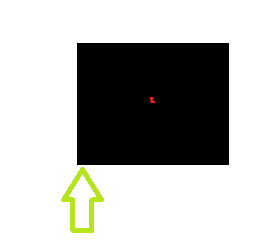
Black rectangle with a small red dot near its centre, with a green arrow pointing up at its bottom edge from below.

I only know about the linear and angular formulas: Pos/rotation = 1/2 * F * Time^2

I have struggled finding topics about this maybe because i don't know the correct nomenclatures and maths.
 
Attachments
  • Black rectangle with a small red dot near its centre, with a green arrow pointing up at its bottom edge from below.
    553ZYzJ.png
    389 bytes · Views: 773
First step is to be clear about what exactly is constant here. Is the direction and point of application of thrust constant relative to the rigid body, as would be the case for an engine within the body, or is the point of application fixed in the body but the direction fixed in the rest frame?
 
haruspex said:
First step is to be clear about what exactly is constant here. Is the direction and point of application of thrust constant relative to the rigid body, as would be the case for an engine within the body, or is the point of application fixed in the body but the direction fixed in the rest frame?

Thanks for answering.

By constant i mean the same force is constantly being applied and as you mention, could be for example a spaceship with an engine.
 
Gabriel Mota said:
Thanks for answering.

By constant i mean the same force is constantly being applied and as you mention, could be for example a spaceship with an engine.
You seem to have missed the crux of my question.
I understand that the force is to be of constant magnitude, but what about its direction? If it is from an engine rigidly fixed to the body then its direction changes as the body rotates; but if it is from an outside source then the direction may be constant in the inertial frame.
 
haruspex said:
You seem to have missed the crux of my question.
I understand that the force is to be of constant magnitude, but what about its direction? If it is from an engine rigidly fixed to the body then its direction changes as the body rotates; but if it is from an outside source then the direction may be constant in the inertial frame.

Yes, the engine would be fixed and rotates with the rigid body.
 
Gabriel Mota said:
Yes, the engine would be fixed and rotates with the rigid body.
Ok, so choose a coordinate system and define some variables.
In Cartesian, with x, y as the coordinates of the mass centre, you need the angle the body makes to the x axis, and an offset distance from the mass centre to the line of action of the thrust. Take the offset as being in the +x direction when the angle is zero.
 
Diagram of a square with corners labelled -1,1; 1,1; -1,-1; and 1,-1, with a red dot at the centre labelled 0,0, a curved arrow showing rotation, and an upward force arrow at the bottom-left corner labelled 1F and Mass: 1.


If point application was center of mass (0,0):
y = (1 / 2) * F * Time2

AngularVelocity increases every frame by = ( Position Cross Product with Force ) / Moment Of Inertia
 
Attachments
  • Diagram of a square with corners labelled -1,1; 1,1; -1,-1; and 1,-1, with a red dot at the centre labelled 0,0, a curved arrow showing rotation, and an upward force arrow at the bottom-left corner labelled 1F and Mass: 1.
    TEnI4Mk.png
    4.1 KB · Views: 608
Gabriel Mota said:
If point application was center of mass (0,0):
But it isn't, and you need to make the origin fixed in space, not fixed as the mass centre.
Gabriel Mota said:
y = (1 / 2) * F * Time2
You omitted mass.
Gabriel Mota said:
AngularVelocity increases every frame by = ( Position Cross Product with Force ) / Moment Of Inertia
That's the angular acceleration. To turn it into the increase in angular velocity in a time step you need to multiply by something.
From the reference to "every frame ", sounds like this is for a simulation.