Constraint force using Lagrangian Multipliers

Click For Summary

Homework Help Overview

The discussion revolves around finding the constraint force acting on a bead that can glide along a rotating rod without friction. The setup involves a rod rotating with a constant angular velocity, and the participants are exploring the application of Lagrangian multipliers to derive the equations of motion and the constraint force.

Discussion Character

  • Exploratory, Conceptual clarification, Mathematical reasoning, Problem interpretation, Assumption checking

Approaches and Questions Raised

  • Participants discuss the choice of generalized coordinates and the formulation of the Lagrangian, with some suggesting the explicit inclusion of the constraint in the Lagrangian. There are questions about the correctness of the derived equations of motion and the interpretation of the constraint force.

Discussion Status

Multiple interpretations of the problem are being explored, particularly regarding the inclusion of gravitational forces and the formulation of the equations of motion. Some participants have provided guidance on correcting the equations and understanding the relationship between generalized constraint forces and physical constraint forces.

Contextual Notes

There are discussions about the assumptions made regarding the constraints, particularly whether additional constraints should be considered beyond the angular constraint. Some participants question the necessity of including gravitational effects in the analysis.

deuteron
Messages
64
Reaction score
14
Homework Statement
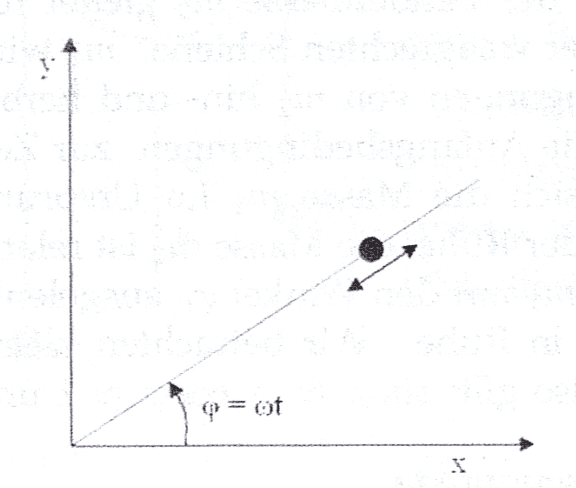
The bead can glide freely along the rod rotating with constant angular velocity on the xy-plane. What is the constraint force exerted by the rod?
Relevant Equations
##\dot\varphi=\omega##
Consider the following setup
1694444352368.png


where the bead can glide along the rod without friction, and the rod rotates with a constant angular velocity ##\omega##, and we want to find the constraint force using Lagrange multipliers.
I chose the generalized coordinates ##q=\{r,\varphi\}## and the constraint equation ##f## to be ##\varphi=\omega t##

We get the Lagrangian to be

$$\mathcal L= \frac 12m (\dot s^2 +s^2 \dot\varphi^2)- mgs\sin\varphi.$$

For the equation of motion, I got:

$$\begin{align}
\frac {\partial\mathcal L}{\partial \varphi}&= -mgs\cos\varphi\\
\frac{\partial\mathcal L}{\partial\dot\varphi}&= ms^2\dot \varphi\\
\frac d{dt}\frac {\partial\mathcal L}{\partial\dot\varphi}&= 2ms\dot s\dot \varphi +ms^2\ddot\varphi\\
\Rightarrow\ 2ms\dot s \omega + mgs\cos(\omega t)&=\lambda\frac {\partial f}{\partial\varphi} = \lambda\\
\frac{\partial\mathcal L}{\partial s}&= ms\dot\varphi^2 -mg\sin\varphi\\
\frac d{dt}\frac{\partial\mathcal L}{\partial\dot s}&= m\ddot s\\
\Rightarrow\ m\ddot s &= ms\dot \varphi^2 =ms\dot\omega^2\ \Rightarrow\ s(t)=s_0 \cos(\omega t)
\end{align}$$

and substituting $s(t)=s_0 \cos(\omega t)$ back to the equation for ##\varphi## results in:

$$-2ms_0^2\omega^2\cos(\omega t)\sin(\omega t) +mgs_0\cos^2(\omega t)=\lambda$$

and the constraint force is ##C=\lambda\frac {\partial f}{\partial\varphi}+\lambda \frac{\partial f}{\partial s} = -2ms_0^2\omega^2\cos(\omega t)\sin(\omega t) +mgs_0\cos^2(\omega t)##

However, this is not true and the force is supposed to be ##C= 2m\omega^2 s_0 \sinh(\omega t)##, what am I doing wrong?
 
Last edited:
  • Like
Likes   Reactions: curious_mind
Physics news on Phys.org
deuteron said:
Homework Statement: The bead can glide freely along the rod rotating with constant angular velocity on the xy-plane. What is the constraint force exerted by the rod?
Relevant Equations: ##\dot\varphi=\omega##

Consider the following setup

View attachment 331816

where the bead can glide along the rod without friction, and the rod rotates with a constant angular velocity ##\omega##, and we want to find the constraint force using Lagrange multipliers.
I chose the generalized coordinates ##q=\{r,\varphi\}## and the constraint equation ##f## to be ##\varphi=\omega t##

We get the Lagrangian to be

$$\mathcal L= \frac 12m (\dot s^2 +s^2 \dot\varphi^2)- mgs\sin\varphi.$$

I think you should include the constraint explicitly in the Lagrangian: <br /> \mathcal{L} = \tfrac12m(\dot s^2 + s^2 \dot \varphi^2) - mgs\sin \varphi + m\lambda(\varphi - \omega t).

For the equation of motion, I got:

$$\begin{align}
\frac {\partial\mathcal L}{\partial \varphi}&= -mgs\cos\varphi\\
\frac{\partial\mathcal L}{\partial\dot\varphi}&= ms^2\dot \varphi\\
\frac d{dt}\frac {\partial\mathcal L}{\partial\dot\varphi}&= 2ms\dot s\dot \varphi +ms^2\ddot\varphi\\
\Rightarrow\ 2ms\dot s \omega + mgs\cos(\omega t)&=\lambda\frac {\partial f}{\partial\varphi} = \lambda\\
\frac{\partial\mathcal L}{\partial s}&= ms\dot\varphi^2 -mg\sin\varphi\\
\frac d{dt}\frac{\partial\mathcal L}{\partial\dot s}&= m\ddot s\\
\Rightarrow\ m\ddot s &= ms\dot \varphi^2 =ms\dot\omega^2\ \Rightarrow\ s(t)=s_0 \cos(\omega t)
\end{align}$$

How do you justify the last line? You correctly found the derivatives of the Lagrangian, but you didn't put them together to form the EOM correctly. I get \begin{split}<br /> \ddot s - s \dot\varphi^2 &amp;= -g\sin\varphi \\<br /> \frac{d}{dt}(s^2\dot\varphi) &amp;= -gs\cos \varphi + \lambda \\<br /> \varphi &amp;= \omega t \end{split} After setting \varphi = \omega t the equation for s is <br /> \ddot s - \omega^2 s = -g\sin(\omega t).
 
pasmith said:
I think you should include the constraint explicitly in the Lagrangian: <br /> \mathcal{L} = \tfrac12m(\dot s^2 + s^2 \dot \varphi^2) - mgs\sin \varphi + m\lambda(\varphi - \omega t).
How do you justify the last line? You correctly found the derivatives of the Lagrangian, but you didn't put them together to form the EOM correctly. I get \begin{split}<br /> \ddot s - s \dot\varphi^2 &amp;= -g\sin\varphi \\<br /> \frac{d}{dt}(s^2\dot\varphi) &amp;= -gs\cos \varphi + \lambda \\<br /> \varphi &amp;= \omega t \end{split} After setting \varphi = \omega t the equation for s is <br /> \ddot s - \omega^2 s = -g\sin(\omega t).
Thank you... I can't believe I have been missing that...
 
  • Like
Likes   Reactions: curious_mind
Why only constraint is phi = omega.t?Isn't there also a radial constant along the rod, idk something like r(t) is constant or between 0 and L. ca you tell ne more how we write constraints how to be sure that here is only one
 
I don't think you are supposed to include the force of gravity in this problem. So, you can set g = 0 in your equations. Thus, equation (4) becomes $$ 2ms\dot s \omega =\lambda\frac {\partial f}{\partial\varphi} = \lambda \,\,\,\,\,\,\,\,\,(4)$$
For the differential equation for ##s##, you wrote $$
m\ddot s = ms\dot \varphi^2 =ms\dot\omega^2\ \Rightarrow\ s(t)=s_0 \cos(\omega t) \,\,\,\,\,\,\,\,\,\,\, (7)$$ The differential equation is correct, except ##\dot \varphi## equals ##\omega## instead of ##\dot \omega##. But the solution ##s(t)=s_0 \cos(\omega t)## is not correct. ##\cos(\omega t)## would be a solution to the equation ##\ddot s = - \omega^2 s## (note the negative sign).

Your approach to finding ##\lambda## is correct, but of course you'll need the correct solution for ##s(t)##.

However, ##\lambda## is the ##\varphi## component of the "generalized" constraint force ##Q_{\varphi}##, not the ##\varphi## component of the actual, physical constraint force ##F_{\varphi}## that you are asked to find. ##Q_{\varphi}## does not have the correct dimensions of an actual force.

##Q_{\varphi}## is defined such that the work done by the constraint force when ##\varphi## changes by ##d\varphi## is $$dW = Q_{\varphi} d\varphi.$$ In terms of the actual force ##F_{\varphi}##, this work would be $$dW = F_{\varphi} {r d\varphi}.$$ Note that ##r d\varphi## is the actual physical distance associated with the movement of a point of the rod located at radial distance ##r## when ##\varphi## changes by ##d \varphi##. Comparing the two expressions for ##dW##, you can see the relation between ##Q_{\varphi}## and ##F_{\varphi}##.

[EDIT: I just noticed that this thread is 8 months old! My reply is directed to the OP (@deuteron), who probably is no longer interested.]
 
Last edited:
TSny said:
I don't think you are supposed to include the force of gravity in this problem. So, you can set g = 0 in your equations. Thus, equation (4) becomes $$ 2ms\dot s \omega =\lambda\frac {\partial f}{\partial\varphi} = \lambda \,\,\,\,\,\,\,\,\,(4)$$
For the differential equation for ##s##, you wrote $$
m\ddot s = ms\dot \varphi^2 =ms\dot\omega^2\ \Rightarrow\ s(t)=s_0 \cos(\omega t) \,\,\,\,\,\,\,\,\,\,\, (7)$$ The differential equation is correct, except ##\dot \varphi## equals ##\omega## instead of ##\dot \omega##. But the solution ##s(t)=s_0 \cos(\omega t)## is not correct. ##\cos(\omega t)## would be a solution to the equation ##\ddot s = - \omega^2 s## (note the negative sign).

Your approach to finding ##\lambda## is correct, but of course you'll need the correct solution for ##s(t)##.

However, ##\lambda## is the ##\varphi## component of the "generalized" constraint force ##Q_{\varphi}##, not the ##\varphi## component of the actual, physical constraint force ##F_{\varphi}## that you are asked to find. ##Q_{\varphi}## does not have the correct dimensions of an actual force.

##Q_{\varphi}## is defined such that the work done by the constraint force when ##\varphi## changes by ##d\varphi## is $$dW = Q_{\varphi} d\varphi.$$ In terms of the actual force ##F_{\varphi}##, this work would be $$dW = F_{\varphi} {r d\varphi}.$$ Note that ##r d\varphi## is the actual physical distance associated with the movement of a point of the rod located at radial distance ##r## when ##\varphi## changes by ##d \varphi##. Comparing the two expressions for ##dW##, you can see the relation between ##Q_{\varphi}## and ##F_{\varphi}##.

[EDIT: I just noticed that this thread is 8 months old! My reply is directed to the OP (@deuteron), who probably is no longer interested.]
how about the constraint equation. when we write lagrangian do we implicitly use the constraint phi - w.t = 0. i dont get what this constraint give us. we have r dot squared as well as omega times r squared as kinetic energies. suppose there is no pptential. what does lambda times constraint equation in the lagrangian give us physically. also why angle part is the only constraint. dont we have also r constraint that is some sort of perhaps an inequality btw 0 and L. i ll be appriciated if you can say some stuff about constraints in general
 
francisavenir said:
dont we have also r constraint that is some sort of perhaps an inequality btw 0 and L. i ll be appriciated if you can say some stuff about constraints in general
In this problem, the only force acting on the bead is the time-dependent normal force from the rod. This force acts perpendicularly to the rod. The bead slides freely on the rod, so there is no constraint force acting parallel to the rod. The normal force is the only constraint force.

It is easy to find the normal force without using Lagrangian mechanics. In polar coordinates##(r, \varphi)##, the acceleration components are well-known to be

##a_r = \ddot r - r^2 \dot \varphi^2##
and
##a_{\varphi} = r \ddot \varphi + 2 \dot r \dot \varphi##.

Since there is no force in the ##r## direction, ##a_r = 0##. Thus, ##\ddot r - r^2 \dot \varphi^2= 0##.
From the constraint ##\varphi = \omega t##, we get the differential equation for ##r##: ##\,\,\,\, \ddot r - \omega^2r = 0##

With initial conditions ##r(0) = r_0## and ##\dot r(0) = 0##, the solution for ##r(t)## is ##r(t) = r_0\cosh(\omega t)##

The normal force (constraint force) is obtained from ##\sum F_{\varphi} = m a_{\varphi} \,## :

##N = m(r \ddot \varphi + 2 \dot r \dot \varphi)= m(0 + 2 \dot r \omega) = 2m\omega^2 r_0 \sinh(\omega t)##

francisavenir said:
how about the constraint equation. when we write lagrangian do we implicitly use the constraint phi - w.t = 0. i dont get what this constraint give us. we have r dot squared as well as omega times r squared as kinetic energies. suppose there is no pptential. what does lambda times constraint equation in the lagrangian give us physically.

The topic of finding constraint forces using Lagrangian mechanics and Lagrange multipliers is covered in standard textbooks. This video might be helpful. Constraints and Lagrange multipliers are introduced at approximately time 9:10 and the physical interpretation of the Lagrange multiplier starts around 17:30. There is a follow-up video that works through a nice example.
 
  • Like
Likes   Reactions: PhDeezNutz and deuteron

Similar threads

  • · Replies 1 ·
Replies
1
Views
3K
  • · Replies 11 ·
Replies
11
Views
3K
  • · Replies 1 ·
Replies
1
Views
2K
  • · Replies 9 ·
Replies
9
Views
2K
  • · Replies 1 ·
Replies
1
Views
2K
Replies
6
Views
2K
  • · Replies 1 ·
Replies
1
Views
2K
  • · Replies 24 ·
Replies
24
Views
3K
Replies
4
Views
2K