DenDanne
- 4
- 1
Summary:: I have a problem getting the circuit of the problem to a Moore-solution.
"Construct a Moore Machine and show it in a circuit, that outputs '1' whenever the sequence '01' is encountered in any input binary string (using D-flipflops)".
First of, I have written the Moore Machine.
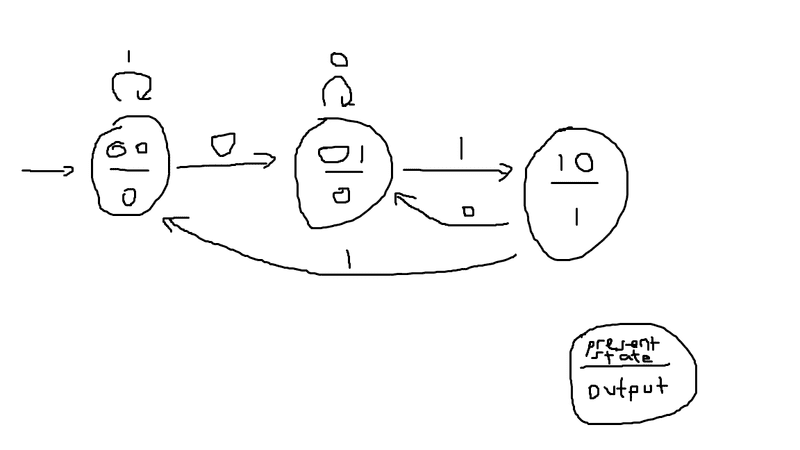
I don't think this is where the problem is, as it is quite straight forward in that step.
From this Moore Machine, I do a truth table.
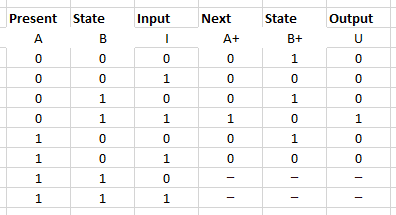
And then I use Karnough-diagrams to find equations for A+, B+ and U.
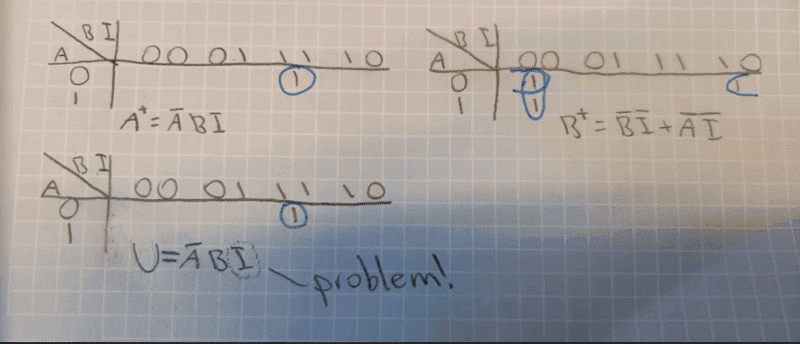
Here is where I get some troubles.
Because by definition of Moore machines. The output shall only be a result of the present state and some output combinatorial logic. NOT the the input. (that is mealy). But as you can see, I get an I in the output formula. So using this method I get an output dependent on the input, which is not allowed!
What have I thought wrong about?
"Construct a Moore Machine and show it in a circuit, that outputs '1' whenever the sequence '01' is encountered in any input binary string (using D-flipflops)".
First of, I have written the Moore Machine.
I don't think this is where the problem is, as it is quite straight forward in that step.
From this Moore Machine, I do a truth table.
And then I use Karnough-diagrams to find equations for A+, B+ and U.
Here is where I get some troubles.
Because by definition of Moore machines. The output shall only be a result of the present state and some output combinatorial logic. NOT the the input. (that is mealy). But as you can see, I get an I in the output formula. So using this method I get an output dependent on the input, which is not allowed!
What have I thought wrong about?
