Continuity of f^+ = max(f, 0) where f crosses zero

  • Topic:
  • Thread starter Thread starter Math Amateur
  • Start date Start date
  • Tags Tags
    Continuity
Join the discussion
Registration is free. Start your own thread to ask a follow-up.
4 replies · 2K views
Math Amateur
Gold Member
MHB
Messages
3,920
Reaction score
48
I am reading Andrew Browder's book: "Mathematical Analysis: An Introduction" ... ...

I am currently reading Chapter 3: Continuous Functions on Intervals and am currently focused on Section 3.1 Limits and Continuity ... ...

I need some help with the proof of Corollary 3.13 ...Corollary 3.13 reads as follows:View attachment 9520Can someone help me to prove that if $$f$$ is continuous then $$f^+ = \text{max} (f, 0)$$ is continuous ...My thoughts are as follows:If $$c$$ belongs to an interval where $$f$$ is positive then $$f^+$$ is continuous since $$f$$ is continuous ... further, if $$c$$ belongs to an interval where $$f$$ is negative then $$f^+$$ is continuous since $$g(x) = 0$$ is continuous ... but how do we construct a proof for those points where $$f(x)$$ crosses the $$x$$-axis ... ..

Help will be much appreciated ...

Peter
 
Attachments

  • Browder - Corollary 3.13 ... .png
    Browder - Corollary 3.13 ... .png
    2.9 KB · Views: 199
Last edited:
Physics news on Phys.org
To prove [tex]f^+[/tex] is continuous at [tex]x_0[/tex] consider 3 cases:
1) [tex]f(x_0)> 0[/tex].
2) [tex]f(x_0)= 0[/tex].
3) [tex]f(x_0)< 0[/tex].

Since f is continuous, in case (1) there exist an interval around [tex]x_0[/tex] such that f(x)> 0
and [tex]f^+(x)= f(x)[/tex]​

for all x in the interval

Since f is continuous, in case (1) there exist an interval around [tex]x_0[/tex] such that f(x)< 0 and [tex]f^+(x)= 0[/tex] for all x in the interval.​
 
HallsofIvy said:
To prove [tex]f^+[/tex] is continuous at [tex]x_0[/tex] consider 3 cases:
1) [tex]f(x_0)> 0[/tex].
2) [tex]f(x_0)= 0[/tex].
3) [tex]f(x_0)< 0[/tex].

Since f is continuous, in case (1) there exist an interval around [tex]x_0[/tex] such that f(x)> 0
and [tex]f^+(x)= f(x)[/tex]​

for all x in the interval

Since f is continuous, in case (1) there exist an interval around [tex]x_0[/tex] such that f(x)< 0 and [tex]f^+(x)= 0[/tex] for all x in the interval.​


Thanks for the help ...

BUT ... you do not describe what to do in case 2 ... and as I indicated it is when f(x) = 0, specifically when f crosses the x-axis that I am having trouble dealing with ...

Peter
 
Peter said:
Thanks for the help ...

BUT ... you do not describe what to do in case 2 ... and as I indicated it is when f(x) = 0, specifically when f crosses the x-axis that I am having trouble dealing with ...

Peter

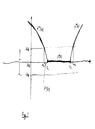
After reflecting on this problem for some time ... here is my proof for the situation where the point investigated is a point where $$f$$ crosses the x-axis ...I think it will suffice to prove that $$f^+$$ is continuous for the case where a point $$c_1 \in \mathbb{R}$$ is such that for $$x \lt c_1, \ f(x) = f^+(x)$$ is positive and for $$x \gt c_1, \ f^+(x) = 0$$ ... ... while for some point $$c_2 \gt c_1$$ we have that $$f^+(x) = 0$$ for $$x \lt c_2$$ and $$f(x) = f^+(x)$$ is positive for $$x \gt c_2$$ ... ... ... see Figure 1 below ...

View attachment 9522Now consider an (open) neighbourhood $$V$$ of $$f^+(c_1)$$ where...
$$V= \{ f^+(x) \ : \ -f^+(a_1) \lt f^+(c_1) \lt f^+(a_1)$$ for some $$a_1 \in \mathbb{R} \}

$$

so ...$$V= \{ f^+(x) \ : \ -f^+(a_1) \lt 0 \lt f^+(a_1)$$ for some $$a_1 \in \mathbb{R} \}$$ ...

Then ... (see Figure 1) ...
$$(f^+)^{ -1 } (V) = \{ a_1 \lt x \lt a_2 \}$$ which is an open set as required ...
Further crossings of the x-axis by $$f$$ just lead to further sets of the nature $$\{ a_{ n-1 } \lt x \lt a_n \}$$ which are also open ... so ...

$$(f^+)^{ -1 } (V) = \{ a_1 \lt x \lt a_2 \} \cup \{ a_3 \lt x \lt a_4 \} \cup \ldots \cup \{ a_{n-1} \lt x \lt a_n \}$$
which being a union of open sets is also an open set ...

The proof is similar if $$f$$ first crosses the x-axis from below ...

Is that correct?Peter
 
Attachments
  • Figure 1 - Continuity of f+ ... .png
    Figure 1 - Continuity of f+ ... .png
    23.3 KB · Views: 184
Last edited:
HallsofIvy said:
To prove [tex]f^+[/tex] is continuous at [tex]x_0[/tex] consider 3 cases:
1) [tex]f(x_0)> 0[/tex].
2) [tex]f(x_0)= 0[/tex].
3) [tex]f(x_0)< 0[/tex].

Since f is continuous, in case (1) there exist an interval around [tex]x_0[/tex] such that f(x)> 0
and [tex]f^+(x)= f(x)[/tex]​

for all x in the interval

Since f is continuous, in case (1) there exist an interval around [tex]x_0[/tex] such that f(x)< 0 and [tex]f^+(x)= 0[/tex] for all x in the interval.​


TYPO: in the last sentence "case (1)" should have been "case (2)".