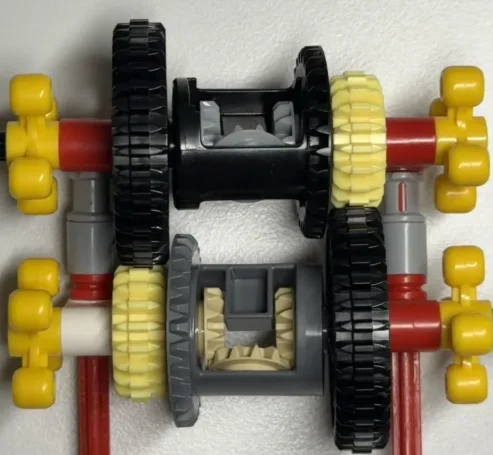
I made a CVT (Continuously Variable Transmission) that uses two differentials to first split power between two gear ratios based on torque (1:1 and 2:1), and then recombine the separate rotations into a single output via a second differential. Yes, I did test this out, and it works. However, My Question Is: Why hasn't this cvt(the one that I just made) been implemented before? Yes, a reverse gear isn't implemented, and the completely automatic nature of it doesn't allow you to control it if needed, but why haven't vehicles like bikes used this before? DISCLAIMER: The model below isn't fully proper; a 1:2 ratio isn't possible between the differentials, and is only possible by multiplying the output of the transmission by two.
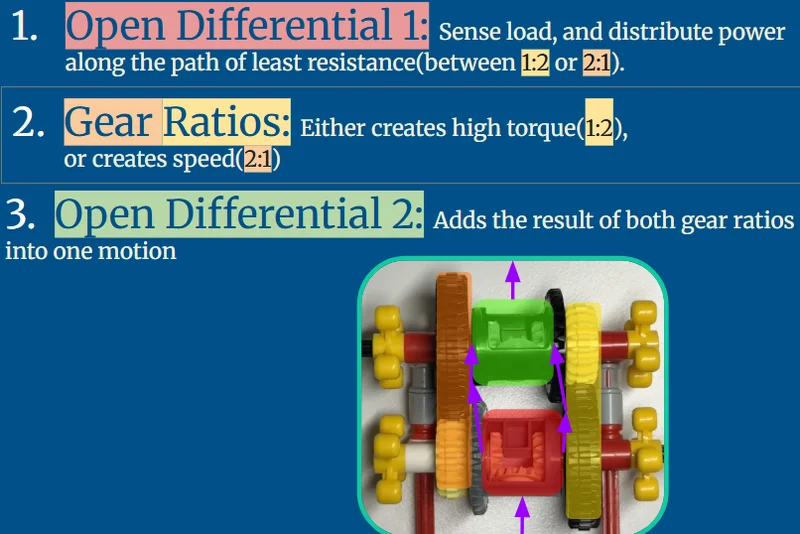
Below is a power diagram:
And now this is the diagram of the CVT I made without edits ontop:
I'm seeing straight-cut gears and differentials, but I'm not seeing anything that would imply continuous variability of the input/output gear ratio. Can you say more about what provides the continuously variable property? Thanks.
So the idea is that the first differential will blend the power between both gear ratio paths. One path is a 1:1 gear ratio, and the other is a 2:1 gear ratio. By default, the open differential wants to send power with the 1:1 gear ratio. However, depending on the amount of torque required, the differential will send part, if not all of the power, to the 2:1 gear ratio. Finally, after the power has been split and either increased speed or torque, they are added back together into one rotation to use. This "blending" of gear ratios is what allows for that continuously variable property.
Some examples that can help:
First example(high load):
A motor rotates at 1 rpm, and the load is high - the differential will send all power through the 2:1 gear ratio(A); no power is given to the 1:1 gear ratio(B). Path A outputs 0.5 rpm(1/2 *1), and path B outputs 0(1/1 *0). The differential adds these outputs into one rotation(0.5+0); the final output is 0.5 prm.
Second example(no load):
A motor rotates at 1 rpm, and the load is low- the differential will send all power through the 1:1 gear ratio(B); no power is given to the 2:1 gear ratio(A). Path B outputs 1 rpm(1/1 *1), and path B outputs 0(1/2 *0). The differential adds these outputs into one rotation(1+0); the final output is 1 rpm.
Third example(medium load - half&half):
A motor rotates at 1 rpm, and the load is medium- the differential will send power through both path A and path B; each path is given equal rotation(0.5 rpm each). Path A outputs 0.5 rpm(1/1 *0.5), and path B outputs 0.25(1/2 *0.5). The differential adds these outputs into one rotation(0.5+0.25); the final output is 0.75 rpm.
From what I can see, the input and output are always identical. It seems to be an interesting alternative to a through-shaft. There is no variability at all to the thing. A video showing otherwise would put me in my place.
Both large gears turn at identical rates, slower than the smaller ones turning faster. The average is the same on both sides. By symmetry, 1:1 in to out.
I did a little more digging and found my exact concept in this article: LINK
The article also shares a video in step 1 by Autstron: LINK
*Step 12 shares that the CVT might require friction in some places to work*
However, My Question Is: Why hasn't this cvt(the one that I just made) been implemented before? Yes, a reverse gear isn't implemented, and the completely automatic nature of it doesn't allow you to control it if needed, but why haven't vehicles like bikes used this before?
Although I haven't analyzed the design deeply, the link you provided in your last post might give some explanation in step 2:
Note that this transmission does not convert torque. But is designed to provide a constant torque though an infinite array of speeds. Any extra torque acquired at low gear is dissipated through friction. This friction is necessary to achieve the higher gears for more speed. Because of the friction at lower gears, this transmission is most efficient at its highest gear ratio.
Having higher torque at low speed is the desired effect of a transmission. This one seems to only lower the rpm and waste the extra torque that could be provided through friction, which is not only unhelpful but also very inefficient.
I think there are possibilities for such a configuration, but that it is too complex for an untrained brain to model immediately as a thought experiment. I get a feeling that complexity here leads easily to circularity, then to delusion, in the same way that a PMM is conceived.
There are different velocities and torques, that resolve to power. Those must follow the energy conservation laws, and the mechanical laws of gears. Since the input differential will share torque equally, as a good differential should, then that torque will be scaled by the following gears to be delivered to the output differential as two unequal torques, which defies the differential's equal sharing of torque assumption. Energy must therefore be circulating, down one side and up the other. I do not yet understand the occasion or magnitude of that circulating energy, but I suspect it may tend towards the maximum energy available. Power factor may be so poor, that no real work is being done.
Now is the time to build a numerical model, or to find an electrical analog.
It looks like each differential carrier wil rotate at identical speeds no matter what. The interesting thing is that if one changes the speed of the left or right set of black/yellow gear pairs by braking or applying power in either direction it makes no difference to the speed of the differential carriers. If the gray carrier is the input and the black carrier is the output then that's all it is. Applying a brake to one black/yellow gear pair will simply speed the other pair up as long as it is allowed to rotate freely. Nothing really new here. It's a type of power combiner. Real CVT transmissions have some sort of variable speed source such as a variable shieve pulley set or a hydrostatic drive. They often use a differential or planetary type combiner but that is secondary.
Thank you so much! I have been stuck around this point for a very long time! So in summary, all this does is vary the speed?
Averagesupernova said:
It's a type of power combiner. Real CVT transmissions have some sort of variable speed source such as a variable shieve pulley set or a hydrostatic drive. They often use a differential or planetary type combiner but that is secondary.
It looks like each differential carrier wil rotate at identical speeds no matter what.
I do not believe that your assumption is the case.
Consider what happens when they do not rotate at the same rate.
Code:
given input and output RPM
x = input RPM
y = output RPM

solve for internal shaft RPMs
a, b, c, d, defined as

x = a + b   input differential
c = a / 2   slow gear path
d = b * 2   fast gear path
y = c + d   output differential

x = a + b
b = x - a   eqn(1)

y = a/2 + 2*b
2*b = y - a/2
b = y/2 - a/4   eqn(2)

equate b, eqn(2) = eqn(1)
y/2 - a/4 = x - a

a - a/4 = x - y/2
a*3/4 = x - y/2
a = 4*(x - y/2)/3
a = (4*x - 2*y)/3

b = x - a   we have the internal RPMs

example 1
x = 100
y = 100
a = (400 - 200)/3 = 66.666
b = 100 - 66.666 = 33.333
c = a/2 = 33.333
d = 2*b = 66.666

example 2
x = 100
y = 70
a = (400 - 140)/3 = 260/3 = 86.666
b = 100 - 86.666 = 13.333
c = a/2 = 43.333
d = 2*b = 26.666

example 3
x = 70
y = 100
a = (280 - 200)/3 = 26.666
b = 70 - 26.666 = 43.333
c = a/2 = 13.333
d = 2*b = 86.666
I haven't gone through any math. I simplified it by thinking about it as if it were two identical automotive rear axles with the same ratios and same wheel sizes rolling along. Slowing down the same side of each axle by using larger tires results in identical changes in the speed on the input assuming the same rolling speed. This translates to speeding up side with smaller tires if we maintain the same speed on the input. Changing tire sizes so we have large tires kitty corner makes no difference between input shaft speeds compared to large tires on the same side. The kitty corner scenario is essentially the same as the proposal put forth by the OP.
The kitty corner scenario is essentially the same as the proposal put forth by the OP.
I thought the OP built the pictured model to gain experience and demonstrate that was not the case.
Your kitty corner analysis is only correct for the case where the input and output angular velocities are the same. That symmetry is the first example at the bottom of my code block.
Then look at the asymmetric higher and lower ratios, examples 2 and 3.
Your kitty corner analysis is only correct for the case where the input and output angular velocities are the same.
The input and output will always be the same. Saying they aren't is like saying that 1 + 1 = 2 except when it doesn't.
-
My example of the automotive differentials should explain why the differential carrier speeds have to be the same no matter what.
The input and output will always be the same. Saying they aren't is like saying that 1 + 1 = 2 except when it doesn't.
I had posted the same. I was wrong.
One can for instance bolt the output to a wall, preventing any rotation. The input can still turn freely. Hence the device acts as a disconnect between in and out. Only by applying friction at the yellow side knobs can torque actually make it to the output, and the whole point of a differential is to transfer variable torque to the output without loss of energy.
This is the problem, the human mind cannot be trusted to correctly analyse a complex mechanical system, we need a mathematical or numerical verification.
I wanted a numerical model to confirm the result either way. Now I would still like to know if the model pictured by the OP agrees with my numbers.
Zx is the input RPM, Zy the output.
Za, Zb, Zc, Zd are the RPM of the gears.
Zxx is the RPM of the input when the loop is closed.
The model for the differentials are:
Zx= ( Za + Zb ) / 2
Zy= ( Zc + Zd ) / 2
The model for the gears are:
Zc = Za / 2.
Zd = Zb * 2.
Examining the numerical results.
Notice that Zx ≠ Zxx, except when Zx = Zy.
So it appears to have a ratio locked at 1:1.
Note also that energy cannot be transmitted if Zx or Zy = zero.
Though your gear system differs, IMHO, result resembles a 'Variable Slip Differential', where clutch limits 'independence' of output shafts.
FWIW, perhaps research epicyclic gear-boxes with ratios changed by variously braking stages ??
A colleague explained such to me: Seems such constant-mesh gear-boxes were fitted to local bus fleet, pneumatically operated. At first, all was well. In fact, drivers and passengers alike were delighted.
Sadly, their first 'serious' winter, frost choked air-line couplings. It was his job to scoot from depot in little van, wallop the 'Usual Suspects' with a soft-faced hammer, restore progress.
I delighted / horrified him by mentioning the hapless US nuclear sub whose air-tanks' tropical humidity fatally 'frosted' air-lines when, after a reactor 'scram', they tried to blow their ballast tanks...
Like that sub's kin, the bus-fleet was urgently retro-fitted with both wider air-couplings and better humidity control...
Your observation may seem obvious, but I do not trust analogies.
There needs to be some parallel independent confirmation.
Fine. Replace the yellow/black gear pairs in the OP with sets of roller chains and sprockets. Same ratio as the gears. Do you think this actually changes anything except the direction of rotation? It will now be even closer. It's silly to say it's an analogy.
You missed my point.
"The human brain can reconcile the unreconcilable". E.L. Doctorow.
Fair enough. I'll know that 10 * 10 = 100 while someone else can count up 10 sets of 10 and come to the same answer. This sort of thing is that familiar to me. I gave an example of why it is that familiar. ;)
I mean, that the simulation shows the components interacting with each other using standard physics simulations with real world values such as friction accounted for. The second part would be if the 3D model could have downloadable files for others to 3D print, and repeat the experiment. I do not own a 3D printer, but if that CVT can be tested by others on this forum by others, then that would allow for people to determine the validity or lack thereof of the original post. Then, torque and speeds must be measured with the real device.
That is no CVT. Apparently it is still disagreed on just how it will behave but it is most definitely not a CVT. Applying power on one input and allowing a different part to slip by a varying amount to get a varying speed out does not qualify it to be a CVT. I can do that with belts, a clutch, etc. but it does not make those things CVTs either.
That is no CVT. Apparently it is still disagreed on just how it will behave but it is most definitely not a CVT. Applying power on one input and allowing a different part to slip by a varying amount to get a varying speed out does not qualify it to be a CVT. I can do that with belts, a clutch, etc. but it does not make those things CVTs either.
So the guy is wrong? He built an over complicated clutch mechanism that slips?