Control Theory: Derivation of Controllable Canonical Form

Click For Summary
SUMMARY

The discussion centers on the derivation of the controllable canonical form in control theory, specifically addressing the role of the coefficient b_0 in the output equation y(t) = b_0 y_1(t). The user seeks clarification on how the inclusion of b_0 u(t) leads to scaling the output by b_0, referencing equations (1) and (2) from their course material. The conclusion drawn is that the linearity of the terms allows for this scaling, as demonstrated through the substitution of z = b_0 y and the manipulation of the equations.

PREREQUISITES
  • Understanding of linear differential equations
  • Familiarity with control theory concepts, particularly controllable canonical form
  • Knowledge of state-space representation in control systems
  • Basic proficiency in mathematical manipulation of equations
NEXT STEPS
  • Study the derivation of the controllable canonical form in detail
  • Explore the implications of linearity in control systems
  • Learn about state-space representation and its applications in control theory
  • Investigate the role of input-output relationships in system dynamics
USEFUL FOR

Students and professionals in control engineering, particularly those studying or working with linear control systems and state-space representations.

Master1022
Messages
590
Reaction score
116
TL;DR
Question about the derivation of the controllable canonical form for state space systems
Hi,

I was recently being taught a control theory course and was going through a 'derivation' of the controllable canonical form. I have a question about a certain step in the process.

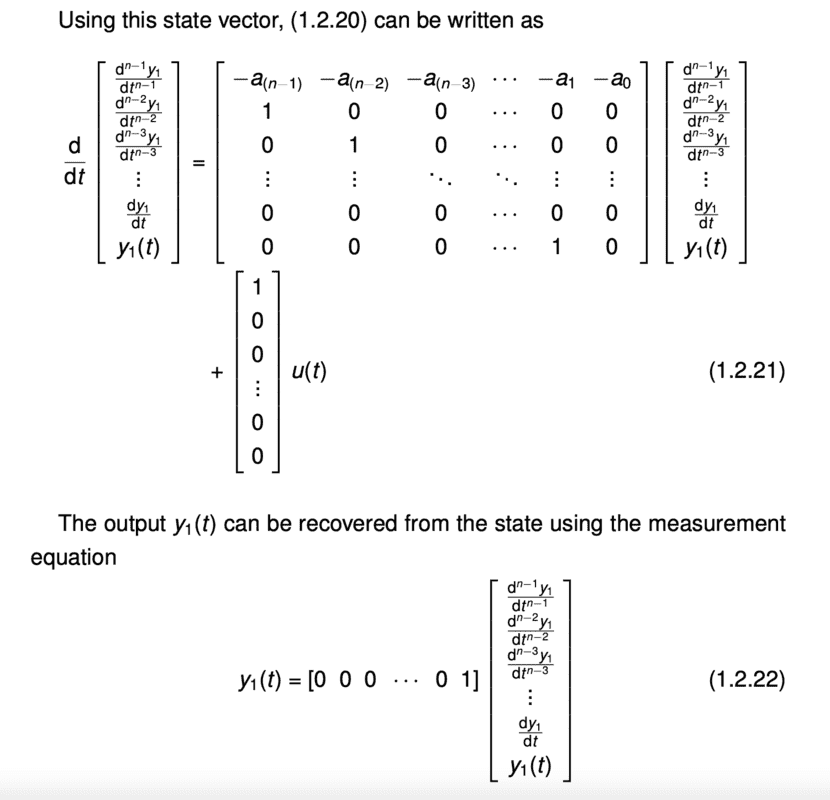
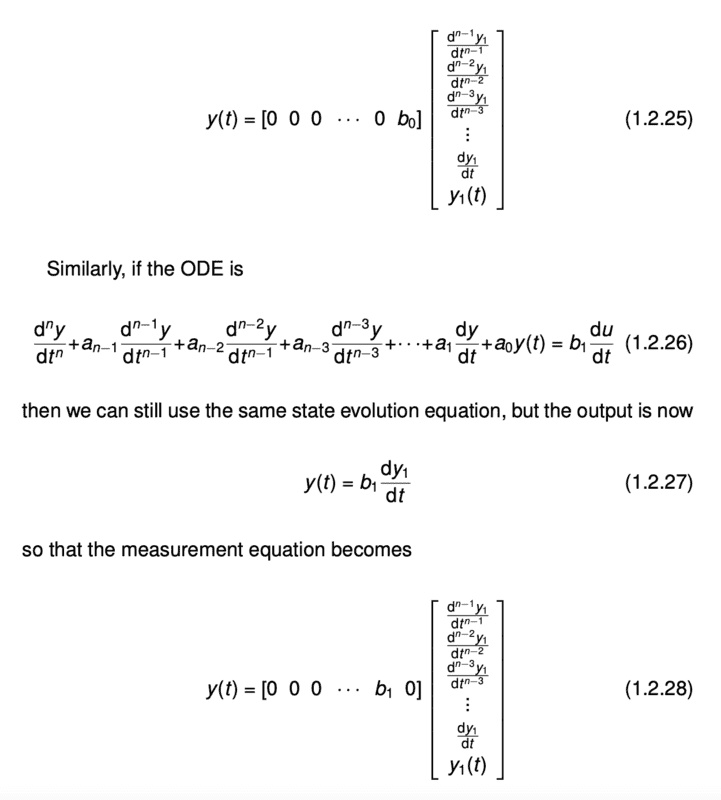
Question: Why does the coefficient ## b_0 ## in front of the ## u(t) ## mean that the output ## y(t) = b_0 y_1 (t) ##? I understand that this probably doesn't make sense at the moment, but below are pictures of the derivation. The last two pictures show the introduction of these ##b_0## and ## b_1 ## constants and I am not sure why including ## b_0 u(t) ## leads to us scaling the output ## y(t) ## by ## b_0 ##? ## u(t) ## is only one component of the expression for ## \frac{d^n y}{dt^n} ##.

In my mind, it is almost as if we have: ## y = c_1 x_1 + c_2 x_2 + x_3 ##. Then, we change the coefficient of ## x_3 ## to ## c_3 ## and are now claiming that ## y ## is scaled by ## c_3 ##. I think I am missing something.

Any help is greatly appreciated.

Method:
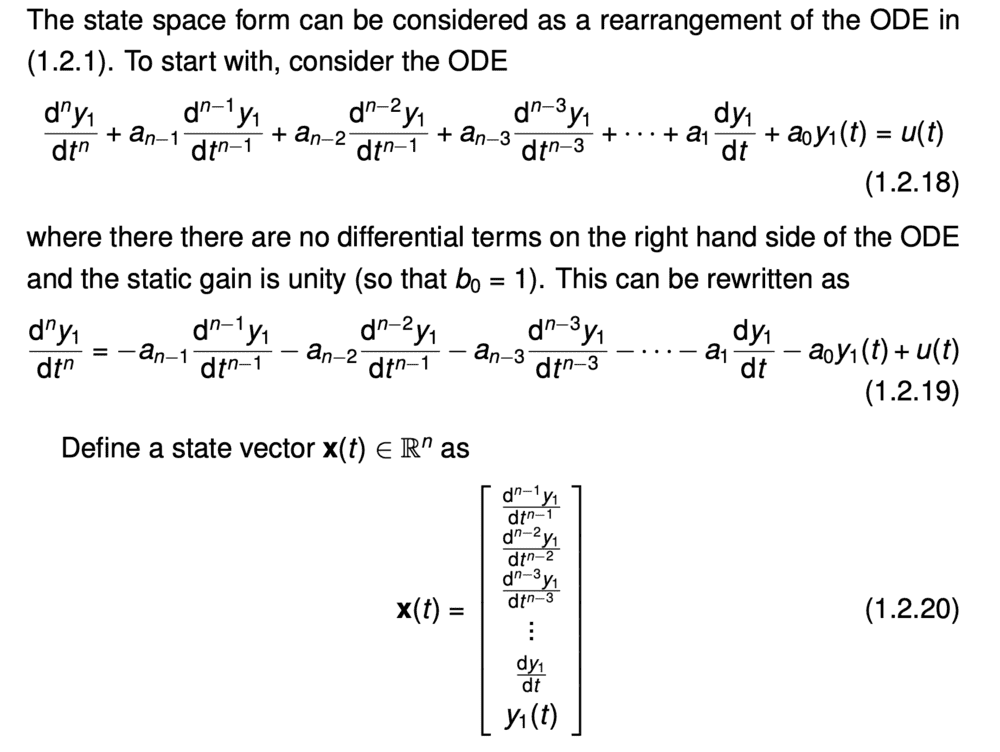
Screen Shot 2021-02-13 at 8.35.26 AM.png


Screen Shot 2021-02-13 at 8.35.53 AM.png


This is where ## b_0 ## is introduced.
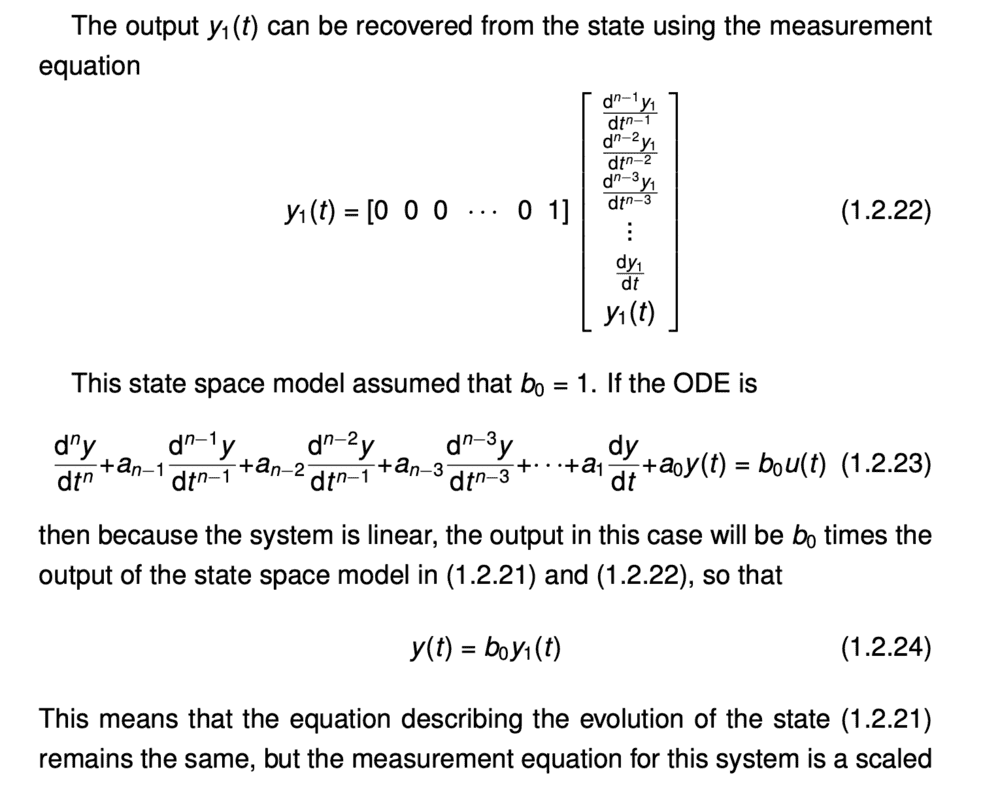
Screen Shot 2021-02-13 at 8.36.43 AM.png

Screen Shot 2021-02-13 at 8.37.34 AM.png
 
Engineering news on Phys.org
Let ##y## be the solution when ##b_{0}=1##, ie.
##a_{1}\frac{dy}{dt} + a_{0}y = u(t)## Eq (1)

Let ##z## be the solution for arbitrary values of ##b_{0}##
##a_{1}\frac{dz}{dt} + a_{0}z = b_{0}u(t)## Eq (2)

If we set ##z = b_{0}y##, and substitute that into the LHS of Eq (2), we get
##a_{1}\frac{db_{0}y}{dt} + a_{0}b_{0}y##.

Then taking the ##b_{0}## out as a common factor for all the terms, we get
##a_{1}b_{0}\frac{dy}{dt} + a_{0}b_{0}y = b_{0}[a_{1}\frac{dy}{dt} + a_{0}y] = b_{0}u(t)##.

In the above, we have recognized the terms in the square brackets as the LHS of Eq (1), and substituted them with the RHS of Eq (1) to end up with the RHS of Eq (2). So by assuming ##z = b_{0}y##, we've been able to get from the LHS to the RHS of Eq (2), which means that our assumption is consistent with Eq (2).

As the book says, this happens because the terms are linear.
 
Last edited:
  • Informative
Likes   Reactions: Master1022
atyy said:
Let ##y## be the solution when ##b_{0}=1##, ie.
##a_{1}\frac{dy}{dt} + a_{0}y = u(t)## Eq (1)

Let ##z## be the solution for arbitrary values of ##b_{0}##
##a_{1}\frac{dz}{dt} + a_{0}z = b_{0}u(t)## Eq (2)

If we set ##z = b_{0}y##, and substitute that into the LHS of Eq (2), we get
##a_{1}\frac{db_{0}y}{dt} + a_{0}b_{0}y##.

Then taking the ##b_{0}## out as a common factor for all the terms, we get
##a_{1}b_{0}\frac{dy}{dt} + a_{0}b_{0}y = b_{0}[a_{1}\frac{dy}{dt} + a_{0}y] = b_{0}u(t)##.

In the above, we have recognized the terms in the square brackets as the LHS of Eq (1), and substituted them with the RHS of Eq (1) to end up with the RHS of Eq (2). So by assuming ##z = b_{0}y##, we've been able to get from the LHS to the RHS of Eq (2), which means that our assumption is consistent with Eq (2).

As the book says, this happens because the terms are linear.

Thank you very much @atyy ! That is very clear and makes sense.
 
  • Like
Likes   Reactions: atyy
Hi @atyy , sorry to bring this up again. I was just re-visiting this topic and came across this question again. I understand your response to the question. However, I am now wondering: why does the ## B ## term in the system have a 1 instead of ## b_i ## terms? (i.e. shouldn't the ## b_0 ## term be in both the ## B ## and ## C ## matrices/vectors?)

My initial guess is that somehow by having the ## b_i ## terms in the ## C ## vector, this accounts for it, but I am unable to fully convince myself of that.
 

Similar threads

Replies
1
Views
2K
  • · Replies 4 ·
Replies
4
Views
2K
  • · Replies 2 ·
Replies
2
Views
3K
  • · Replies 1 ·
Replies
1
Views
9K
  • · Replies 3 ·
Replies
3
Views
2K
  • · Replies 5 ·
Replies
5
Views
2K
  • · Replies 5 ·
Replies
5
Views
2K
  • · Replies 4 ·
Replies
4
Views
2K
  • · Replies 2 ·
Replies
2
Views
2K
  • · Replies 4 ·
Replies
4
Views
3K