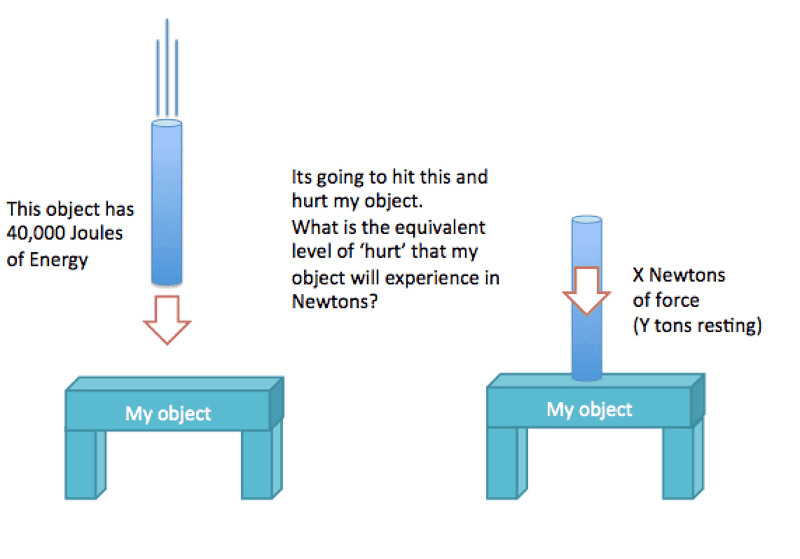
To estimate [itex]k[/itex], here is an example for your «My Object».
The 2 vertical rods can be model as a spring with the following spring constant:
[tex]k_{vr} = \frac{E_mA}{L}[/tex]
Where:
[itex]k_{vr}[/itex] is the spring stiffness of one vertical rod;
[itex]E_m[/itex] is the
Young's modulus of the material;
[itex]A[/itex] is the cross section area of the rod;
[itex]L[/itex] is the length of the rod.
For the horizontal beam, if a force [itex]P[/itex] hit the beam in the middle,
the deflection [itex]x[/itex] at that point will be [itex]\frac{PL^3}{48E_mI}[/itex] or:
[tex]P = k_{hb}x[/tex]
[tex]P = k_{hb}\frac{PL^3}{48E_mI}[/tex]
hence:
[tex]k_{hb} = \frac{48E_mI}{L^3}[/tex]
Where:
[itex]k_{hb}[/itex] is the spring stiffness of one horizontal beam;
[itex]I[/itex] is the
second moment of area of the beam's cross-section.
The equivalent stiffness of two springs in parallel or in series are:
In parallel:
[tex]k_{eq} = k_1 + k_2[/tex]
In series:
[tex]k_{eq} = \frac{k_1 k_2}{k_1 + k_2}[/tex]
So, two vertical rods in parallel ([itex]k_{2vr} = k_{vr} + k_{vr}[/itex]) are in series with on horizontal beam, hence the stiffness of your frame, [itex]k_f[/itex], is:
[tex]k_f = \frac{k_{2vr} k_{hb}}{k_{2vr} + k_{hb}}[/tex]
From my previous post:
[tex]F = \sqrt{2k_f E}[/tex]
or, if you want to also model the hitting object as a spring ([itex]k_h = \frac{E_mA}{L}[/itex]):
[tex]F = \sqrt{2k E}[/tex]
Where:
[tex]k = \frac{k_f k_h}{k_f + k_h}[/tex]
As the geometry of your frame gets more complex, so does the finding of [itex]k[/itex]. But you can often find the «weak spot» which is where you have the lowest spring stiffness and model all other springs [itex]i[/itex] as perfectly stiff rod (i.e. [itex]k_i = \infty[/itex]).
And this is the simplest approximation I can think of.

When I started this post, I wanted to show you how «easy» it was to estimate [itex]k[/itex], but as I read back this post, I see how many concepts you have to grasp to fully understand what I've just explained and I hope you followed everything.