Converting position vectors between cartesian and cylindrical coordinates

1 reply · 1K views · last reply
Nordcus
Messages
1
Reaction score
0
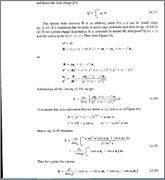
Hey guys, can someone please help me with this? In the case of the line charge (pictures 1 and 2), can someone please explain to me how he converted the vector R from cartesian coordinates to cylindrical coordinates without doing any calculation?

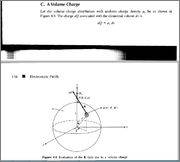
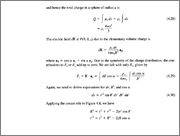
Also, on the case of the sphere (pictures 3 and 4), I didn't understand how he got the components cos(alpha) az and sin(alpha) ap of the vector ar.

Can someone please recommend me some material or book to study this subject about orthogonal basis of cylindrical and spherical coordinates?

Sorry for my bad english, and thank you very much.
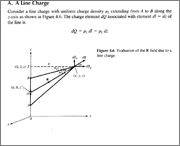
Diagram of a uniform line charge along the z-axis with charge density rho_l, showing a differential element dQ at a point, the position vector R from the element to the field point, and the field point P at coordinates (0, 0, z); equation dQ = rho_l dz shown beside it.


Small, low-resolution scanned textbook page showing typeset equations with a figure of a charged line or sphere geometry; individual symbols are too blurry to transcribe reliably.


Textbook page titled C. A Volume Charge with a volume charge distribution rho_v(r) and a charge Q, and below it a diagram of a spherical charge with a point P and a vector labelled R, showing an electric field geometry with angles alpha and theta.


Low-resolution page of printed equations: a line-charge expression for the vector R with an element dl and a cylindrical unit vector a_rho, followed by numbered equations below it.
 
Nordcus said:
can someone please help me with this? In the case of the line charge (pictures 1 and 2), can someone please explain to me how he converted the vector R from cartesian coordinates to cylindrical coordinates without doing any calculation?
The radial vector ##\mathbf{a}_\rho## in the cylindrical coordinate is a unit vector that lies in the z=0 plane. Therefore, any vector which has zero ##z## component can be written as a vector of appropriate magnitude in the direction of ##\mathbf{a}_\rho##. There is also a more formal prove using the formulae for the coordinate change between Cartesian and cylindrical coordinates. It requires more work but is actually easy to show.
Nordcus said:
Also, on the case of the sphere (pictures 3 and 4), I didn't understand how he got the components cos(alpha) az and sin(alpha) ap of the vector ar.
The author wanted to write ##\mathbf{a}_R## in Cylindrical components. Since the line along ##\mathbf{a}_R## connects a general point with a point on the z axis, the ##\mathbf{a}_\phi## component must be zero leaving only ##\mathbf{a}_\rho## and ##\mathbf{a}_z## only.