Triple Product of Vectors: Coplanar or Collinear? Understanding the Result

  • Thread starter Thread starter Valenti
  • Start date Start date
Click For Summary
SUMMARY

The discussion centers on determining whether the vectors u = i + 5j - 2k, v = 3i - j, and w = 5i + 9j - 4k are coplanar or collinear based on their scalar triple product. The calculated determinant of the vectors arranged in a 3x3 matrix is zero, indicating that the vectors are coplanar. It is established that coplanar vectors can span a plane, while collinear vectors lie along a single line. The distinction is clarified that collinear vectors are a subset of coplanar vectors.

PREREQUISITES
  • Understanding of vector operations, specifically the scalar triple product.
  • Knowledge of determinants and their geometric interpretations.
  • Familiarity with linear combinations of vectors.
  • Ability to manipulate and row-reduce matrices.
NEXT STEPS
  • Study the properties of the scalar triple product in vector analysis.
  • Learn how to compute determinants of 3x3 matrices in detail.
  • Explore linear dependence and independence of vectors in vector spaces.
  • Investigate graphical representations of vector subspaces and their dimensions.
USEFUL FOR

Students and educators in mathematics, particularly those studying linear algebra and vector calculus, as well as anyone seeking to understand the geometric relationships between vectors in three-dimensional space.

Valenti
Messages
15
Reaction score
0
Like the title says I'm not sure when the result is coplanar or collinear

Homework Statement


Are the following vectors in triple product coplanar or collinear?
u = i + 5j -2k
v= 3i - J
w= 5i + 9j - 4k

Homework Equations


Cross product - place into a 3x3 matrix grid
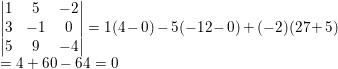
The Attempt at a Solution


lateximg.png
[/B]
After placing them into a 3x3 grid the result is 0. Now I'm not sure if this means they are coplanar or collinear.
 
Physics news on Phys.org
Valenti said:
Like the title says I'm not sure when the result is coplanar or collinear

Homework Statement


Are the following vectors in triple product coplanar or collinear?
u = i + 5j -2k
v= 3i - J
w= 5i + 9j - 4k

Homework Equations


Cross product - place into a 3x3 matrix grid

The Attempt at a Solution


lateximg.png
[/B]
After placing them into a 3x3 grid the result is 0. Now I'm not sure if this means they are coplanar or collinear.
Does the set of vectors span a line or a plane?
 
Student100 said:
Does the set of vectors span a line or a plane?
Not sure honestly, I changed the question around for my own use, but in the original question it says to verify why it is coplanar, so id assume it to span across a plane
 
Valenti said:
Not sure honestly, I changed the question around for my own use, but in the original question it says to verify why it is coplanar, so id assume it to span across a plane

Load the vectors into a matrix and row reduce, then look at how you can write the result as a linear combination. That should be a good give away to whether you're dealing with a line or a plane.
 
Student100 said:
Load the vectors into a matrix and row reduce, then look at how you can write the result as a linear combination. That should be a good give away to whether you're dealing with a line or a plane.
Seems I may be missing something, i still can't tell when its a plane or line
 
Valenti said:
Seems I may be missing something, i still can't tell when its a plane or line

Go ahead and row reduce the above, what's a basis for the subspace? How can you graphically represent the subspace?
 
If what I'm saying sounds like gibberish, then by taking the scalar triple product and obtaining a result of zero let's you know the signed area of the parallelepiped is zero, thus the vectors are coplanar. You didn't do that correctly in the above, however.

It also can be misleading, as collinear subspaces are coplanar, but coplanar subspaces aren't always collinear. The geometric approach of finding a basis for the subspace spanned by the vectors is a better approach to the question as posed.

I'm also tired, so maybe I'm not doing a good job here articulating my thoughts.
 
Valenti said:
Like the title says I'm not sure when the result is coplanar or collinear

Homework Statement


Are the following vectors in triple product coplanar or collinear?
u = i + 5j -2k
v= 3i - J
w= 5i + 9j - 4k

Homework Equations


Cross product - place into a 3x3 matrix grid

The Attempt at a Solution


lateximg.png
[/B]
After placing them into a 3x3 grid the result is 0. Now I'm not sure if this means they are coplanar or collinear.
This is the "determinant", not just a "3x3 grid"!
 
Valenti said:
Seems I may be missing something, i still can't tell when its a plane or line
Go back to the definitions. Two vectors are collinear when they have the same direction, only the magnitudes differ. You get one vector with multiplying the other vector with a scalar. Is any of the given vectors u, v, w, a multiple of an other one?
Three vectors are co-planar if they are in the same plane. A plane has two dimensions, so two independent vectors. The third one is linear combination of the other two:
w=a u+b v. Write out this equation in components. Can you solve it?
The three vectors are independent (span 3 dimensions) if you can not combine one of them from the other two, that is, a linear combination can be zero, au +bv +cw =0 only when all coefficients a, b, c, are zero. You get a non-zero solution only when the vectors are dependent, span a plane. Arranging the vector components so as they form the rows of a determinant, the value of the determinant is zero if and only if one row can be combined from the other two. You calculated the determinant and got zero. So are u,v,w dependent or independent vectors?
 
  • Like
Likes   Reactions: gracy
  • #10
Here's a helpful hint that may help you. The determinant
$$\begin{vmatrix}
1&5&-2 \\
3&-1&0 \\
5&9&-4
\end{vmatrix}
= \begin{vmatrix}
u_x&u_y&u_z \\
v_x&v_y&v_z \\
w_x&w_y&w_z
\end{vmatrix}$$
may be rewritten as
$$\begin{vmatrix}
u_x&u_y&u_z \\
v_x&v_y&v_z \\
w_x&w_y&w_z
\end{vmatrix} = \vec u \cdot ( ~ \vec v \times \vec w~ )$$
You have already figured out the determinant is zero. What does this mean?
 

Similar threads

  • · Replies 13 ·
Replies
13
Views
3K
  • · Replies 2 ·
Replies
2
Views
2K
  • · Replies 11 ·
Replies
11
Views
7K
  • · Replies 1 ·
Replies
1
Views
2K
  • · Replies 26 ·
Replies
26
Views
77K
  • · Replies 1 ·
Replies
1
Views
1K
Replies
3
Views
1K
  • · Replies 9 ·
Replies
9
Views
3K
  • · Replies 2 ·
Replies
2
Views
1K
Replies
2
Views
2K