Crane Load Problem: Understanding Tension Torque and Beam Bending

  • Thread starter Thread starter MotoPayton
  • Start date Start date
  • Tags Tags
    Crane Load
Click For Summary
SUMMARY

The discussion centers on the analysis of torque due to tension in crane load scenarios, specifically addressing the mechanics of beam bending and cable attachment points. The torque is derived from the roller at point B rather than the end of the beam to simplify calculations and avoid complications from cable bending. The cable configuration involves a fixed point at A, a tensioned cable to B, and a lifting cable from B to C, which is reeled in by a motor. Participants seek online resources for further analysis of beams and forces.

PREREQUISITES
  • Understanding of basic mechanics of materials
  • Familiarity with torque and bending moments
  • Knowledge of crane load dynamics
  • Experience with structural analysis software
NEXT STEPS
  • Research beam bending analysis techniques
  • Explore torque calculation methods in mechanical systems
  • Learn about structural analysis software such as SAP2000 or ANSYS
  • Investigate online resources for beam and force analysis, like Wolfram Alpha or Autodesk's Structural Analysis tools
USEFUL FOR

Engineers, structural analysts, and students studying mechanics, particularly those involved in crane operations and load analysis.

MotoPayton
Messages
96
Reaction score
0
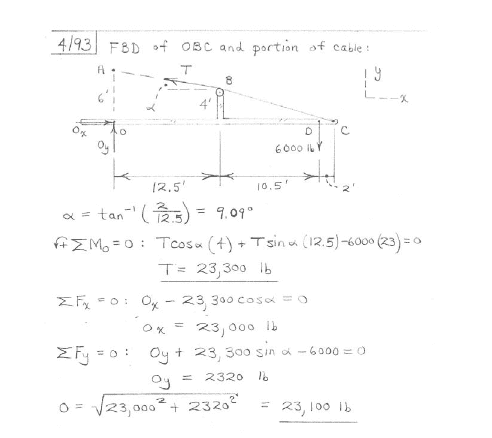
Can someone explain to me why the torque due to tension is taking from the roller instead of at the end of the beam.

If you were to take it from the end of the beam you would also need to take the torque created by the bending of the cable. This is obviously more complicated.

It just doesn't seem like the way they did it should work.
Screenshot2011-10-05at62038PM.png
 
Physics news on Phys.org
I can't figure out what is at B. Is the cable attached at C and slides over (above) a peg at B? Or is the cable attached at B, and a separate line connects B to C?

I think the cable might be fixed to the wall at A, and connected by a tensioned cable of fixed length to B. There is a separate lifting cable running from B to C that can be reeled in by a motor at B. That seems how it is analyzed, anyway.
 
It is the same cable and that is a roller at B.
 
Then it looks like the extra force acting on the beam is a not-quite-vertical force at B, its line of action being midway through angle ABC. But I'm no expert.

Are there online resources where you can analyse beams and forces, as a check?
 

Similar threads

  • · Replies 7 ·
Replies
7
Views
3K
  • · Replies 2 ·
Replies
2
Views
3K
  • · Replies 4 ·
Replies
4
Views
5K
  • · Replies 9 ·
Replies
9
Views
3K
Replies
6
Views
2K
  • · Replies 2 ·
Replies
2
Views
3K
  • · Replies 2 ·
Replies
2
Views
2K
Replies
4
Views
4K
Replies
65
Views
6K
Replies
5
Views
4K