Misc. Creating a Charcoal Forge - a thought

  • Thread starter Thread starter some bloke
  • Start date Start date
Click For Summary
SUMMARY

The discussion centers on designing a charcoal forge using two cylinders, where the outer cylinder contains burning charcoal and the inner cylinder, which is perforated, holds the workpiece. The proposed design aims to heat the workpiece through hot gases rather than direct contact with charcoal, although participants express skepticism about its effectiveness. Key points include the necessity of direct contact with coal for optimal heating and the potential for the inner cylinder to corrode or melt due to high temperatures. Participants recommend traditional methods of blacksmithing, emphasizing the importance of experience over theoretical designs.

PREREQUISITES
  • Understanding of charcoal forge design principles
  • Knowledge of blacksmithing techniques and materials
  • Familiarity with heat treatment processes for steel
  • Basic skills in metalworking and tool handling
NEXT STEPS
  • Research traditional charcoal forge designs and their efficiencies
  • Learn about the heat treatment processes for different types of steel
  • Explore the construction of a deep V channel forge with air feed
  • Investigate materials suitable for high-temperature applications in forges
USEFUL FOR

This discussion is beneficial for hobbyist blacksmiths, metalworkers, and anyone interested in constructing or optimizing charcoal forges for ironwork projects.

some bloke
Messages
283
Reaction score
99
TL;DR
I'm looking to build a charcoal forge for my garden - and I have a thought for a redesign.
I'm going to be taking up some ironwork as a hobby again, which I dabbled in a few years back. I had a forge made of a brake hub, and it worked quite well. I'm now considering a redesigned charcoal forge and I thought I would run an idea by you guys, who are probably more knowledgeable than me on the nature of fire!

The idea is to have 2 cylinders, one inside the other. the inside of the large one is filled with burning charcoal, and the inner one is where the workpiece is placed. the inner one is perforated full of holes, to let the hot gases pass through.

My theory is that the hot gases from the charcoal can be pumped into the inner cylinder, heating the workpiece as the air feed makes the charcoal burn hotter. This theory relies entirely on the idea that the gases released by the charcoal will make it hot enough to make steel glow, without actual contact with the charcoal.
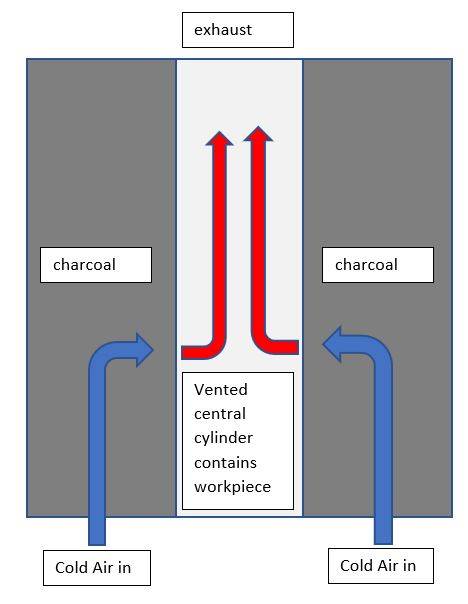
forge.JPG

The outer cylinder would be capped and would need a constant feed of air to keep it burning. The inner one is perforated and open at the top. The outer cylinder would have an air-feed from a fan of sorts to pump the air through.

I suspect that the air wouldn't heat up enough to make this effective. My goal is to make something akin to a gas forge, but without the need for a gas bottle and the potential explosion that goes with it! I'm confident in my abilities to make a pot of fire, but not in working with gas!
 
Physics news on Phys.org
Most forges I've seen have the workpiece sitting directly in the coals. Does that happen in your design? It does not look like that to me.
 
  • Like
Likes 256bits
How does one handle the workpiece with the hot gases rising to meet your hand when you want to fish it out? Jim has a good point for handlng the workpiece easily and quickly and sturdily with the grippers.
What material would you consider for the inner cylinder?
After how many uses would it take for it to corrode?
 
@some bloke I assume your brake drum forge had the work-piece directly on the fire. Why would you want anything different since you'll never get as much heat indirectly ?
 
Last edited:
If your gases are hot enough to soften the workpiece, won’t they melt your inner cylinder?
 
Both cylinders will sink heat away from the gases, and the more air you pump in, the more they will be cooled. I can see you chasing your tail on this one (and flaying the skin off your arm when you extract the workpiece).

Much simpler would be a deep V channel with a perforated tube at the bottom. Fill with coal, light it, and pump air into the tube. If you watch a blacksmith at work, he will generally bury the piece in the coal, suggesting hot gases are not enough - you need direct contact with brightly burning coal.
 
  • Like
Likes 256bits and phinds
It sounds like this is one of those cases where modern man, given all his powerful theories, and fast computers, finds it difficult to match the expertise of ancient blacksmiths who built their knowledge on years of experience and the apprentice system.
 
  • Like
Likes Tom.G, 256bits and phinds
Guineafowl said:
If you watch a blacksmith at work, he will generally bury the piece in the coal, suggesting hot gases are not enough - you need direct contact with brightly burning coal.
To be fair to the OP, the design does account for some loss due to radiation of the workpiece, but put a crucible in the inner tube and some kind of vented lid to reflect vertical radiation and presto, you have a kiln.
 
256bits said:
... and presto, you have a kiln.
Certainly. You'd have a kiln, but he's asking about a forge
 
  • #10
phinds said:
Certainly. You'd have a kiln, but he's asking about a forge
OK
 
  • #11
  • #12
I’ve made a couple of knives in the past, but certainly don’t have the wealth of knowledge and experience to work like a proper blacksmith. You need to start somewhere, so here is my understanding...

Cut a rough blank out of the steel. If you know what type it is, you can look up how to heat treat it, otherwise proceed as follows:

1) Anneal. Heat it until a magnet won’t stick, then perhaps 20 seconds more, then bury it in ashes. Leave for an hour.

Doing this will even out any stresses and tempers, and make it workable. You will save on drill bits and time, so it’s definitely worth doing. Finish shaping the knife, but leave the edge blunt.

2) Harden. Heat as above, then quench in plenty of oil, moving it up and down briefly to improve heat transfer (not side-to-side, as you might bend it). Try to choose an oil with a high flash point.

If a file skates across the surface but doesn’t bite, you have succeeded. If not, try again but quench in water.

3) Temper. This is one to look up for your particular application. I tempered my knives to blue in the oven. Other suggest heating away from the edge with a gas torch until the edge is blue or straw-coloured. A file should now bite, but not easily. Sharpen and polish!

Best of luck. Call me old-fashioned, but a man should make a knife for himself.
 
  • Informative
Likes Tom.G
  • #13
Thankyou all for your replies!

I guess I just liked the look of the gas forges I've seen, but didn't fancy trying to make one because gas is dangerous!

I will be making a traditional type forge, where the metal goes in the coals!

Cheers!
 

Similar threads

  • · Replies 7 ·
Replies
7
Views
2K
  • · Replies 8 ·
Replies
8
Views
3K
Replies
2
Views
2K
  • · Replies 5 ·
Replies
5
Views
3K
Replies
1
Views
1K
  • · Replies 4 ·
Replies
4
Views
1K
Replies
11
Views
4K
  • · Replies 39 ·
2
Replies
39
Views
15K
Replies
25
Views
4K
Replies
7
Views
4K