Creating liquid isobutane from r600a

  • Thread starter Thread starter PRIDES
  • Start date Start date
  • Tags Tags
    Liquid
Click For Summary

Discussion Overview

The discussion revolves around the creation and study of liquid isobutane from r600a refrigerant, focusing on the chemical compatibility of isobutane as a solvent and propellant. Participants explore the feasibility of achieving liquid isobutane under specific pressure and temperature conditions, as well as the implications for chemical compatibility with various materials.

Discussion Character

  • Exploratory
  • Technical explanation
  • Conceptual clarification
  • Debate/contested

Main Points Raised

  • One participant describes a setup involving a pressure chamber to study isobutane but notes the absence of liquid isobutane despite expectations based on vapor pressure.
  • Another participant questions the expectation of liquid isobutane, suggesting that the air compressor creates most of the pressure, resulting in a low partial pressure of isobutane.
  • A participant proposes that if isobutane is introduced at a low temperature (10°F), it may remain liquid when pressurized, but seeks clarification on whether chemical compatibility tests should be conducted at low temperatures.
  • Concerns are raised about the safety of using PVC tubing under pressure and the potential for chemical reactions at different temperatures.
  • Discussion includes the need to understand the implications of chemical compatibility ratings for isobutane with various plastics, particularly EPDM and Nylon, and the meaning of "bad ratings" in this context.
  • Another participant explains that a "bad rating" indicates potential dissolution or swelling of materials in isobutane and discusses factors affecting solubility, including temperature and pressure.

Areas of Agreement / Disagreement

Participants express differing views on the feasibility of achieving liquid isobutane in the described setup, with some agreeing on the importance of temperature and pressure while others emphasize the limitations of the current approach. The discussion remains unresolved regarding the best method to study chemical compatibility.

Contextual Notes

Participants highlight the need for careful consideration of pressure limits in PVC tubing and the potential for chemical reactions at varying temperatures, but do not reach a consensus on the optimal conditions for their experiments.

Who May Find This Useful

This discussion may be of interest to those involved in experimental chemistry, materials science, or engineering, particularly in the context of working with hydrocarbons and assessing chemical compatibility of materials.

PRIDES
Messages
20
Reaction score
0
There is a recent project I have been working on that requires the use of Isobutane as a propellant/solvent, so I have come up with a way to study the chemical compatibility of isobutane:

I have a pressure chamber that I built from transparent PVC and opaque PVC with a tire valve as an inlet for air and isobutane:
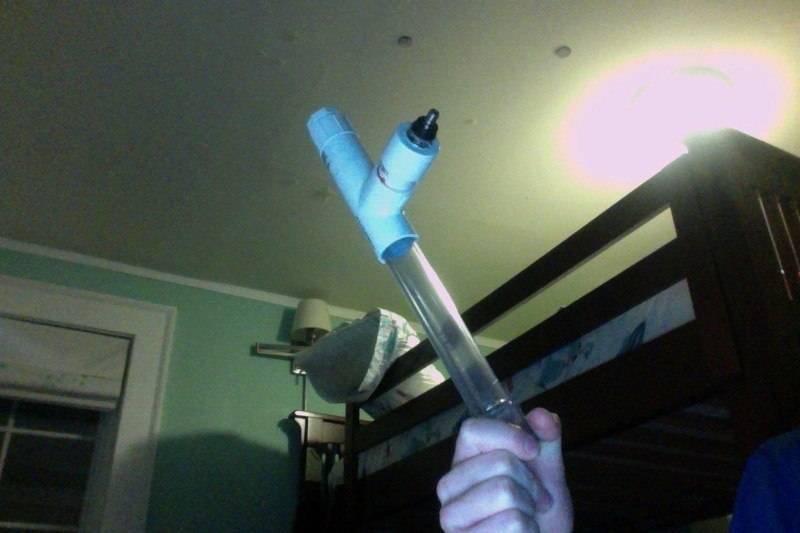
Photo on 11-19-13 at 7.48 PM.jpg


I use r600a refrigerant for isobutane (420 grams, 720 liters)
I can put solid objects into the top of the chamber.
I use anti-air loss tire valve connectors.

The procedure is as follows:
1. connect r600a refrigerant canister to pressure chamber and wait a little bit.
2. remove the connection quickly.
3. connect air compressor to the pressure chamber and pressurize to 50 psi.
4. optional: remove the connection quickly.

I know that the vapor pressure of Isobutane is about 43 psi, so I should see a liquid in the chamber, but I don't. Please this is making no sense to me.
 
Last edited:
Engineering news on Phys.org
Why do you expect liquid isobutane when the bulk of the pressure is created by the air compressor?
It seems unlikely that the isobutane has close to 43 psi partial pressure in your setup, rather based on your setup, which equilibrates the isobutane/air mix at atmospheric pressure (15psi), you have maybe 7-8 psi partial pressure of isobutene, the rest air. So there is far too little isobutene in your setup for anything to liquefy.
I would also note that there needs to be a way to remove the latent heat of condensation if you plan to see a liquid. Remember that your setup is in some ways a bit like a refrigerator, it cannot work unless it has some way to reject heat.
 
So another question?

etudiant said:
Why do you expect liquid isobutane when the bulk of the pressure is created by the air compressor?
It seems unlikely that the isobutane has close to 43 psi partial pressure in your setup, rather based on your setup, which equilibrates the isobutane/air mix at atmospheric pressure (15psi), you have maybe 7-8 psi partial pressure of isobutene, the rest air. So there is far too little isobutene in your setup for anything to liquefy.
I would also note that there needs to be a way to remove the latent heat of condensation if you plan to see a liquid. Remember that your setup is in some ways a bit like a refrigerator, it cannot work unless it has some way to reject heat.

Ah ok! I think I understand now. So the air is containing most of the pressure. I've done some thinking and math and I don't think I could create liquid isobutane in the container just by pressure. But if I waited until it was 10° F outside, and went outside and just poured the isobutane in the container, could I then keep it liquid by pressurizing it while it was liquid, and then bringing it into room temperature to carry out my observations, or would I need to carry them out in the cold? Would it have a different chemical compatibility properties in the cold?
 
Well, if you start with liquid isobutane almost filling the container at 10*F, there will be ample pressure to keep your sample liquid at room temperature as well. No need to pump it up to start with, that will just bump up your system pressure more, for no purpose.
You should in any case be careful about putting much pressure into PVC tubing. It does not really have much strength. Please wear good safety goggles while working with this setup, pressurized PVC bursts rather than leak slowly. Also, make sure there are no flames or spark sources around, isobutane is a great fuel.
The chemical reactions that you are investigating will simply happen more slowly at lower temperatures, but they do take place. Isobutane is a pretty stable compound though, so it would be a surprise to see it become involved in chemical reactions. Do you perhaps have some solvent effects in mind on seals or lubricants?
 
etudiant said:
Well, if you start with liquid isobutane almost filling the container at 10*F, there will be ample pressure to keep your sample liquid at room temperature as well. No need to pump it up to start with, that will just bump up your system pressure more, for no purpose.
You should in any case be careful about putting much pressure into PVC tubing. It does not really have much strength. Please wear good safety goggles while working with this setup, pressurized PVC bursts rather than leak slowly. Also, make sure there are no flames or spark sources around, isobutane is a great fuel.
The chemical reactions that you are investigating will simply happen more slowly at lower temperatures, but they do take place. Isobutane is a pretty stable compound though, so it would be a surprise to see it become involved in chemical reactions. Do you perhaps have some solvent effects in mind on seals or lubricants?

Well I need to use isobutane as a solvent, so I need to know what it can dissolve, and I know its not really a solvent, but chemical compatibility charts suggest that it has a bad rating with EPDM definitely, but charts have some conflicting data concerning other plastics such as Nylon:

Screen Shot 2013-11-20 at 8.55.03 AM.png


But of course, I'm not a chemist, so I don't know exactly what the bad rating means, whether it be that isobutane dissolves the plastic, or it has a bad reaction with it.
 
PRIDES said:
Well I need to use isobutane as a solvent, so I need to know what it can dissolve, and I know its not really a solvent, but chemical compatibility charts suggest that it has a bad rating with EPDM definitely, but charts have some conflicting data concerning other plastics such as Nylon:

View attachment 64122

But of course, I'm not a chemist, so I don't know exactly what the bad rating means, whether it be that isobutane dissolves the plastic, or it has a bad reaction with it.

A bad rating in this context means that it would dissolve/infiltrate/swell the item getting put into the isobutane. Note that temperature and pressure will impact solubility, but unless you heat the materials a lot, chemical reactions are very unlikely between plastics and isobutane.
Isobutane is a simply hydrocarbon, just contains hydrogen and carbon, so it is a non polar solvent, good for most hydrocarbons. If you add polar groups to the hydrocarbons, from oxygen atoms for instance, or if you polymerize the material under test, it will not dissolve nearly as easily. Nylon is an example of such an oxygen containing material, plus it is polymerized, so it is pretty insoluble in isobutane.
There are solubility tables that can help you get the answer to your question or at least give you a decent basis for estimating.
 

Similar threads

  • · Replies 3 ·
Replies
3
Views
653
  • · Replies 28 ·
Replies
28
Views
4K
  • · Replies 8 ·
Replies
8
Views
6K
Replies
2
Views
3K
  • · Replies 39 ·
2
Replies
39
Views
16K
  • · Replies 2 ·
Replies
2
Views
4K
  • · Replies 3 ·
Replies
3
Views
4K
Replies
2
Views
3K
  • · Replies 14 ·
Replies
14
Views
8K
  • · Replies 3 ·
Replies
3
Views
4K