Cross product of complex vectors

Click For Summary
SUMMARY

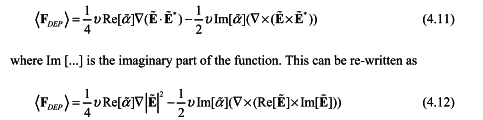
The discussion centers on the derivation of the cross product of complex vectors, specifically questioning the accuracy of an equation presented in "AC Electrokinetics: Colloids and Nanoparticles" by Morgan and Green. Participants noted a discrepancy involving the imaginary unit 'i' in the second term of the equation, suggesting a potential missing factor of -2i. Despite doubts about the author's correctness, simulations based on the second equation yielded sensible results, while attempts to expand the first equation did not. This highlights the importance of verifying mathematical expressions in complex vector analysis.

PREREQUISITES
  • Understanding of complex vector mathematics
  • Familiarity with cross product operations
  • Knowledge of complex conjugates
  • Basic simulation techniques in mathematical modeling
NEXT STEPS
  • Review the derivation of cross products in complex vector spaces
  • Study the properties of complex conjugates in vector analysis
  • Learn about simulation techniques for verifying mathematical equations
  • Explore advanced topics in "AC electrokinetics" for practical applications
USEFUL FOR

Mathematicians, physicists, and engineers interested in complex vector analysis, as well as students seeking to understand the implications of mathematical derivations in applied physics.
s_guo82
Messages
2
Reaction score
0
Would you pls help me with the following vector product? I got no idea how the author derived the second equation from the first one. My derivation result is always including the imaginary unit i for the second term in the second equation on the right hand side. Specifically, how to verify that the cross product of the complex vector and its conjugate is equal to the cross product of the real part of the complex vector and the its imaginary part? ~ denotes a complex variable.
equ mor and gre.png


Thank you in advance
 
Last edited:
Physics news on Phys.org
Looks like a -2i factor is missing in the second term of the second equation. You get this as well?
 
Yes, I got the same thing. I doubt there should be a "i" for the second term on the right hand side of the second equation. However, all the author's simulation is based on the second equation. I also tried to expand the first equation and simulated it, but it did not give a result that makes sense. However, with the second equation, the simulation result seems to make sense. I asked this question because I am neither a maths student nor physics and I am not confident that the renowned author can make mistakes for such an important expression. He used this equation all the way in his book.

This is from the book "AC electrokinetics: Colloids and nanoparticles" by Morgan and Green.

Any other thoughts, guys?
 
I am studying the mathematical formalism behind non-commutative geometry approach to quantum gravity. I was reading about Hopf algebras and their Drinfeld twist with a specific example of the Moyal-Weyl twist defined as F=exp(-iλ/2θ^(μν)∂_μ⊗∂_ν) where λ is a constant parametar and θ antisymmetric constant tensor. {∂_μ} is the basis of the tangent vector space over the underlying spacetime Now, from my understanding the enveloping algebra which appears in the definition of the Hopf algebra...

Similar threads

  • · Replies 14 ·
Replies
14
Views
3K
  • · Replies 4 ·
Replies
4
Views
4K
  • · Replies 11 ·
Replies
11
Views
3K
  • · Replies 7 ·
Replies
7
Views
3K
  • · Replies 4 ·
Replies
4
Views
6K
  • · Replies 8 ·
Replies
8
Views
2K
Replies
21
Views
3K
  • · Replies 8 ·
Replies
8
Views
2K
Replies
1
Views
2K
  • · Replies 5 ·
Replies
5
Views
1K