Crystallographic representation of a material, two sources seem very d

Click For Summary
SUMMARY

The discussion centers on the comparison between two software tools for plotting crystallographic representations of materials, specifically CoSb3. The Atomic Simulation Environment (ASE), a Python-based software with a database, is contrasted with the Materials Project website, which offers interactive visualization of crystal orientations. Users express uncertainty regarding the reliability and equivalence of these sources, noting differences in unit cell choices and bonding representations. Ultimately, the focus is on selecting the most trustworthy source for crystallographic data.

PREREQUISITES
  • Familiarity with crystallography concepts
  • Basic understanding of Python programming for ASE
  • Knowledge of materials science terminology
  • Experience with interactive data visualization tools
NEXT STEPS
  • Explore the capabilities of Atomic Simulation Environment (ASE) for crystallographic plotting
  • Investigate the Materials Project database for additional material properties
  • Learn about unit cell definitions and their impact on crystallographic representations
  • Research best practices for verifying the reliability of scientific data sources
USEFUL FOR

Materials scientists, crystallographers, and researchers involved in computational materials modeling will benefit from this discussion, particularly those seeking reliable software for visualizing crystallographic structures.

fluidistic
Gold Member
Messages
3,934
Reaction score
283
While searching for a software to plot a crystallographic representation of a particular material, I have come across two sources that seem to give two very different views of a same material. In this case, it is CoSb3.
On the one hand there is
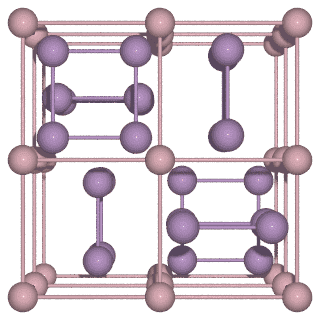
spacegroup-cosb31.png
from ASE (Atomic Simulation Environment), a software in Python with a database.
On the other hand there is https://materialsproject.org/materials/mp-1317/ from the Materials Project website. With the mouse, we can change the orientation we see the part of the crystal, but I see no way to get anything close to the above picture.

So I am not sure whether they are both unreliable sources, or if they are equivalent (and trustworthy) or if one of them is wrong and the other is correct, etc.

In the end I am not interested in CoSb3 in particular, but in another compound, and I am not sure which source to use.
 
Physics news on Phys.org
I think the materials project structure looks equivalent. Only difference being that they chose a different unit cell and showed the bonding slightly differently, but these two things are not important.

1609666035938.png
 
  • Informative
Likes   Reactions: fluidistic
Big thank you, I wouldn't have figured all this out, for sure.
 
  • Like
Likes   Reactions: etotheipi

Similar threads

  • · Replies 5 ·
Replies
5
Views
2K
  • · Replies 19 ·
Replies
19
Views
1K
  • · Replies 26 ·
Replies
26
Views
3K
  • · Replies 6 ·
Replies
6
Views
3K
  • · Replies 56 ·
2
Replies
56
Views
7K
  • · Replies 12 ·
Replies
12
Views
3K
  • · Replies 9 ·
Replies
9
Views
8K
  • · Replies 3 ·
Replies
3
Views
2K
  • · Replies 2 ·
Replies
2
Views
5K
  • · Replies 5 ·
Replies
5
Views
3K