Cubic approximation multivariable taylor series

6 replies · 7K views · last reply
abdooo89
Messages
20
Reaction score
0
hi everyone , i don't understand these steps for Taylor Expansion , it has used for state space equations
the equations are
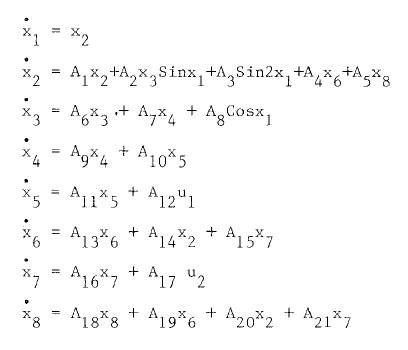
Set of eight state-space equations listing x1 dot through x8 dot as linear combinations of states x1 to x8 and inputs u1 and u2, with coefficients A1 to A21, including terms in sin x1, sin 2x1 and cos x1.


the approximations for sin and cos

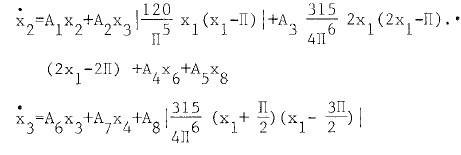
Two state-space equations written in plain typed notation: x2 dot equals A1 x2 + A2 x3 plus a term with 120/pi^5 times x1(x1 - pi), plus A3 times 315/(4 pi^6) times 2x1(2x1 - pi), times (2x1 - 2pi), plus A4 x6 + A5 x8; x3 dot equals A6 x3 + A7 x4 + A8 times 315/(4 pi^6) times (x1 + pi/2)(x1 - 3pi/2).


the equation for Taylor series is ( i don't understand at all )
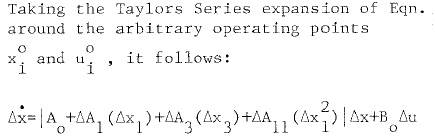
Typeset text stating: Taking the Taylors Series expansion of Eqn. around the arbitrary operating points x_i^o and u_i^o, it follows: followed by the linearized state equation dx/dt = |A_o + dA_1(dx_1) + dA_3(dx_3) + dA_11(dx_1^2)| dx + B_o du.

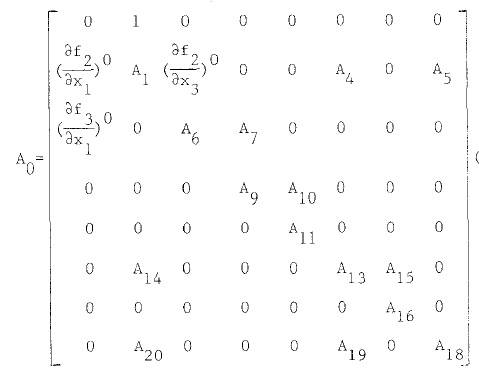
Matrix A0 as an 8 by 8 array, with entries 0 and 1 in fixed positions and labelled entries A1 to A20 and partial derivatives (∂f2/∂x1)0, (∂f2/∂x3)0 and (∂f3/∂x1)0 in the first column and top row.

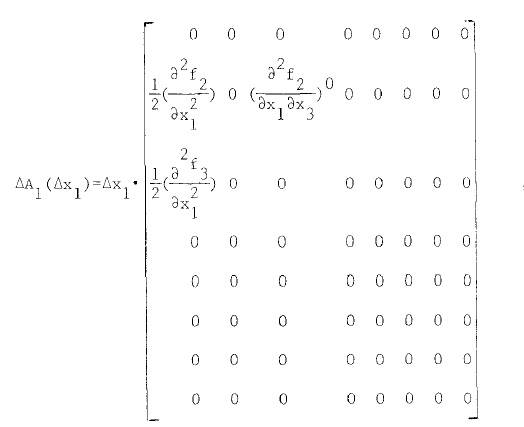
Matrix equation: delta A_1(delta x_1) = delta x_1 times a 9 by 9 matrix whose upper-left entries are 1/2 (second partial of f_2 with respect to x_1 squared), 0, and 1/2 (second partial of f_2 with respect to x_1 and x_3), with the rest of the entries zero; remaining entries include 1/2 (second partial of f_3 with respect to x_1 squared).

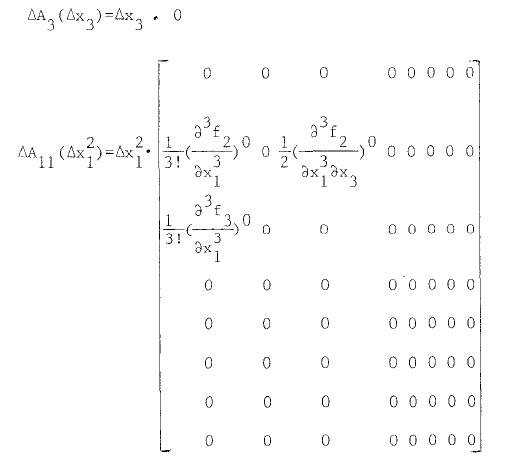
Handwritten-style matrix expansion showing ΔA_3(Δx_3) = Δx_3 · 0 and ΔA_11(Δx_1^2) = Δx_1^2 · followed by a large matrix of zeros with entries (1/3!)(∂^3 f_2/∂x_1^3)^0, (1/2)(∂^3 f_2/∂x_1^2∂x_3)^0, and (1/3!)(∂^3 f_3/∂x_1^3)^0.


please help me if you can
 
Perhaps people need more help to understand what you are saying. You say "I don't understand these steps for Taylor expansion". The Taylor expansion of what function? And you have "taking the Taylor expansion of Eqn." Of what equation? There seems to be a lot here you are telling us.
 
taking the Taylor expansion of Eqn ,

i mean equations ( X'1 to X'8 )

after that Taylor expansion has been taken like that

ΔX'={ A0 + ΔA1(ΔX1)+ΔA3(ΔX3)+ΔA11(ΔX1^2))ΔX+B0 Δu → ( xx)


i don't understand equation ( xx = taylor expansion ) , and how can i get A0 , ΔA1 , ΔA3, ΔA11

i mean which rule they used to get A0 , ΔA1 , ΔA3, ΔA11

the complete file has been attached
 
Attachments
Last edited:
abdooo89 said:
taking the Taylor expansion of Eqn ,

i mean equations ( X'1 to X'8 )

after that Taylor expansion has been taken like that

ΔX'={ A0 + ΔA1(ΔX1)+ΔA3(ΔX3)+ΔA11(ΔX1^2))ΔX+B0 Δu → ( xx)


i don't understand equation ( xx = taylor expansion ) , and how can i get A0 , ΔA1 , ΔA3, ΔA11

i mean which rule they used to get A0 , ΔA1 , ΔA3, ΔA11

the complete file has been attached


The author is NOT (at least initially) using Taylor expansions. He uses approximations of the form
[tex]\sin x_1 \approx p_1(x_1) \equiv \frac{120}{\pi^5} x_1 (x_1 - \pi )\\<br /> \sin 2x_1 \approx p_2(x_1) \equiv \frac{315}{4 \pi^6} (2 x_1 - \pi)(2 x_1 – 2 \pi)\\<br /> \cos x_1 \approx p_3(x_1) \equiv \frac{315}{4 \pi^6} (x_1 + \frac{\pi}{2}) (x_1 - \frac{3 \pi}{2})[/tex]
etcetera. These are not Taylor expansions; if you read carefully you will see that he makes it clear in the article that he claims he is using a form of least-squares approximation to ##\sin x_1##, etc. However, it appears the author makes some errors; he should have
[tex]\sin x_1 \approx \frac{120}{\pi^5} x_1 (\pi - x_1)[/tex]
with sign opposite sign to what he writes; if you plot the two functions you will see that the approximation is not too bad over the interval ##x \in [0,\pi]##. However, the approximations ##p_2## and ##p_3## are horrible: they do not resemble the functions ##\sin 2x_1## and ##\cos x_1## at all, as you can see by plotting them.
 
First, thank you for your reply, secondly I want to know if this approximations (p2 and p3) are not valid or horrible as you say, what is your advice for me to do?

and why ΔA3 =0
 
Last edited: