SUMMARY
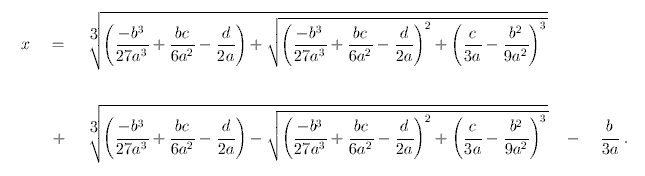
The cubic formula can be expressed in various forms, but there is no unique way to write it. While the standard presentation is preferred for clarity, alternative representations exist, often complicating the expression. The discussion references Bhaskara II's contributions to formula representation, emphasizing that while infinite variations are possible, they typically do not simplify the solution. Thus, the established cubic formula remains the most effective for practical use.
PREREQUISITES
- Understanding of polynomial equations
- Familiarity with algebraic manipulation techniques
- Knowledge of Bhaskara's contributions to mathematics
- Basic grasp of mathematical notation and expressions
NEXT STEPS
- Research alternative forms of the cubic formula
- Explore algebraic manipulation techniques for polynomial equations
- Study Bhaskara II's methods and their applications in modern mathematics
- Learn about the implications of formula complexity in mathematical problem-solving
USEFUL FOR
Mathematicians, educators, and students interested in algebraic expressions and the historical context of mathematical formulas.