Current as a function of time in a solenoid

Click For Summary

Homework Help Overview

The discussion revolves around determining the current in a coil placed inside a solenoid, with specific parameters provided for both the solenoid and the coil. The problem involves concepts from electromagnetism, particularly Faraday's law of induction and magnetic flux.

Discussion Character

  • Exploratory, Conceptual clarification, Mathematical reasoning, Problem interpretation, Assumption checking

Approaches and Questions Raised

  • Participants discuss calculating the induced emf in the coil by first determining the magnetic field in the solenoid and then the magnetic flux through the coil. There are attempts to derive expressions for current based on the changing magnetic field and the resistance of the coil.

Discussion Status

Some participants have provided calculations and expressed uncertainty about the values used for current and turns in the solenoid. Others have suggested reconsidering the approach to ensure clarity in the calculations and have pointed out the importance of using the correct parameters for the coil and solenoid.

Contextual Notes

There is confusion regarding which values to use for the number of turns and the area when calculating the magnetic flux. Additionally, participants are questioning how the specific time of 0.010 seconds factors into their calculations.

Linus Pauling
Messages
187
Reaction score
0
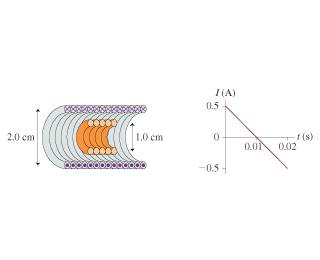
1. The figure shows a five-turn, 1.0-cm-diameter coil with R = 0.20 ohms inside a 2.0-cm-diameter solenoid. The solenoid is 9.0 cm long, has 130 turns, and carries the current shown in the graph. A positive current is cw when seen from the left.


34.P40.jpg


Determine the current in the coil at = 0.010s.


2. flux = BAcos(theta), faraday's law


3. By the graph, the equation for current as a function of time is 0.5A - 50(A/s)t. Plugging in t = 0.010s gives I=0. This seems deceptively easy...
 
Physics news on Phys.org
Hello Linus Pauling,

You've found the current in the 2 cm diameter solenoid (at time t = 0.01 s). But I believe the question is asking for the current in the 1 cm diameter, inner coil. :smile: That...might not be quite as simple.
 
Could someone help me get started on this one?
 
I think you need to calculate the induced emf in the coil (first, calculate the magnetic field in the solenoid, then the flux in the coil, then find its rate of change,...). Once you have the induced emf in the coil, consider the coil's resistance when calculating its current.
 
B for the solenoid = mu0NI/l = 9.1*10-4 if I use 0.5A for I. I am not sure if that value for I is correct... I just figured it's not zero so this seemed like a natural choice. Whether or not this is correct, can someone explain what I value is correct and why? Proceeding with the claculation:

flux per coil = B*A = 7.15*10-8 Tm2

EMF of the coil = d(flux)/dt * N = (7.15*10-8)/0.01 s * 5 turns = 3.57*10-5 V

EMF = IR
I = EMF/R = 1.79*10-4 A
 
Is that correct?
 
Linus Pauling said:
B for the solenoid = mu0NI/l = 9.1*10-4 if I use 0.5A for I. I am not sure if that value for I is correct... I just figured it's not zero so this seemed like a natural choice. Whether or not this is correct, can someone explain what I value is correct and why? Proceeding with the claculation:

flux per coil = B*A = 7.15*10-8 Tm2

EMF of the coil = d(flux)/dt * N = (7.15*10-8)/0.01 s * 5 turns = 3.57*10-5 V

EMF = IR
I = EMF/R = 1.79*10-4 A

Sorry for the delayed response.

I haven't gone through the whole problem myself, but I think you're getting close, but not quite.

Start with the equation for B, like you've already done, but leave the answer in terms of I. There's no point in sticking a specific number in for I since I is changing.

Next, look at the plot and come up with an equation for dI/dt. You should be able to use that to find an expression for dB/dt. How does that relate to -dΦ/dt in the coil? (where Φ is the flux and dΦ/dt is the rate of change of flux per unit time).

[Edit: Like I mentioned before, I haven't double checked all the math, but I just noticed that you started with I = 0.5 A, and then later divided by 0.01 s in a later part of the problem, which might end up giving you the right answer in the end (but possibly by coincidence, depending on how the grader interprets your work). If your instructor is grading on partial credit, I suggest redoing the problem in terms of dI/dt and dB/dt . It gives a cleaner way of getting to the solution.]

[Edit 2: Also, don't forget about the negative sign in the [tex]\epsilon = -\frac{d\Phi}{dt},[/tex] if you are required to show the direction of the induced current. (Which I'm guessing you are -- the problem statement gave a convention for what is positive current, meaning your answer might be negative, if the current flows in the opposite direction of the positive-convention.)]
 
Last edited:
Ok, I just calculated it this way and got an incorrect answer:

EMF = N2A*mu0/l * dI/dt

I = 0.5A - 50a/s(t)
dI/dt = -50

So, EMF = 9.29*10-4


I used N = 130. Am I supposed to use the other N value? What about A, which radius am I supposed to use?
 
So I am confused on which values to plug in for N and A. Also, I do not see where the t = 0.010 sec. comes into play...
 
  • #10
Linus Pauling said:
So I am confused on which values to plug in for N and A. Also, I do not see where the t = 0.010 sec. comes into play...

Don't get too confused, you almost had it with your first attempt. (As a matter of fact you sort of did get the answer) :smile: I didn't mean to confuse you, but the manner in which you obtained the answer was kinda iffy. (you might want to scratch your second attempt though).

Like you did the first time, the 130 turns of the solenoid along with the 0.09 m length, fits into the B of the solenoid (thus it also fits into the dB/dt of the solenoid too).

When it comes to the area used for the flux through the coil (and thus d/dt of the flux through the coil), you need to find the circular, cross sectional area of the coil, multiplied by its 5 turns.

Seriously, you kind of had the answer the first time. My only criticism is the way you got to the answer.

But if you want to be clear about it,

Find B in terms of I of the solenoid.

Find dB/dt of the solenoid (in this case, just replace I with dI/dt in your result above).

Multiply the above by the negative area of the coil (also accounting for the 5 turns) to get -dΦ/dt.

You should be able to take it from there.
 
Last edited:

Similar threads

Replies
7
Views
2K
Replies
9
Views
6K
Replies
5
Views
5K
  • · Replies 3 ·
Replies
3
Views
4K
  • · Replies 7 ·
Replies
7
Views
10K
  • · Replies 10 ·
Replies
10
Views
5K
  • · Replies 2 ·
Replies
2
Views
2K
  • · Replies 1 ·
Replies
1
Views
3K
  • · Replies 21 ·
Replies
21
Views
6K
Replies
4
Views
6K