How Do Injected Holes Flow in an NPN Transistor?

Click For Summary
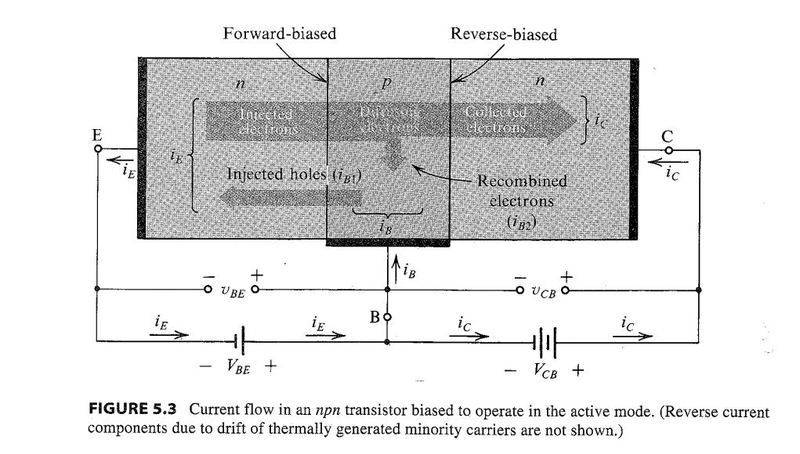
Injected holes in an NPN transistor flow from the base (P-type) to the emitter (N-type) due to the positive voltage at the base, allowing for hole diffusion. However, the number of holes that can diffuse into the emitter is significantly lower than the electrons flowing from the emitter to the base due to the higher concentration of free electrons in the N-type material. When holes are injected into the emitter, they quickly recombine with electrons, limiting their distance of travel. The confusion arises regarding the behavior of electrons in the conduction band and their movement after recombination, with two potential pathways suggested for their movement in the valence band. Overall, the dynamics of hole and electron movement are crucial for understanding the current gain in NPN transistors.
anhnha
Messages
179
Reaction score
1
Here is an image show how currents flow in NPN transistor from Microelectronic Circuits by Sedra Smith:
attachment.php?attachmentid=59440&stc=1&d=1370916434.jpg

Can you explain more about injected holes (iB1)? I can't imagine how holes can flow into emitter (N type)
Is it possible to for holes to flow from base to emitter?
 

Attachments

  • Current flow.JPG
    Current flow.JPG
    52.8 KB · Views: 751
Physics news on Phys.org
I think my main question is how holes diffuse from P type to N type semiconductor.
Can anyone help me explain it (how holes diffuse) in terms of electrons?
I can't imagine how holes can exist in N type by diffusion.
 
It's been a few years so I'm a bit rusty but..

The base is +ve with respect to the emitter so you would expect holes to flow from base to emitter and electrons the other way. The number of holes injected into the emitter is a lot less than the number of electrons injected the other way due to the doping.

Due to the number of free electrons in the n-type emitter a hole injected there is not likely to go far before it meets an electron and is destroyed.

Since the base is short most of the electrons make it from the emitter to the collector and since only a few holes make it from base to emitter Ic>>Ib and the transitor has current gain.
 
  • Like
Likes 1 person
Hi,
I am confused about this:
When we say that holes are injected from base to emitter it means that electrons in valence band (not electrons in conduction band) move from emitter to base.
Is this right?

And this is another question:
When an electron in conduction band from emitter falls into hole in base, it become electron in valence band. I wonder where the electron will go.
- the electron now is in valence band and it moves in valence band to positive lead of battery VBE
- the the electron now is in valence band and it moves in valence band to depletion region in CB junction and here it gets energy from VCB exits valence band and go into depletion region.

The first possibility is what I understand from the book but I wonder if the second is possible.
 
The book claims the answer is that all the magnitudes are the same because "the gravitational force on the penguin is the same". I'm having trouble understanding this. I thought the buoyant force was equal to the weight of the fluid displaced. Weight depends on mass which depends on density. Therefore, due to the differing densities the buoyant force will be different in each case? Is this incorrect?

Similar threads

  • · Replies 6 ·
Replies
6
Views
972
Replies
23
Views
3K
  • · Replies 5 ·
Replies
5
Views
4K
Replies
10
Views
6K
  • · Replies 11 ·
Replies
11
Views
2K
  • · Replies 8 ·
Replies
8
Views
1K
Replies
2
Views
3K
  • · Replies 1 ·
Replies
1
Views
3K
Replies
13
Views
6K
  • · Replies 1 ·
Replies
1
Views
5K