Nuru
- 2
- 0
Magnetic Field on an incline
This is what looks to be a fairly simple magnetic field problem, but I don't have much experience in relating velocities to electrical currents, so I'm a bit stuck. The problem as described is
I = unknown
m = 0.19 kg
B = 0.047 T
a = 9.8 m/s (gravity)
L = 1.6 m
The formula I know for this sort of thing is simply [tex]F = ILB\sin{\theta}[/tex]. My first approach was to use the relation [tex]F\,=\,MA[/tex] and substitute that in so I had: [tex]MA\,=\,ILB\sin{\theta}[/tex]
This turns into [tex]I\,=\, \frac{MA}{LB\sin{\theta}}[/tex]
So [tex]I\,=\,\frac{(.19 kg)(9.8 m/s)}{(1.6 m)(0.047 T)\sin{30}}[/tex]
then [tex]I\,=\,49.5212766[/tex]
However, that obviously isn't right. Did I miss an important detail? I found another problem which was identical except that it had a frictional coefficient they applied in the numerator and they had a [tex]\theta[/tex] of 90. Unless I misunderstood something it seems like this should be solvable the same way. Any help would be appreciated.
This is what looks to be a fairly simple magnetic field problem, but I don't have much experience in relating velocities to electrical currents, so I'm a bit stuck. The problem as described is
So my variables to my knowledge are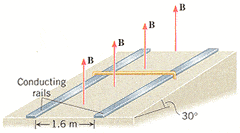
The two conducting rails in the drawing are tilted upwards so they make an angle of 30.0° with respect to the ground. The vertical magnetic field has a magnitude of 0.047 T. The 0.19 kg aluminum rod (length = 1.6 m) slides without friction down the rails at a constant velocity. How much current flows through the bar?
I = unknown
m = 0.19 kg
B = 0.047 T
a = 9.8 m/s (gravity)
L = 1.6 m
The formula I know for this sort of thing is simply [tex]F = ILB\sin{\theta}[/tex]. My first approach was to use the relation [tex]F\,=\,MA[/tex] and substitute that in so I had: [tex]MA\,=\,ILB\sin{\theta}[/tex]
This turns into [tex]I\,=\, \frac{MA}{LB\sin{\theta}}[/tex]
So [tex]I\,=\,\frac{(.19 kg)(9.8 m/s)}{(1.6 m)(0.047 T)\sin{30}}[/tex]
then [tex]I\,=\,49.5212766[/tex]
However, that obviously isn't right. Did I miss an important detail? I found another problem which was identical except that it had a frictional coefficient they applied in the numerator and they had a [tex]\theta[/tex] of 90. Unless I misunderstood something it seems like this should be solvable the same way. Any help would be appreciated.
Last edited: