Current leakage between the charged plates of a capacitor

Click For Summary
SUMMARY

The discussion focuses on the calculation of current leakage between charged plates of a capacitor, specifically using the formula $$I=\Delta Q/\Delta t$$. Participants analyze the implications of charge decay, leading to the conclusion that a negative sign is necessary in the differential equation $$\frac{dQ}{dt}=-\frac{Q}{\kappa\epsilon_0\rho}$$ to accurately represent the decrease in charge over time. The final expression for time, $$\Delta t=\kappa\epsilon_0\rho$$, is derived, confirming the importance of correct sign usage in capacitor leakage calculations.

PREREQUISITES
  • Understanding of capacitor theory and charge dynamics
  • Familiarity with differential equations and their applications
  • Knowledge of the constants involved: permittivity ($$\epsilon_0$$), resistivity ($$\rho$$), and dielectric constant ($$\kappa$$)
  • Proficiency in mathematical tools such as Desmos for visualizing equations
NEXT STEPS
  • Study the derivation of the capacitor discharge equation in detail
  • Learn about the impact of dielectric materials on capacitor performance
  • Explore advanced topics in electrostatics, including electric field calculations
  • Investigate numerical methods for solving differential equations in electrical engineering
USEFUL FOR

Electrical engineers, physics students, and anyone involved in capacitor design and analysis will benefit from this discussion, particularly those interested in current leakage phenomena and charge decay dynamics.

archaic
Messages
688
Reaction score
214
Homework Statement
A charged plate capacitor is filled with a dielectric of dielectric constant ##\kappa=2.50## and resistivity ##\rho=1.90\times10^{15}\,\Omega m##. It is first charged to ##Q=8.00\,\mu C##.
1) What is the magnitude of the leakage current in amps?
2) What is time interval (in hours) over which the charge on the capacitor will fall to ##1/e## of its initial value?
Relevant Equations
$$I=\frac{A\Delta V}{\ell\rho}$$$$C=\frac{\kappa\epsilon_0A}{\ell}$$
1)$$\frac{Q}{\Delta V}=\frac{\kappa\epsilon_0A}{\ell}\Leftrightarrow\Delta V=\frac{Q\ell}{\kappa\epsilon_0A}$$$$I=\frac{A\Delta V}{\ell\rho}=\frac{Q}{\kappa\epsilon_0\rho}$$
2) The charge is decreasing by ##\Delta Q##, so ##Q(t)=Q-\Delta Q##.$$I=\frac{\Delta Q}{\Delta t}\Leftrightarrow\Delta Q=\frac{Q}{\kappa\epsilon_0\rho}\Delta t$$$$Q-\Delta Q=\frac{Q}{e}\Leftrightarrow\frac{Q}{\kappa\epsilon_0\rho}\Delta t=\frac{e-1}{e}Q\Leftrightarrow\Delta t=\left(\frac{e-1}{e}\right)\kappa\epsilon_0\rho$$
I divide by ##3600## to get the result in hours.

I am getting that 2) is wrong, though. I entered the values correctly. Here's the calculation as I have done it on desmos
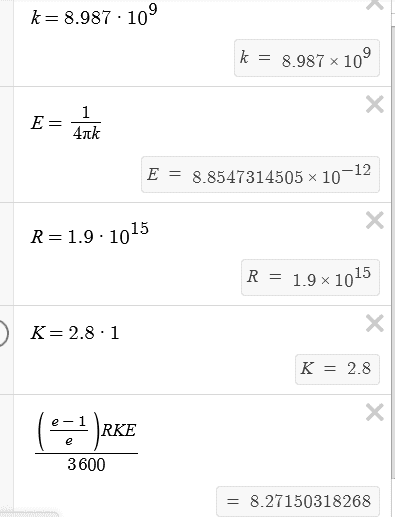
Capture.PNG

Is ##I=\Delta Q/\Delta t## a wrong assumption in this case?
 
Physics news on Phys.org
I think you could try take the limit in $$\Delta Q = \frac{Q}{\kappa \rho \varepsilon }\Delta t$$, not only, i think we need a negative sign here, otherwise
$$\Delta Q$$
would end being positive.
 
LCSphysicist said:
I think you could try take the limit in $$\Delta Q = \frac{Q}{\kappa \rho \varepsilon }\Delta t$$
Hm$$\frac{dQ}{dt}=-\frac{Q}{\kappa\epsilon_0\rho}\Leftrightarrow-\kappa\epsilon_0\rho\frac{dQ}{Q}=dt\Leftrightarrow-\kappa\epsilon_0\rho\ln\left(\frac{Q'}{Q_0}\right)=\Delta t$$with ##Q'=Q_0/e##, I get ##\Delta t=\kappa\epsilon_0\rho##.
LCSphysicist said:
i think we need a negative sign here
yep, I added that in ##Q-\Delta Q##, but not in the first formula since the question asked for the magnitude.
This is it! Thank you. :)
 

Similar threads

Replies
5
Views
3K
  • · Replies 4 ·
Replies
4
Views
2K
  • · Replies 6 ·
Replies
6
Views
3K
  • · Replies 4 ·
Replies
4
Views
1K
Replies
12
Views
2K
Replies
6
Views
1K
Replies
6
Views
1K
  • · Replies 2 ·
Replies
2
Views
2K
  • · Replies 11 ·
Replies
11
Views
2K
Replies
12
Views
2K