Curvature of Light Paths Near a Mass

  • Context: Graduate 
  • Thread starter Thread starter Sonderval
  • Start date Start date
  • Tags Tags
    Curvature Light Mass
Click For Summary

Discussion Overview

The discussion centers around the curvature of light paths near a mass, exploring the implications of spacetime geometry on the angular sums of triangles formed by light geodesics and rigid rods. Participants examine the relationship between spatial curvature and the behavior of light in the vicinity of massive objects, considering both theoretical and conceptual aspects.

Discussion Character

  • Exploratory
  • Debate/contested
  • Conceptual clarification

Main Points Raised

  • Some participants propose that space near a mass is negatively curved, suggesting that a triangle formed with rigid rods would have angles summing to less than 180°.
  • Others argue that the curvature of spacetime determines whether the angle sum is less or greater than 180°, with hyperbolic geometry leading to less than 180° and positive curvature leading to more.
  • A participant questions how the space projection of light rays from multiple stars would form a triangle and whether the angle sum would be more or less than 180°.
  • Another participant emphasizes that the net spatial curvature will be positive when including the mass in the triangle, leading to an angle sum greater than 180°.
  • There is a clarification that light paths in space are not geodesics, while light worldlines in spacetime are, and that the bending direction of spatial geodesics and light paths is the same.
  • One participant expresses uncertainty about the angular sum of space projections of geodesics around a mass, while another confirms that it will be greater than 180°.

Areas of Agreement / Disagreement

Participants express differing views on the nature of curvature near a mass and its effects on angular sums, indicating that multiple competing views remain unresolved.

Contextual Notes

Participants note that the discussion involves complex concepts of spacetime geometry and the projection of light paths, which may depend on specific definitions and assumptions about curvature.

Sonderval
Messages
234
Reaction score
11
If I understand everything correctly, space near (but outside) a mass is curved negatively, so that if I create a triangle with, for example, rigid rods and the mass in its center, the angles would sum up to less than 180°. (If I am mistaken, please correct me.)

On the other hand, the typical light-bending pictures look like this
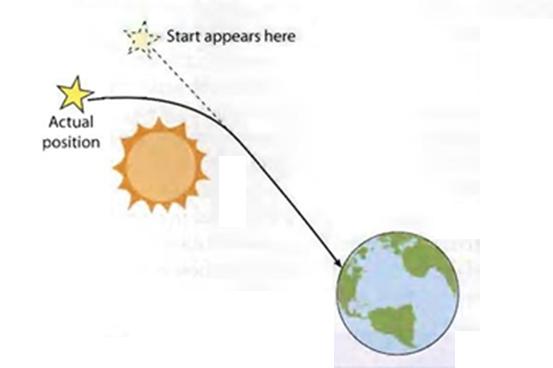
today.jpg

I do understand that the space projection of the iight geodesic does not coincide with the shortest path in space as gotten by laying out rods (this is obvious because there is a dt² in the formula for the space-time distance).

But how does the projection of the light geodesics look like, exactly? If I had three stars situated on a triangle with the mass in the middle, would the angular sum of the space projections of the geodesics be smaller or larger than 180°? From the fact that images are shifted away from the central mass, I would think that the sum has to be larger, but I'm not sure.
 
Physics news on Phys.org
I don't understand what you mean. The shortest path in spacetime is given by the geodesics (they are straight lines).
Now whether the sum of angles is less or bigger than 180 depends on the geometry of your spacetime (universe). An hyperbolic geometry (or negative curvature) would lead in less than 180 degrees, whereas in a geometry with positive curvature, it's greater than 180...
 
@ChrisVer
Imagine a second star in the lower left corner of the picture above and imagine light-rays from each star to the Earth and between the stars. Does the space projection of the light rays form a triangle with asum of more or less than 180°?
 
again I say, it depends on the curvature of the spacetime. you can't see that on such a diagram...
 
Last edited:
Sonderval said:
If I understand everything correctly, space near (but outside) a mass is curved negatively, so that if I create a triangle with, for example, rigid rods and the mass in its center, the angles would sum up to less than 180°. (If I am mistaken, please correct me.)
You are mistaken. If you include the mass in the triangle, the net spatial curvature will be positive, so a triangle made of spatial geodesics (straight rigid rods) will have an inner angle sum of more than 180°. If you keep the mass outside of the triangle, it will be lees than 180°.

Sonderval said:
I do understand that the space projection of the iight geodesic does not coincide with the shortest path in space as gotten by laying out rods (this is obvious because there is a dt² in the formula for the space-time distance).
That is important to keep in mind. The light paths in space are not geodesics. The light worldlines in space-time are geodesics. But in this case the bending direction of a spatial geodesic and light paths in space is the same.

Sonderval said:
If I had three stars situated on a triangle with the mass in the middle, would the angular sum of the space projections of the geodesics be smaller or larger than 180°? From the fact that images are shifted away from the central mass, I would think that the sum has to be larger, but I'm not sure.
This is correct, the angle sum for a light triangle around a mass will be greater than 180°.
 
Last edited:
@A.T.
Thanks a lot for clearing up my initial mistake, that was very helpful. Now it all fits together.
 

Similar threads

  • · Replies 15 ·
Replies
15
Views
2K
Replies
82
Views
6K
  • · Replies 30 ·
2
Replies
30
Views
2K
  • · Replies 8 ·
Replies
8
Views
2K
  • · Replies 20 ·
Replies
20
Views
1K
  • · Replies 14 ·
Replies
14
Views
2K
  • · Replies 20 ·
Replies
20
Views
3K
  • · Replies 51 ·
2
Replies
51
Views
7K
  • · Replies 13 ·
Replies
13
Views
3K
  • · Replies 9 ·
Replies
9
Views
2K