Curvilinear coordinate, derivative

Click For Summary
SUMMARY

The discussion centers on the properties of curvilinear coordinates, specifically addressing the relationship between tangent vectors and normal vectors to isosurfaces. The example of 2D polar coordinates is utilized, where the unit vector in the radial direction is defined as ## u_1 = r ##. It is established that the gradient vector, represented as ## \frac{\partial \mathbf{r}}{\partial r} ##, is normal to the isosurfaces of constant radius, which are circular in nature. This confirms that the gradient is perpendicular to the surfaces defined by constant values of the radial coordinate.

PREREQUISITES
  • Understanding of curvilinear coordinate systems
  • Familiarity with polar coordinates in two dimensions
  • Knowledge of vector calculus, particularly gradients
  • Ability to visualize geometric representations of mathematical concepts
NEXT STEPS
  • Study the properties of gradients in curvilinear coordinates
  • Explore the mathematical derivation of tangent and normal vectors
  • Learn about the application of curvilinear coordinates in physics
  • Investigate higher-dimensional curvilinear coordinate systems
USEFUL FOR

Students and professionals in mathematics, physics, and engineering who are working with curvilinear coordinates and vector calculus, particularly those interested in the geometric interpretation of gradients and isosurfaces.

kidsasd987
Messages
142
Reaction score
4
https://www.particleincell.com/2012/curvilinear-coordinates/
http://www.jfoadi.me.uk/documents/lecture_mathphys2_05.pdf
Hi, I have a question about the curvilineare coordinate system.
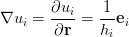
I wonder why
5Cpartial%5Cmathbf%7Br%7D%7D%3D%5Cfrac%7B1%7D%7Bh_i%7D%5Cmathbf%7Be%7D_i&bg=ffffff&fg=000000&s=0.png
is normal to the isosurfaces?isnt ei a tangent vector to the surface ui

since

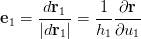
"With these definitions, we can define the unit vector in the
latex.png
direction (basis vector)"
latex.png
 
Physics news on Phys.org
It might help to look at a specific example, and 2D polar coordinates is a good one to start with. Take ## u_1 = r ## and draw a picture of ## \frac{\partial \mathbf{r}}{\partial r} ## at some point. It points radially away from the origin. Now note that surfaces of constant ## r ## are just circles centered at the origin. The gradient is indeed normal to each such surface at the appropriate points.
 

Similar threads

  • · Replies 2 ·
Replies
2
Views
2K
  • · Replies 1 ·
Replies
1
Views
2K
  • · Replies 4 ·
Replies
4
Views
2K
  • · Replies 2 ·
Replies
2
Views
3K
  • · Replies 4 ·
Replies
4
Views
2K
  • · Replies 8 ·
Replies
8
Views
3K
Replies
2
Views
3K
  • · Replies 2 ·
Replies
2
Views
2K
  • · Replies 2 ·
Replies
2
Views
2K
  • · Replies 3 ·
Replies
3
Views
2K