D'Alembertian in Sakurai's Advanced QM book

  • Context: Undergrad 
  • Thread starter Thread starter Wrichik Basu
  • Start date Start date
  • Tags Tags
    advanced Book Qm
Click For Summary
SUMMARY

The forum discussion centers on the treatment of the D'Alembertian operator in Sakurai's "Advanced Quantum Mechanics," specifically in relation to the Dirac equation presented in equation 3.31. Users highlight discrepancies in notation, particularly the use of the D'Alembertian operator as ##\partial ^\mu \partial ^\nu## instead of the conventional ##\partial ^\mu \partial _\mu##. The conversation also critiques Sakurai's reluctance to utilize the metric tensor and the outdated notation for four-vectors, suggesting that readers may find more clarity in modern texts like "Modern Quantum Mechanics." Ultimately, participants express confusion regarding Sakurai's notation and recommend considering alternative resources for a clearer understanding.

PREREQUISITES
  • Understanding of the Dirac equation and its implications in quantum mechanics.
  • Familiarity with the properties of ##\gamma## matrices and their anticommutation relations.
  • Knowledge of four-vector notation in special relativity.
  • Basic concepts of the D'Alembertian operator and its applications in quantum field theory.
NEXT STEPS
  • Study the properties and applications of the D'Alembertian operator in quantum field theory.
  • Learn about the differences between Sakurai's "Advanced Quantum Mechanics" and "Modern Quantum Mechanics."
  • Research the use of metric tensors in quantum mechanics and relativity.
  • Examine contemporary texts on quantum mechanics for updated notation and methodologies.
USEFUL FOR

Students and researchers in quantum mechanics, particularly those grappling with the Dirac equation and its notation, as well as anyone seeking clarity on the evolution of quantum mechanics texts and their notational conventions.

Wrichik Basu
Science Advisor
Insights Author
Gold Member
Messages
2,180
Reaction score
2,690
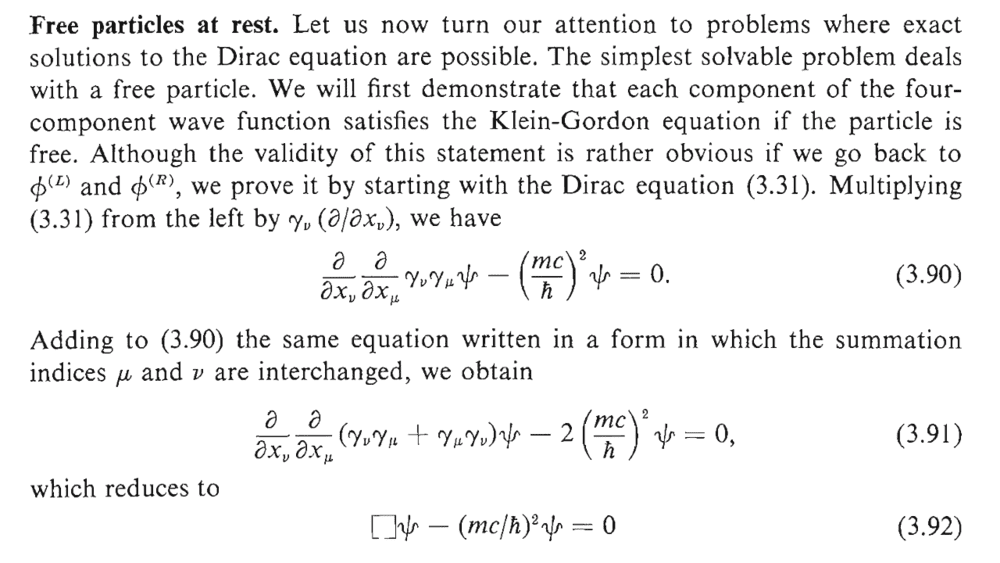
In Sakurai's book "Advanced QM", he writes the Dirac equation (equation 3.31 to be exact) as: $$\left(\gamma _\mu \ \dfrac{\partial}{\partial\ x_\mu} + \frac{m\ c}{\hbar}\right) \ \psi= 0$$ which we can write as $$\left(\gamma _\mu \ \partial ^\mu \ + \frac{m\ c}{\hbar}\right) \ \psi= 0$$

Next, we go to the section 3-3, and subsection "Free particles at rest".

The author multiples the Dirac equation from the left by ##\gamma _\nu \ \partial ^\nu##. We get the form $$\left[ \partial ^\nu \ \partial ^\mu \ \gamma_\nu \ \gamma_\mu \ - \left(\frac{m\ c}{\hbar}\right)^2 \ \right]\psi = 0$$ If we interchange the indices ##\mu## and ##\nu##, and add to the above equation, we get $$\left[ \partial ^\nu \ \partial ^\mu\ \left( \gamma_\nu \ \gamma_\mu + \gamma_\mu \ \gamma_\nu\right) \ - 2 \ \left(\frac{m\ c}{\hbar}\right)^2 \ \right]\psi = 0$$ which reduces to $$\Box \ \psi - \left(\frac{m\ c}{\hbar}\right)^2 \ \psi = 0$$ using the anticommutation relations of the ##\gamma## - matrices.

Till now, I have just quoted from the book (except changing the ##\partial / \partial x_\mu## to ##\partial ^\mu##).

I knew the D'Alembertian operator to be ##\partial ^\mu \ \partial _\mu##, but Sakurai seems to be suggesting that it is ##\partial ^\mu \ \partial ^\nu## instead. The two can be related: $$\partial _\mu \ \partial ^\mu \ = \ g_{\mu \nu} \ \partial ^\nu \ \partial ^\mu\ ,$$ but that's not what the author has written. What am I missing?

Here is a picture of the page:
Screenshot_20190602-193126.png
 
  • Like
Likes   Reactions: atyy
Physics news on Phys.org
One of the properties of ##\gamma## matrices is $$\left\{\gamma^\mu,\gamma^\nu\right\}=2g^{\mu\nu}$$
 
  • Like
Likes   Reactions: vanhees71, atyy and Wrichik Basu
Gaussian97 said:
One of the properties of ##\gamma## matrices is $$\left\{\gamma^\mu,\gamma^\nu\right\}=2g^{\mu\nu}$$
Thank you, that perfectly solves the problem.

I don't know why Sakurai is reluctant to use the metric tensor. He just writes ##\{ \gamma_\mu , \ \gamma_\nu \} = 2 \delta _{\mu \nu}##. In fact, in chapter 1, he says,
Note that we make no distinction between a covariant and a contravariant vector, nor do we define the metric tensor. These complications are absolutely unnecessary in the special theory of relativity. (It is regrettable that many textbook writers do not emphasize this elementary point.)
 
Last edited:
Well, this is possible by defining 4-vectors as ##x^\mu=(ct,ix,iy,iz)##. Then $$x^\mu x_\mu=\delta_{\mu\nu}x^{\mu}x^{\nu}=c^2t^2-x^2-y^2-z^2$$
 
  • Like
Likes   Reactions: atyy
Gaussian97 said:
Well, this is possible by defining 4-vectors as ##x^\mu=(ct,ix,iy,iz)##. Then $$x^\mu x_\mu=\delta_{\mu\nu}x^{\mu}x^{\nu}=c^2t^2-x^2-y^2-z^2$$
OK, but that's not what most other books use. At least I have learned till date ##x^\mu=(ct,x,y,z)##. I am really getting confused with the notation in this book.
 
Wrichik Basu said:
OK, but that's not what most other books use. At least I have learned till date ##x^\mu=(ct,x,y,z)##. I am really getting confused with the notation in this book.
Yes, I think nowadays using ##(t,x,y,z)## with ##c=1## is the most common way to proceed, so maybe you want to change your book... Sakurai is from 1967.
 
Gaussian97 said:
so maybe you want to change your book... Sakurai is from 1967.
Sakurai is quite a recommended book, that's why I started reading it. But I'll not continue with this book any longer.
 
Well, I've never read Sakurai's book, but it's true it has a lot of popularity. You need to think if it's worth for you. Maybe you can start with something else and then return to Sakurai when you think you'll be able to be comfortable with the notation.
 
  • Like
Likes   Reactions: Wrichik Basu
Wrichik Basu said:
Sakurai is quite a recommended book, that's why I started reading it. But I'll not continue with this book any longer.

Sakurai has written (at least) two different books, "Advanced Quantum Mechanics" and "Modern Quantum Mechanics". I have seen both books recommended, but I have seen "Modern Quantum Mechanics" recommended much more often than "Advanced Quantum Mechanics".

"Modern Quantum Mechanics" is probably the text used most often in North America for graduate quantum mechanics courses.
 
  • Like
Likes   Reactions: Wrichik Basu
  • #10
Wrichik Basu said:
OK, but that's not what most other books use. At least I have learned till date ##x^\mu=(ct,x,y,z)##. I am really getting confused with the notation in this book.

It is old notation for special relativity. It doesn't carry over (as far as I know) into general relativity. You can see an example of the change of notation from SR to GR also in 't Hooft's notes http://www.staff.science.uu.nl/~hooft101/lectures/genrel_2013.pdf.
 
  • Like
Likes   Reactions: Wrichik Basu
  • #11
Advanced Quantum Mechanics is a bit old-fashioned. One reason is the use of imaginary components to describe four-vectors.
 
  • Like
Likes   Reactions: Wrichik Basu

Similar threads

  • · Replies 0 ·
Replies
0
Views
1K
  • · Replies 3 ·
Replies
3
Views
2K
  • · Replies 1 ·
Replies
1
Views
1K
  • · Replies 3 ·
Replies
3
Views
2K
  • · Replies 5 ·
Replies
5
Views
1K
  • · Replies 24 ·
Replies
24
Views
3K
  • · Replies 15 ·
Replies
15
Views
2K
  • · Replies 1 ·
Replies
1
Views
2K
  • · Replies 14 ·
Replies
14
Views
3K
  • · Replies 8 ·
Replies
8
Views
6K