Definition of transmission & reflection in TE/TM

Click For Summary

Discussion Overview

The discussion revolves around the definitions of reflection and transmission coefficients in transverse electric (TE) and transverse magnetic (TM) modes. Participants explore the differences in how these coefficients are defined for magnetic and electric fields, questioning the consistency of these definitions and their implications in optics.

Discussion Character

  • Debate/contested
  • Technical explanation
  • Conceptual clarification

Main Points Raised

  • Some participants question why the reflection coefficient is defined only by the parallel component of the magnetic field for TE modes and the electric field for TM modes, while the transmission coefficient includes the whole component.
  • There is a suggestion that the subscript "t" in the transmission coefficient stands for "transmitted" rather than "total," but this interpretation is debated.
  • One participant notes that the transmitted vector retains the same polarization as the incident vector, asserting that there is no discrepancy in the definitions.
  • Another participant expresses confusion over the definitions being inconsistent, particularly regarding the dependence of polarization on angles of incidence and transmission.
  • Participants discuss the relevance of the z-direction being perpendicular to the interface and how this relates to the boundary conditions of Maxwell's equations.
  • There is mention of the Kirchhoff Fresnel relations and their established presence in textbooks, suggesting that the derivations should be free of ambiguity.
  • Some participants propose that the definitions of reflection and transmission coefficients could yield the same results if approached differently, but this remains a point of contention.

Areas of Agreement / Disagreement

Participants do not reach a consensus on the definitions of the reflection and transmission coefficients, with multiple competing views and ongoing confusion about their consistency and implications.

Contextual Notes

Participants highlight limitations in the provided material, noting that the definitions may not be adequately explained and that the derivations could lead to misunderstandings. There is also mention of potential discrepancies in the author's approach compared to standard texts.

Dimani4
Messages
50
Reaction score
0
Hi,
I have a question in definition of reflection/transmission coefficients in TE/TM modes.
Let's see TE polarization case.
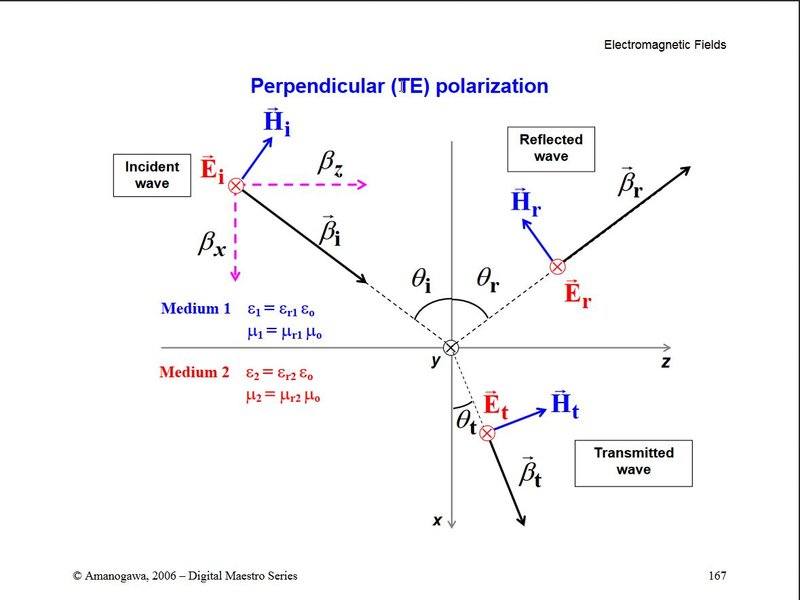
TE polarization.jpg

The reflection coefficient for the magnetic field is defined as:

Refl_H.jpg

However the transmission coefficient for the magnetic field is defined as:
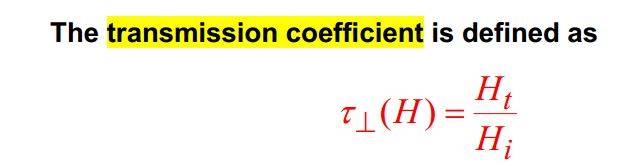
Transm_H.jpg

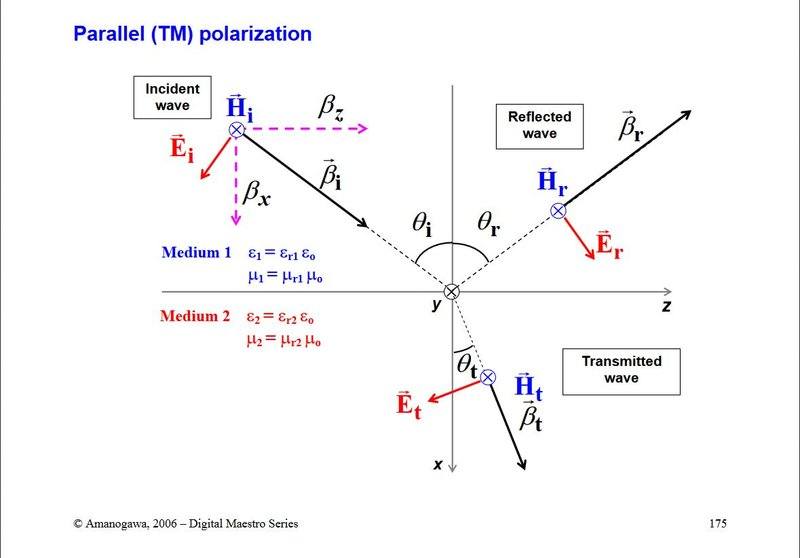
Now, let's see the TM mode.
TM polarization.jpg

Here, transmission coefficient for electric field is defined as:

Transm_E_TM.jpg

And the reflection coefficient is defined as;

Refl_E_TM.jpg

My question is: why the reflection coefficient is defined the only by the parallel component of the magnetic (Hz for TE) and electric field (Ez for TM) but the transmission coefficient is defined by the whole component (Et/Ei or Ht/Hi of the electric/magnetic field?

Thank you.

The pictures are taken from the attached pdf file (EM13).
 

Attachments

  • TE polarization.jpg
    TE polarization.jpg
    28.5 KB · Views: 3,665
  • Refl_H.jpg
    Refl_H.jpg
    12.5 KB · Views: 1,599
  • Transm_H.jpg
    Transm_H.jpg
    9.7 KB · Views: 1,364
  • TM polarization.jpg
    TM polarization.jpg
    26.7 KB · Views: 2,659
  • Transm_E_TM.jpg
    Transm_E_TM.jpg
    9.7 KB · Views: 1,262
  • Refl_E_TM.jpg
    Refl_E_TM.jpg
    11 KB · Views: 1,420
  • EM13.pdf
    EM13.pdf
    341.5 KB · Views: 992
Science news on Phys.org
If I understood your question properly, the subscript ## t ## which you think may stand for "whole" or "total" stands for "transmitted" rather than "total".
 
Charles Link said:
If I understood your question properly, the subscript ## t ## which you think may stand for "whole" or "total" stands for "transmitted" rather than "total".
Yes, the subscript here means transmitted but also a total. Check it out the pdf file I've attached (for instance page 180 for TM).
 
Dimani4 said:
Yes, the subscript here means transmitted but also a total. Check it out the pdf file I've attached (for instance page 180 for TM).
The transmitted vector has the same polarization as the incident vector. There isn't any discrepancy here. I have been through this material quite a number of times, (the first time in an optics course in approximately 1976), and I have never observed anything anomalous about it.
 
Charles Link said:
The transmitted vector has the same polarization as the incident vector. There isn't any discrepancy here. I have been through this material quite a number of times, (the first time in an optics course in approximately 1976), and I have never observed anything anomalous about it.
you can't say it. take a look for example the polarization for H in the TE case or polarization of E in the TM case. Their polarization is dependent for the angles of incidence (θi) and transmission (θt). My confusion or "misunderstanding" is why the definition for transmission and reflection coefficient is different.
 
Dimani4 said:
you can't say it. take a look for example the polarization for H in the TE case or polarization of E in the TM case. Their polarization is dependent for the angles of incidence (θi) and transmission (θt). My confusion or "misunderstanding" is why the definition for transmission and reflection coefficient is different.
Please try to explain the difficulty you are having in more detail. I don't see any problem with the equations.
 
Charles Link said:
Please try to explain the difficulty you are having in more detail. I don't see any problem with the equations.
Let's take TE case.
The reflection coefficient for magnetic field is defined as :
Refl_H.jpg

Transmission coefficient is:
Transm_H.jpg

My question is why reflection coefficient is not Γ(H)=Hr/Hi but Hzr/Hzi or vise a versa why transmission coefficient is not τ(H)=Hzt/Hzi but Ht/Hi ? I see that the definitions here are not consistent.

Thank you.
 

Attachments

  • Refl_H.jpg
    Refl_H.jpg
    12.5 KB · Views: 921
  • Transm_H.jpg
    Transm_H.jpg
    9.7 KB · Views: 899
Just giving a quick answer, (I may study this in more detail, but I think I may have picked out the point of confusion), the z-direction is the direction perpendicular to the interface for these optics problems, while y is the transverse direction. In one of the boundary conditions of Maxwell's equations, ## \nabla \times E=-\frac{\partial{B}}{\partial{t}} ##, the y-component is involved in the derivation, while for the equation ## \nabla \cdot E=0 ##, only the z-component is needed. I'll look at this in more detail if this doesn't answer your question, but I'm thinking it might suffice.
 
Charles Link said:
Just giving a quick answer, (I may study this in more detail, but I think I may have picked out the point of confusion), the z-direction is the direction perpendicular to the interface for these optics problems, while y is the transverse direction. In one of the boundary conditions of Maxwell's equations, ## \nabla \times E=-\frac{\partial{B}}{\partial{t}} ##, the y-component is involved in the derivation, while for the equation ## \nabla \cdot E=0 ##, only the z-component is needed. I'll look at this in more detail if this doesn't answer your question, but I'm thinking it might suffice.
Thank you for your quick response but here I guess z is transverse to the incidence plane (z actually is in this plane), y is perpendicular to this plane and as x is also perpendicular as you can see here;
12.jpg


Please explain it in more details because I never paid attention on this point till now... :)
 

Attachments

  • 12.jpg
    12.jpg
    19.7 KB · Views: 1,421
  • #10
Dimani4 said:
Thank you for your quick response but here I guess z is transverse to the incidence plane and x is perpendicular as you can see here;
View attachment 220214

Please explain it in more details because I never paid attention on this point till now... :)
I looked at the "link"=yes, they have an odd choice of ## z ##. My guess is that most everything else they did was correct, and you can read through their derivation and see if it makes sense. Alternatively, try reading another source on the same topic. It would take a while for me to go through this author's write-up in detail, but this topic, in general, has never presented any major problems of any kind. If it is problematic, it is likely that is is due to this particular author rather than the concept itself.
 
  • #11
Charles Link said:
I looked at the "link"=yes, they have an odd choice of ## z ##. My guess is that most everything else they did was correct, and you can read through their derivation and see if it makes sense. Alternatively, try reading another source on the same topic. It would take a while for me to go through this author's write-up in detail, but this topic, in general, has never presented any major problems of any kind. If it is problematic, it is likely that is is due to this particular author rather than the concept itself.
yes. the derivations of the formulas are right but they didn't explain why these definitions (transmission and reflection coefficients) are not consistent. the coefficients are also right but I still don't understand (they say "we can define". you can't say "we can define" because this coefficient you can measure and the definition of the reflection coefficient is the reflected field/incidence field and nothing more.)
Anyway, they didnt explain why for reflection you take only the transverse field but for transmission you take the whole field. do you have any idea?

Actually if you do Hr/Hi you have the same coefficient as they get but without minus sign i.e. Eyr/Eyi but it really odd because you have the same reflection coefficient for electric and magnetic field (TE case page 173).
Thank you.
 
Last edited:
  • #12
The boundary conditions are generally of the form ## E_i +E_r=E_t ##. etc. Suggest you try reading through a derivation of normal incidence before doing the more complex case. I haven't studied this author's derivation sufficiently to really comment on it, but if it is written up properly, there really should be no ambiguity. ## \\ ## The Kirchhoff Fresnel relations are written up in many textbooks including J.D. Jackson's Classical Electrodynamics, where I studied them in detail as a graduate student. Thousands upon thousands of students have read through these derivations, and I believe they are free of errors. ## \\ ## Since it is in the same material, and the ratio of electric field to magnetic field is the same for the transverse electromagnetic wave, (other than a possible minus sign), you will get the same reflection coefficient for electric field as you do for the magnetic field.
 
Last edited:
  • #13
Charles Link said:
The boundary conditions are generally of the form ## E_i +E_r=E_t ##. etc. Suggest you try reading through a derivation of normal incidence before doing the more complex case. I haven't studied this author's derivation sufficiently to really comment on it, but if it is written up properly, there really should be no ambiguity. ## \\ ## The Kirchhoff Fresnel relations are written up in many textbooks including J.D. Jackson's Classical Electrodynamics, where I studied them in detail as a graduate student. Thousands upon thousands of students have read through these derivations, and I believe they are free of errors. ## \\ ## Since it is in the same material, and the ratio of electric field to magnetic field is the same for the transverse electromagnetic wave, (other than a possible minus sign), you will get the same reflection coefficient for electric field as you do for the magnetic field.

yes, I understand the tangential boundary conditions for electric field as for the magnetic field. ## H_i +H_r=H_t ## but still the question of reflection and transmission coefficient definition still remains. This pdf file presents very good detailed analysis for the TE and TM case but this point is not so clear, like the author doesn't want to focus on this specific point. I'm not saying that this is an error I say I have some misunderstanding.
 

Similar threads

  • · Replies 1 ·
Replies
1
Views
1K
  • · Replies 4 ·
Replies
4
Views
18K
  • · Replies 10 ·
Replies
10
Views
3K
  • · Replies 2 ·
Replies
2
Views
5K
  • · Replies 0 ·
Replies
0
Views
1K
Replies
3
Views
3K
  • · Replies 8 ·
Replies
8
Views
75K
  • · Replies 1 ·
Replies
1
Views
2K
  • · Replies 1 ·
Replies
1
Views
2K
  • · Replies 1 ·
Replies
1
Views
4K