Deflection of wave in dissipative media with a complex refractive index

Click For Summary
SUMMARY

The discussion centers on the deflection of a monochromatic plane wave with a wavelength of 500µm as it transitions from a dissipative medium with a complex refractive index of 1-0.0002i to free space. The participants analyze the implications of Snell's Law and the role of the complex refractive index in determining the wave's behavior at the boundary. It is concluded that the angle of deflection is primarily influenced by the real part of the refractive index, with the imaginary part having minimal impact on the boundary conditions. The conversation highlights differing interpretations of the refraction process, particularly regarding the Descartes-Snell law.

PREREQUISITES
  • Understanding of Snell's Law in optics
  • Familiarity with complex refractive indices
  • Knowledge of wave propagation in dissipative media
  • Basic principles of monochromatic plane waves
NEXT STEPS
  • Research the application of Snell's Law in complex media
  • Explore the implications of complex refractive indices on wave propagation
  • Study the Descartes-Snell law of refraction in detail
  • Investigate experimental methods to measure wave deflection in dissipative media
USEFUL FOR

Students and professionals in optics, physicists studying wave behavior in complex media, and researchers interested in the practical applications of refractive index in optical systems.
Tinaaaaaa
Messages
7
Reaction score
2

Homework Statement


A monochromatic plane wave with wavelength 500µm is propagating through a dissipative medium with refractive index 1-0.0002i. It approaching the edge of the medium, and will pass out into free space. If the angle of incidence is not 90°, how much will the wave deflect as it passes out into free space?

Homework Equations


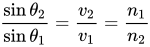
Snell's Law:
b5a73124df21668801a4d20054bb1b13f6709752


The Attempt at a Solution


The refractive index of free space would be 1-0*i so so far I have 1-0.0002i/1. But I don't know how to find the angles.
 
Physics news on Phys.org
I haven't previously worked this type of problem, even though I have an Optics background, but I can give you a couple of inputs to it. In a medium with complex ## n ##, the wave will propagate as ## E=E_o e^{i( n_r k_o x-\omega t)} e^{-n_i k_o x} ##. I don't think the ## e^{-n_i k_o x } ## factor will affect the boundary value conditions that determine which direction the wavefront emerges when it encounters a boundary. I think that is simply determined by ## n_r ##. If my inputs are indeed correct, the answer to this problem, for which ## n_r=1 ##, should be obvious.
 
  • Like
Likes Tinaaaaaa
Charles Link said:
I haven't previously worked this type of problem, even though I have an Optics background, but I can give you a couple of inputs to it. In a medium with complex ## n ##, the wave will propagate as ## E=E_o e^{i( n_r k_o x-\omega t)} e^{-n_i k_o x} ##. I don't think the ## e^{-n_i k_o x } ## factor will affect the boundary value conditions that determine which direction the wavefront emerges when it encounters a boundary. I think that is simply determined by ## n_r ##. If my inputs are indeed correct, the answer to this problem, for which ## n_r=1 ##, should be obvious.
Thank you this makes a lot of sense
 
  • Like
Likes Charles Link
Tinaaaaaa said:
Thank you this makes a lot of sense
A google of this question shows there seems to be a couple of different schools of thought on the subject. There are a couple of postings that talk about the Descartes-Snell law of refraction, but there are other postings that interpret it exactly like I did. I leave the question open to further discussion, but I don't know that there is a definitive answer to this one that everyone will agree upon. ## \\ ## Unless ## n_i ## is considerably greater than ## 0 ##, it may be difficult to experimentally verify any result that would show ## n_i ## could cause some effect, but if ## n_i ## gets to be significant, the wave doesn't propagate very far through the material.
 

Similar threads

Replies
2
Views
1K
Replies
1
Views
2K
Replies
12
Views
1K
  • · Replies 1 ·
Replies
1
Views
2K
Replies
3
Views
2K
  • · Replies 1 ·
Replies
1
Views
3K
  • · Replies 1 ·
Replies
1
Views
948
  • · Replies 17 ·
Replies
17
Views
2K
  • · Replies 1 ·
Replies
1
Views
1K
  • · Replies 11 ·
Replies
11
Views
3K