Discussion Overview
The discussion centers around the potential contributions of the early universe's density to the redshift observed in distant galaxies. Participants explore various aspects of this relationship, including the implications of spacetime metric tensors, gravitational potential, and the nature of redshift in the context of General Relativity.
Discussion Character
- Exploratory
- Technical explanation
- Debate/contested
- Conceptual clarification
Main Points Raised
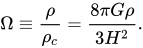
- Some participants question whether the relative density of the early universe contributes to the redshift of distant galaxies and seek to understand how this could be calculated.
- One participant argues that the density of the universe decreasing is essentially a reflection of its expansion, suggesting that attributing redshift to density change may be circular reasoning.
- Another participant asserts that the early universe's matter density was too low to have a measurable effect on redshift, emphasizing that redshift is primarily due to the universe's expansion.
- There is a discussion about the nature of gravitational potential in non-stationary spacetimes, with one participant stating that defining gravitational potential in such contexts does not make sense.
- Participants explore different conceptual frameworks for understanding cosmological redshift, including the expansion of wavelengths, energy conservation in photon gases, and perspective effects from moving observers.
- One participant raises a question about whether the heuristic arguments regarding photon pressure could apply to ordinary matter, noting differences in how energy densities change with expansion.
- Another participant clarifies that while the momentum of ordinary particles also redshifts, the relationship between massless particles and their energy is fundamentally different.
Areas of Agreement / Disagreement
Participants express differing views on the relationship between the early universe's density and redshift, with no consensus reached. Some argue for a connection, while others assert that redshift is primarily a result of expansion, not density differences.
Contextual Notes
Participants acknowledge the complexity of redshift calculations in General Relativity, noting that these calculations do not simply aggregate contributions from different effects like Doppler or gravitational redshift.


 Not sure what I read that I misunderstood so badly.