patric44
- 308
- 40
- Homework Statement
- derive Child-Langmuir law
- Relevant Equations
- I = k V^(3/2)
hi guys
i was trying to understand the derivation of the child Langmuir law that govern the current flow between the two plates of vacuum tubes
and saw this derivation online :
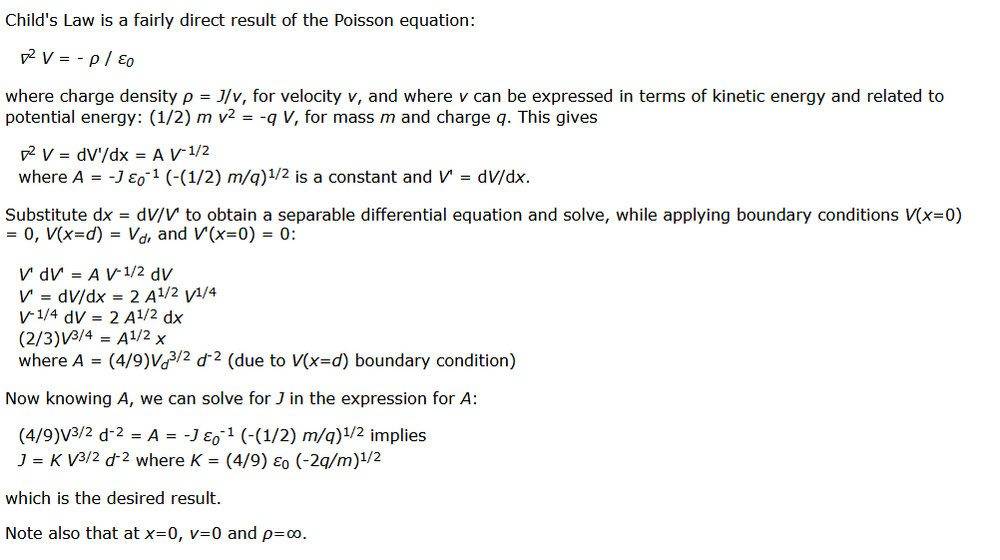
and i am stuck at couple of points :
when i saw the derivation it seem like a direct application of the Poisson's equation :
$$\nabla^{2}\phi = \frac{-\rho}{\epsilon_{o}}$$
in which ##\phi## is the potential between the two plates , i guess he will calculate the potential at the plate related to the charge density that has been collected by the anode which had come directly from the flow of the current density from the cathode ? is that right .
that a little diagram i draw that illustrate what i mean :
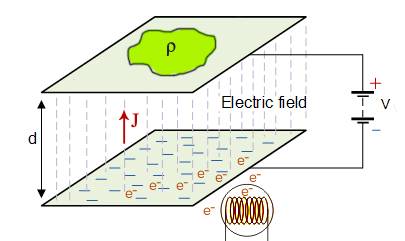
1) a little dump question : how the electron coming from the filament will be collected by the anode when its near the negative cathode shouldn't it be repealed .
.
2) the equation ##V' = 2A^{1/2}V^{1/4}## doesn't have an integration constant , and if i introduced a constant after the integration i need to the take the square root for the ##V'## it will get complicated .
i was trying to understand the derivation of the child Langmuir law that govern the current flow between the two plates of vacuum tubes
and saw this derivation online :
and i am stuck at couple of points :
when i saw the derivation it seem like a direct application of the Poisson's equation :
$$\nabla^{2}\phi = \frac{-\rho}{\epsilon_{o}}$$
in which ##\phi## is the potential between the two plates , i guess he will calculate the potential at the plate related to the charge density that has been collected by the anode which had come directly from the flow of the current density from the cathode ? is that right .
that a little diagram i draw that illustrate what i mean :
1) a little dump question : how the electron coming from the filament will be collected by the anode when its near the negative cathode shouldn't it be repealed
.2) the equation ##V' = 2A^{1/2}V^{1/4}## doesn't have an integration constant , and if i introduced a constant after the integration i need to the take the square root for the ##V'## it will get complicated .
 .
.