Derive The Transfer Function from First Principles

Click For Summary
SUMMARY

The discussion focuses on deriving the Transfer Function of a circuit using first principles, specifically for a course in Signal Analysis. Participants emphasize the importance of basic circuit analysis, including series and parallel combinations, and suggest using general impedances for simplification. The recommended approach involves applying Kirchhoff's Current Law (KCL) to a three-node voltage divider problem and substituting actual impedances afterward. Additionally, Khan Academy is highlighted as an effective resource for learning basic circuit concepts in under five hours.

PREREQUISITES
  • Basic circuit analysis concepts
  • Understanding of series and parallel combinations
  • Familiarity with Kirchhoff's Current Law (KCL)
  • Knowledge of impedance in electrical circuits
NEXT STEPS
  • Study the derivation of Transfer Functions in electrical circuits
  • Learn about Kirchhoff's Laws and their applications in circuit analysis
  • Explore the concept of impedance in AC circuits
  • Complete the basic circuits course on Khan Academy
USEFUL FOR

Electrical engineering students, circuit designers, and anyone interested in mastering the derivation of Transfer Functions and basic circuit analysis techniques.

optically challenged
Messages
4
Reaction score
0
All,

I need help deriving the Transfer Function of this circuit from first principles.
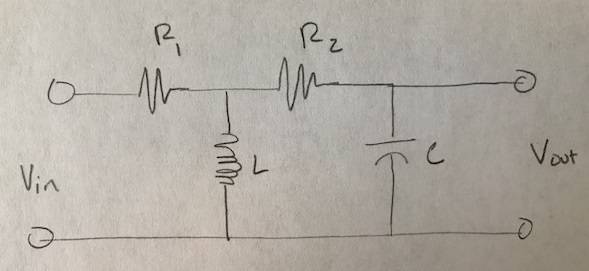
24v3z9s.jpg

http://i66.tinypic.com/24v3z9s.jpg
 
Engineering news on Phys.org
Do you consider Ohm's Law first principle ?
 
anorlunda said:
Do you consider Ohm's Law first principle ?
Yes
 
Ok, have you learned about basic circuit analysis, series and parallel combinations?

If this is homework, it should be posted in the homework forum and use the template.
 
In short, No. No intro of circuit analysis and parallel/series combinations. Basically given this with one previous example and told to go figure it out. This is for a course in Signal Analysis.

Thanks Anorlunda, I will post it there.
 
Simplest way to attack this (i.e. how I would attack a similar problem at work).

1. Replace all devices with a general impedance (call it, for example, Z, so R1 = Z1, R2 = Z2, L = Z3, C = Z4.)
2. Solve the now trivial three-node voltage divider problem using KCL.
3. Replace all the Zs with their actual impedences (e.g. Z1 = R1, Z2 = R2, Z3 = sL, Z4 = 1/sC)
4. Simplify the expression and you're done!
 
That's not nice for the teacher to give you that problem without the proper background.

If you are only interested in this problem, use @analogdesign 's advice in post #6. But basic circuits is something you'll surely need in your career. It is worth your time to learn it. A very effective and fast way to learn is using Khan Academy. It takes less than 5 hours there to learn a whole basic circuits course.

https://www.khanacademy.org/science/physics/circuits-topic#circuits-resistance
 
Schoolwork thread in the EE forum is closed.
 

Similar threads

  • · Replies 30 ·
2
Replies
30
Views
5K
  • · Replies 1 ·
Replies
1
Views
3K
Replies
11
Views
3K
  • · Replies 10 ·
Replies
10
Views
2K
Replies
1
Views
1K
  • · Replies 20 ·
Replies
20
Views
2K
  • · Replies 5 ·
Replies
5
Views
2K
  • · Replies 16 ·
Replies
16
Views
2K
  • · Replies 3 ·
Replies
3
Views
2K
Replies
2
Views
3K