Discussion Overview
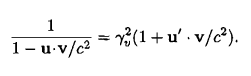
The discussion revolves around deriving equation 4.8 from earlier equations in Steane's "Relativity made relatively easy." Participants explore various methods and approaches to achieve this derivation, focusing on the relationships between different equations and the manipulation of terms.
Discussion Character
- Exploratory
- Technical explanation
- Mathematical reasoning
- Homework-related
Main Points Raised
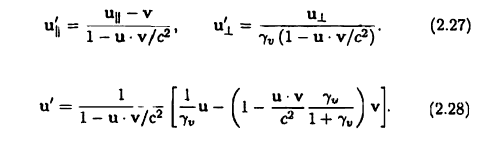
- One participant expresses difficulty in deriving equation 4.8 using earlier equations 2.27 and 2.28, seeking an easier method.
- Several participants suggest expanding both sides of equation 4.8 and working in a basis where a specific direction is parallel to a vector.
- There is a suggestion to find a middle equation by working from both the starting and target equations to facilitate the derivation.
- Another participant notes that the restriction against manipulating the right-hand side (RHS) of equation 4.8 may stem from a desire to derive it without prior knowledge of its form.
- One participant emphasizes that understanding the RHS of equation 4.8 could aid in the derivation process, suggesting that expanding it might reveal necessary steps.
- A participant mentions the importance of considering the relative velocity of the moving frame when discussing parallel and perpendicular components of vectors.
- Another participant provides a straightforward approach starting from a specific equation involving the dot product of vectors.
Areas of Agreement / Disagreement
Participants do not reach a consensus on the best approach to derive equation 4.8, with multiple competing views on how to proceed. Some participants advocate for expanding the equation, while others prefer to derive it directly from earlier equations without manipulating the RHS.
Contextual Notes
Participants express uncertainty regarding the form of the RHS of equation 4.8 and the implications of various restrictions on the derivation process. There are also unresolved questions about the best method to align the equations for a successful derivation.