Deriving equation of wave motion

Join the discussion
Ask a follow-up here, or get your own question answered by working scientists, mathematicians and engineers — people, not an autocomplete.
Real named experts · corrections over time · the nuance an AI answer skips
1 reply · 5K views
Pushoam
Messages
961
Reaction score
53
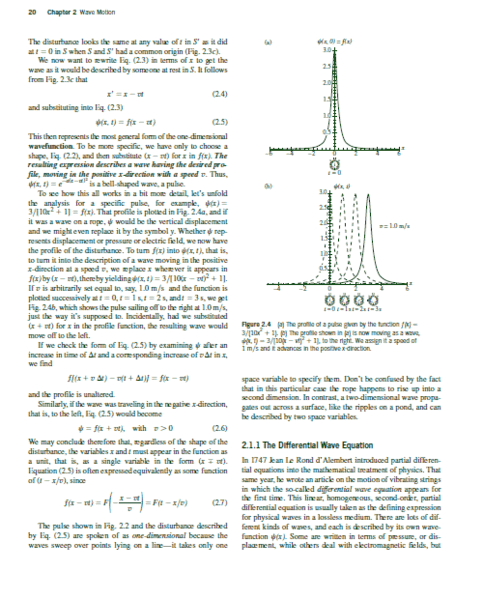
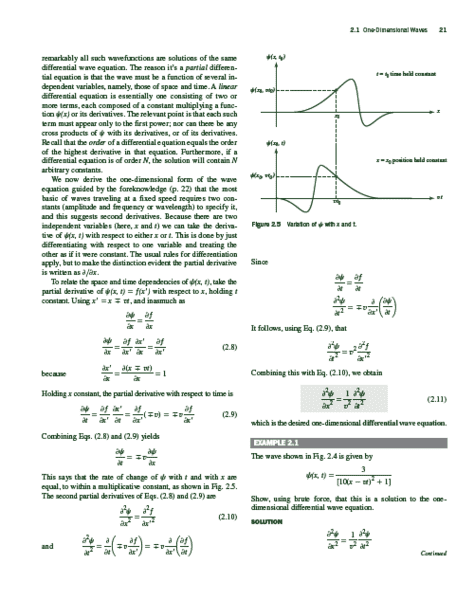
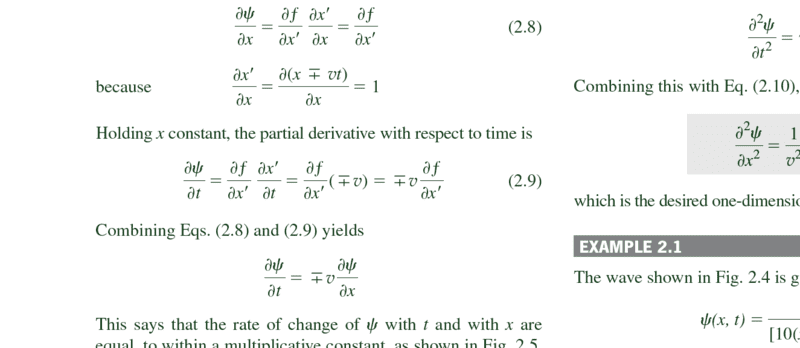
The equation below (2.9) is also a linear differential equation.
This equation also describes the wave phenomena.
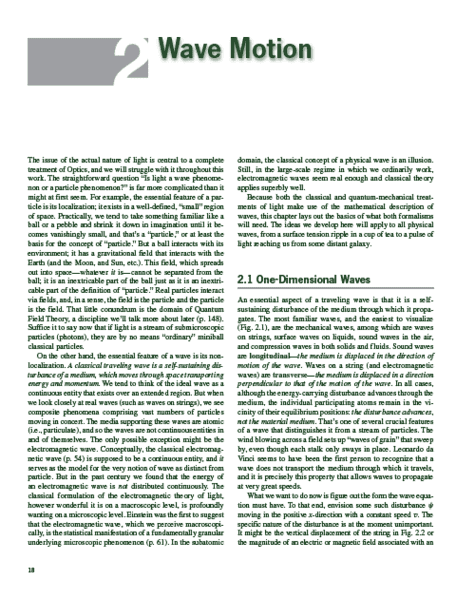
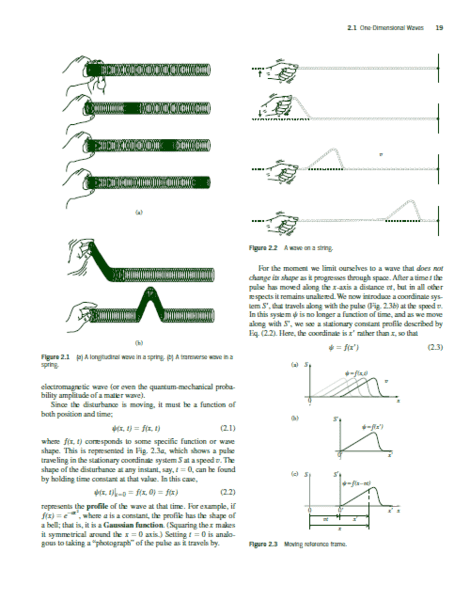
So, why is this equation not considered as wave equation?
I have taken it from the optics book by Chapter two Eugene Hecht,5th edition ,Pearson.
upload_2017-5-28_17-56-55.png


upload_2017-5-28_17-50-0.png
upload_2017-5-28_17-50-39.png
upload_2017-5-28_17-51-8.png
upload_2017-5-28_17-51-45.png

391fdd9f-40f6-4648-874e-37d04b73169a
 
Last edited:
Physics news on Phys.org
I must say that this is the worst derivation of the D'Alambert equation I've ever seen. It's simple but seems to describe any differentiable function. It is true that "wave" is a really general concept, in fact there are many different kind of waves and many different equation describing them, but it's not like anything is a wave!
Anyway, as the text say on page 21, you need at least a second order differential equation to describe a wave since it has in the simplest case an amplitude and a frequency, so two parameters which requires two conditions.