Sinking Object Motion Equations

Click For Summary

Discussion Overview

The discussion revolves around the derivation of equations related to the motion of a sinking object in fluid dynamics, specifically focusing on the forces acting on the object, including gravity, buoyancy, and viscous resistance. Participants seek to understand the mathematical proof behind the velocity equation and its relation to time, terminal velocity, and initial velocity, as well as the derivation of the distance equation.

Discussion Character

  • Exploratory
  • Technical explanation
  • Mathematical reasoning

Main Points Raised

  • One participant expresses confusion about the derivation of the velocity equation from the net force equation, seeking clarification on whether it is based on mathematical proof or trial and error.
  • Another participant points out that the net force equation leads to a differential equation and references a solution discussed in a specific section of a resource.
  • A participant proposes an alternative method of derivation using a second-order linear differential equation, questioning its applicability and seeking validation of this approach.
  • Subsequent replies clarify that the proposed method results in an equation involving the first derivative of distance rather than distance itself, suggesting that the integration process is necessary to obtain the distance.

Areas of Agreement / Disagreement

Participants do not reach a consensus on the best method for deriving the equations, as there are multiple approaches discussed, and some participants challenge the applicability of certain methods without resolving the disagreement.

Contextual Notes

The discussion includes unresolved assumptions about the definitions of terms and the specific forms of the equations being derived. There is also a lack of clarity on the initial conditions and parameters involved in the equations.

Johnnnnnnnn
Messages
8
Reaction score
0
Hi guys! I am currently learning about fluid dynamics, and I am stuck on a certain equation derivation. It's about sinking motion which considers only gravity force, buoyant force, and viscous resistance. The link attached has the details.

http://hyperphysics.phy-astr.gsu.edu/hbase/lindrg.html#c2
The problem I have is how the equation for velocity was found. I understand that Fnet = mg - pVg - bv, which is basically net force = weight - buoyant force - viscous resistance, but I don't get how the velocity (equation below) was derived in terms of time, terminal velocity (Vt), and initial velocity (V0).
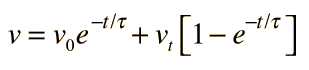
viscf4d.gif


Is there a mathematical proof for this? Or was the equation created based on trial and error? If you could, could you also please explain how the equation for distance (image below) was also obtained? Thanks!

viscf4e.gif
.
 
Physics news on Phys.org
Hello Joh8n,

The Newton equation of motion ##F_{\rm net} = mg'- bv ## is a differential equation
(##F_{\rm net} = {dv\over dt} ##)

The solution is discussed here (6.4.10 onwards; they don't express in terms of ##v_0## and ##v_t##, but I hope you can follow the reasoning)
 
  • Like
Likes   Reactions: Johnnnnnnnn
Oh I see... Thanks for the help!
 
BvU said:
Hello Joh8n,

The Newton equation of motion ##F_{\rm net} = mg'- bv ## is a differential equation
(##F_{\rm net} = {dv\over dt} ##)

The solution is discussed here (6.4.10 onwards; they don't express in terms of ##v_0## and ##v_t##, but I hope you can follow the reasoning)

So after seeing the derivation of sinking motion, I was wondering if this method of derivation is also correct.

Since ##F_{\rm net} = ma = mg'- bv ##,
##a = g' - (b/m)v##

From here, could I set a = d2y/ dt2, and v = dy/dt, letting y be the vertical distance the object travels, and use second order linear differential equation to solve it?

So in another words, (using y' as the notation for dy/dt)

y'' = g - (b/m) y'
y'' + (b/m)y' = g

Would solving for y with this second order linear differential equation be a correct way to solve for y? If not, could you also please explain why such way is not applicable? Thanks!
 
It's still an equation in y', not in y ...
 
But I thought second order linear differential equations are in the form of y'' + p(x)y' + q(x)y = g(x), where q(x) would be 0 in this case. I'm guessing you mean that it's unnecessary to change v into y' as it just complicates the calculation?
 
Correct. You have an equation where y does not appear, but y' does. So you solve for y' and then integrate once to get y.
 

Similar threads

  • · Replies 6 ·
Replies
6
Views
4K
  • · Replies 15 ·
Replies
15
Views
3K
  • · Replies 13 ·
Replies
13
Views
2K
  • · Replies 11 ·
Replies
11
Views
2K
  • · Replies 5 ·
Replies
5
Views
5K
  • · Replies 35 ·
2
Replies
35
Views
5K
  • · Replies 48 ·
2
Replies
48
Views
5K
  • · Replies 20 ·
Replies
20
Views
3K
  • · Replies 5 ·
Replies
5
Views
2K
  • · Replies 18 ·
Replies
18
Views
3K