Deriving Magnetic Field of Two Parallel Wires on the X-Axis

Click For Summary
SUMMARY

The discussion centers on deriving the magnetic field (B) produced by two parallel wires carrying currents in opposite directions. The correct expression for the magnitude of B at any point on the x-axis is derived using the formula B = (μ₀I)/(π√(a²+x²)), where μ₀ is the permeability of free space, I is the current, and a is the distance from the wires to the x-axis. The direction of the magnetic field is determined using the right-hand rule, resulting in a net field that has only an x-component due to the cancellation of the y-components from each wire.

PREREQUISITES
  • Understanding of the right-hand rule for magnetic fields
  • Familiarity with the Biot-Savart Law
  • Knowledge of vector addition in physics
  • Basic trigonometry for calculating angles and components
NEXT STEPS
  • Study the Biot-Savart Law for magnetic fields around current-carrying conductors
  • Learn about vector components and how to resolve them in physics problems
  • Explore the concept of superposition in electromagnetic fields
  • Investigate the effects of varying current directions on magnetic fields
USEFUL FOR

Students of physics, electrical engineers, and anyone interested in understanding electromagnetic theory and applications related to current-carrying conductors.

ovoleg
Messages
93
Reaction score
0
Hello guys. I just had a question about the below problem. I am not sure if this is right but more likely it is wrong. I have been trying this problem for an extensive period of time now. If anyone could help out I would greatly appreciate it.

Following the dashed lines I showed the work that I did to solve this.

Question: Figure below is an end view of two long, parallel wires perpendicular to the xy-plane. Each carries a current I, but in opposite directions. (X means into the mage and the dot is out of the page).

Derive the expression for the magnitude of B at any point on the x-axis in terms of the x-coordinate of the point. What is the direction of B?
Click on this link to view the picture I copied.
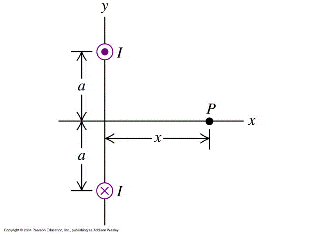
38648?db=v4net.gif
--------

This is what I tried~~~

By right hand rule the vector would be upward and both of the magnetic fields from the two wires will add.

The field due to a long, straight, current-carrying conductor is B=mu_0I/2(pi)r where r is the distance from the wire to the point P.

The distance there is r=sqrt(a^2+x^2) from both conductors. By using superposition and adding vectors we can find the field B.

Thus Btotal=B1+B2

B1=Mu_0*I/(2*pi*sqrt(a^2+x^2))
B2=Mu_0*I/(2*pi*sqrt(a^2+x^2))

B1+B2= 2*Mu_0*I/(2*pi*sqrt(a^2+x^2))
B1+B2= Mu_0*I/(pi*sqrt(a^2+x^2))

Is this not correct?
 
Last edited:
Physics news on Phys.org
ovoleg said:
Hello guys. I just had a question about the below problem. I am not sure if this is right but more likely it is wrong. I have been trying this problem for an extensive period of time now. If anyone could help out I would greatly appreciate it.

Following the dashed lines I showed the work that I did to solve this.

Question: Figure below is an end view of two long, parallel wires perpendicular to the xy-plane. Each carries a current I, but in opposite directions. (X means into the mage and the dot is out of the page).

Derive the expression for the magnitude of B at any point on the x-axis in terms of the x-coordinate of the point. What is the direction of B?
Click on this link to view the picture I copied.

38648?db=v4net.gif


--------

This is what I tried~~~

By right hand rule the vector would be upward and both of the magnetic fields from the two wires will add.

The field due to a long, straight, current-carrying conductor is B=mu_0I/2(pi)r where r is the distance from the wire to the point P.

The distance there is r=sqrt(a^2+x^2) from both conductors. By using superposition and adding vectors we can find the field B.

Thus Btotal=B1+B2

B1=Mu_0*I/(2*pi*sqrt(a^2+x^2))
B2=Mu_0*I/(2*pi*sqrt(a^2+x^2))

B1+B2= 2*Mu_0*I/(2*pi*sqrt(a^2+x^2))
B1+B2= Mu_0*I/(pi*sqrt(a^2+x^2))

Is this not correct?
Your magnitudes are ok but the directions you give are wrong. The B fields produced by each wire at point P is *not* upward. You have to use a certain version of the right hand rule (with now the thumb pointing in the direction of the current and your hand curling around the wire, showing the direction of the B field ). For the top wire for example, the B field at P will be somewhere in the first quadrant (draw a circle centered around the wire and at point P the B field must be tangent to the circle, pointing in a direction in the first quadrant (if a was equal to x, the B field would be pointing straight northeast). Likewise, the B field produced by the lower wire at point P is somewhere in the fourth quadrant (would be straight southeast if a was equal to x).

It's hard to explain without a blackboard!
 
nrqed said:
Your magnitudes are ok but the directions you give are wrong. The B fields produced by each wire at point P is *not* upward. You have to use a certain version of the right hand rule (with now the thumb pointing in the direction of the current and your hand curling around the wire, showing the direction of the B field ). For the top wire for example, the B field at P will be somewhere in the first quadrant (draw a circle centered around the wire and at point P the B field must be tangent to the circle, pointing in a direction in the first quadrant (if a was equal to x, the B field would be pointing straight northeast). Likewise, the B field produced by the lower wire at point P is somewhere in the fourth quadrant (would be straight southeast if a was equal to x).

It's hard to explain without a blackboard!

Thanks! The field would then point along the +x axis using the right hand rule.

I am trying to use the answer that I got for magnitude and my system does not accept Mu_0*I/(pi*sqrt(a^2+x^2)) for the magnitude of the field at point P.
Is it possible I made an error in the calculation? Thanks!
 
Last edited:
ovoleg said:
I see what you are saying let me try it right now and see what I get. I understand the thumb must point in the direction that the current is flowing which is toward me on the higher wire and toward the page on the lower wire.

One sec
Right...and because the currents are identical and the distances are the same, you should see that the *y* component of the two B fields cancel out exactly in this problem, leaving only an *x* component (the final result will therefore be that the total B field at P has only an x component which is equal to twice the x component of the B field of one wire)
 
nrqed said:
Right...and because the currents are identical and the distances are the same, you should see that the *y* component of the two B fields cancel out exactly in this problem, leaving only an *x* component (the final result will therefore be that the total B field at P has only an x component which is equal to twice the x component of the B field of one wire)
Thanks, also
Still unable to solve the part with the magnitude though, it seems that it might be wrong, maybe I am missing something important
 
Last edited:
ovoleg said:
Thanks, also
magcur.gif

Shows a nice diagram that we can visualize the circles and tangent magnetic fields

Still unable to solve the part with the magnitude though, it seems that it might be wrong, maybe I am missing something important
nice drawing.

But did you calculate the x component of each B field and added them up together? You need to do that!

It's really hard to explain without a drawing, but let's say you look at the B field produced by the top wire at P. It is pointing in the first quadrant, right? Now, it makes an angle with the x axis. You will have to mulitply your magnitude of B by the cos of that angle.

Now, if you draw a line from the top wire to point B, you should be able to convince yourself that the angle between that line and a vertical line is the same as the angle between the B field and the x axis. Then, using trigonometry, you can figure out the cos of that angle
 
Last edited by a moderator:
nrqed said:
nice drawing.

But did you calculate the x component of each B field and added them up together? You need to do that!

It's really hard to explain without a drawing, but let's say you look at the B field produced by the top wire at P. It is pointing in the first quadrant, right? Now, it makes an angle with the x axis. You will have to mulitply your magnitude of B by the cos of that angle.

Now, if you draw a line from the top wire to point B, you should be able to convince yourself that the angle between that line and a vertical line is the same as the angle between the B field and the x axis. Then, using trigonometry, you can figure out the cos of that angle

So B1 will actually B1cos(theta) in which case will be

B=mu*I/(2*pi*r)*a/(sqrt(x^2+a^2)
and thus

B1+B2 = mu*I*a/(pi*(x^2+a^2)

? Still not there :(
 
Last edited:
ovoleg said:
So B1 will actually B1cos(theta) in which case will be

B=mu*I/(2*pi*r)*a/(sqrt(x^2+a^2)
and thus

B1+B2 = mu*I*a/(pi*(x^2+a^2)

? Still not there :(
What is the correct answer?? This looks right to me
 
nrqed said:
What is the correct answer?? This looks right to me

That one seemed to do the trick. Thanks a lot for all your help! :biggrin: :) :) :)
 
  • #10
ovoleg said:
That one seemed to do the trick. Thanks a lot for all your help! :biggrin: :) :) :)
Great! You are welcome.

(btw, it is always nice to check some limits in expressions like those...as a goes to zero, you can expect from the figure that the B field will go to zero and that agreea with the expression. As x goes to zero, you expect the two B field to be parallel and in the x direction so that the total B field will be twice the magnitude of each wire, and that also checks out)

Regards


Patrick
 

Similar threads

Replies
11
Views
4K
Replies
3
Views
600
Replies
5
Views
1K
Replies
6
Views
1K
  • · Replies 3 ·
Replies
3
Views
1K
  • · Replies 6 ·
Replies
6
Views
699
Replies
3
Views
3K
  • · Replies 3 ·
Replies
3
Views
2K
Replies
25
Views
3K
Replies
2
Views
1K