Deriving the Voltage Equation: Using Kinematics to Show V=(mv^2/2q)

  • Context: MHB 
  • Thread starter Thread starter Mango12
  • Start date Start date
  • Tags Tags
    Voltage
Click For Summary
SUMMARY

The discussion focuses on deriving the voltage equation V=(mv^2/2q) using principles of kinematics and electric fields. The key steps involve recognizing that the work done on a charged particle by an electric field is equal to its kinetic energy. Specifically, when a particle of charge q is accelerated by an electric field E over a distance Δx, the work done (W) is expressed as W = FΔx, where F=qE. This leads to the conclusion that V = (mv^2)/(2q) when equating work to kinetic energy.

PREREQUISITES
  • Understanding of electric fields and forces (F=qE)
  • Knowledge of kinetic energy formula (U_k = 1/2 mv^2)
  • Familiarity with the concept of work done (W = FΔx)
  • Basic principles of kinematics
NEXT STEPS
  • Study the relationship between electric fields and potential energy
  • Learn about the motion of charged particles in electric fields
  • Explore the derivation of energy conservation principles in electric systems
  • Investigate the role of mass and charge in particle acceleration
USEFUL FOR

Students and professionals in physics, electrical engineering, and anyone interested in understanding the relationship between electric fields and particle dynamics.

Mango12
Messages
48
Reaction score
0
Knowing that V=E(delta x), show that V=(mv^2/2q)

I think I have to use kinematics and substitute some things but I'm not sure
 
Mathematics news on Phys.org
Mango12 said:
Knowing that V=E(delta x), show that V=(mv^2/2q)

I think I have to use kinematics and substitute some things but I'm not sure
There is a lot more to the question than you posted. Do you have a particle in a mass-selector or velocity selector? I'm trying to figure out where the kinetic energy term comes from in V=(mv^2/2q).

-Dan
 
topsquark said:
There is a lot more to the question than you posted. Do you have a particle in a mass-selector or velocity selector? I'm trying to figure out where the kinetic energy term comes from in V=(mv^2/2q).

-Dan

Well, the problem involves xenon. One mole of xenon is .131kg and one atom is 2.2*10^-25 kg. And velocity is 2.7*10^4 m/s if that helps.

He wants us to show that V=(mv^2/2q) is true, so I don't know if he wants us to set them equal to each other or...how else would I prove it is true?
 
Mango12 said:
Well, the problem involves xenon.
Please post the whole question, not just what it involves. You still haven't given enough information!

-Dan
 
topsquark said:
Please post the whole question, not just what it involves. You still haven't given enough information!

-Dan

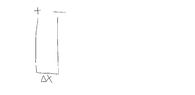
One mole of xenon is .131kg and a single atom of xenon is 2.2*10^-25 kg. It is traveling 2.7*10^4 m/s. Using the diagram and knowing that voltage=E(delta x), show that voltage=mv^2/2q

View attachment 5411
 

Attachments

  • docu.png
    docu.png
    2.8 KB · Views: 122
Mango12 said:
One mole of xenon is .131kg and a single atom of xenon is 2.2*10^-25 kg. It is traveling 2.7*10^4 m/s. Using the diagram and knowing that voltage=E(delta x), show that voltage=mv^2/2q

Hi Mango12,

When a particle of charge $q$ is accelerated by an electric field $E$, the electric force is $F=qE$.
When traversing a distance $\Delta x$ the work done is $W = F\Delta x$ (if the force is constant).
That work is equal to the kinetic energy $U_k = \frac 12 m v^2$ that the particle gains (assuming it starts from a speed of about zero).

So we have:
$$W = U_k \quad\Rightarrow\quad F\Delta x = \frac 12 m v^2
\quad\Rightarrow\quad qE\Delta x =\frac 12 m v^2
\quad\Rightarrow\quad qV =\frac 12 m v^2
\quad\Rightarrow\quad V =\frac {m v^2}{2q}
$$
 
I like Serena said:
Hi Mango12,

When a particle of charge $q$ is accelerated by an electric field $E$, the electric force is $F=qE$.
When traversing a distance $\Delta x$ the work done is $W = F\Delta x$ (if the force is constant).
That work is equal to the kinetic energy $U_k = \frac 12 m v^2$ that the particle gains (assuming it starts from a speed of about zero).

So we have:
$$W = U_k \quad\Rightarrow\quad F\Delta x = \frac 12 m v^2
\quad\Rightarrow\quad qE\Delta x =\frac 12 m v^2
\quad\Rightarrow\quad qV =\frac 12 m v^2
\quad\Rightarrow\quad V =\frac {m v^2}{2q}
$$

This makes a lot of sense. Thank you! I understand it a lot better now.
 

Similar threads

Replies
4
Views
2K
  • · Replies 5 ·
Replies
5
Views
734
Replies
4
Views
3K
Replies
28
Views
2K
  • · Replies 3 ·
Replies
3
Views
1K
  • · Replies 11 ·
Replies
11
Views
5K
  • · Replies 59 ·
2
Replies
59
Views
5K
  • · Replies 49 ·
2
Replies
49
Views
4K
  • · Replies 1 ·
Replies
1
Views
2K
  • · Replies 20 ·
Replies
20
Views
2K