Design a Crank Mechanism: Solutions & Equations

Click For Summary
SUMMARY

This discussion focuses on the design of a crank mechanism, specifically addressing the equations related to piston motion. The equation l² = r² + x² - 2*r*x*cos(A) is confirmed as correct for calculating the length of the crank, where x represents the maximum stroke of the piston. The user clarifies that the total stroke is indeed 2*r, and provides a method for calculating the piston position using trigonometric relationships involving the crank angle A. The discussion emphasizes the importance of understanding these equations for accurate crank mechanism design.

PREREQUISITES
  • Understanding of crank mechanisms and their components
  • Familiarity with trigonometric functions and their applications
  • Knowledge of piston motion equations
  • Basic mechanical engineering principles
NEXT STEPS
  • Study the derivation of piston motion equations in crank mechanisms
  • Explore the application of trigonometry in mechanical design
  • Learn about the dynamics of crank and slider mechanisms
  • Investigate simulation tools for modeling crank mechanisms
USEFUL FOR

Mechanical engineers, students in mechanical design courses, and anyone involved in the design and analysis of crank mechanisms will benefit from this discussion.

TheRedDevil18
Messages
406
Reaction score
2
I want to design a crank mechanism. I found this page on Wikipedia
https://en.wikipedia.org/wiki/Piston_motion_equations
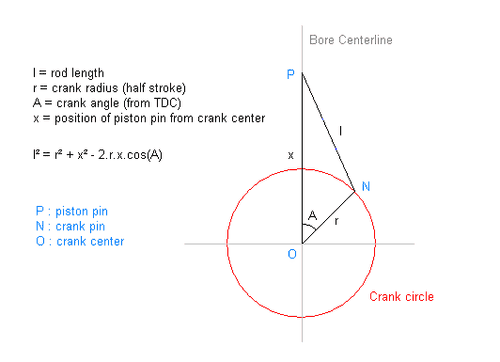
500px-Piston_motion_geometry.png


Relating from this diagram, is x the max stroke of the piston ?, or is it PO-(max stroke of piston) ?

And why is l^2 = r^2 + x^2 - 2*r*x*cos(A)

Shouldn't it be, l^2 = r^2 + OP^2 - 2*r*OP*cos(A) ?
 
Engineering news on Phys.org
Total stroke is 2*r. There are a couple of ways to calculate piston position (the position of the center of the piston wrist pin, to be more precise). A common one is to use a perpendicular from the stroke line to form two right triangles. The length of that perpendicular is r*sin A. So the piston is at (r*cos A) + [l^2-(r*sin a)^2]^0.5. When angle A is zero the position is (l+x). When angle A is 180 deg the position is (l-x).

If you look further down in the Wikipedia article you will find the equation above.
 
Last edited:

Similar threads

  • · Replies 6 ·
Replies
6
Views
5K
Replies
7
Views
3K
Replies
9
Views
2K
  • · Replies 30 ·
2
Replies
30
Views
20K
  • · Replies 2 ·
Replies
2
Views
3K
  • · Replies 26 ·
Replies
26
Views
9K
  • · Replies 1 ·
Replies
1
Views
2K
  • · Replies 1 ·
Replies
1
Views
10K
  • · Replies 1 ·
Replies
1
Views
5K