etf
- 179
- 2
Hi!
I want to design DC power supply 12V 2A. Here is what I have done.
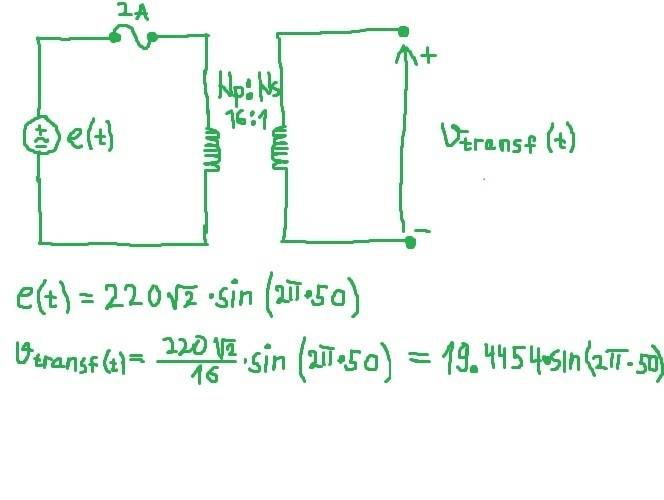
Firstly, we need to transform AC main voltage. I will use transformer with ratio Np:Ns=16:1 :
We must choose diodes with maximum forward current more than 2 amperes. I will choose UG8JTHE3/45.. This diode has maximum forward current 8A and maximum reverse voltage 600V, Is=1.0025^(-12)A, Emission Coefficient n=1.74999 (according to Multisim model).
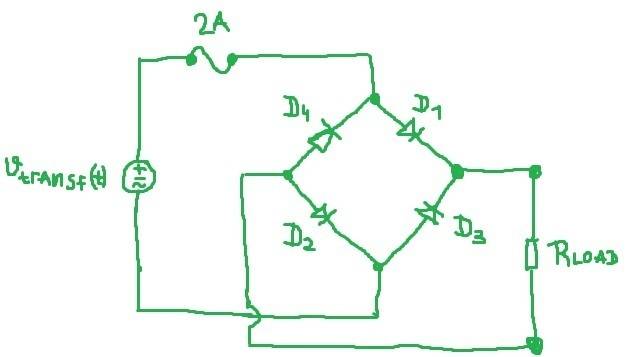
Let's analyse circuit in case e(t)>0. I will not analyse case e(t)<0 since everything is same as in this case (only difference is of course that two other diodes conducts). In this case D1 and D2 are on, while D3 and D4 are off:
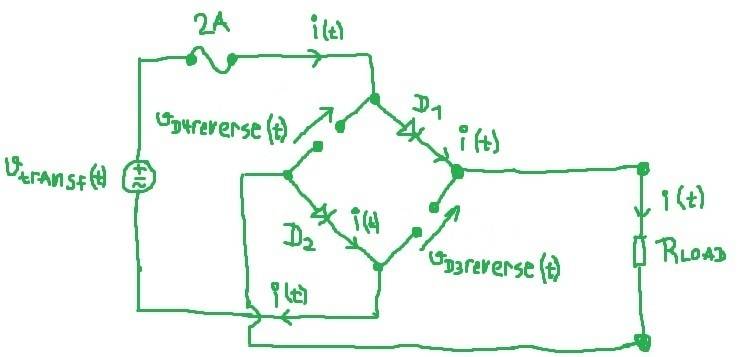
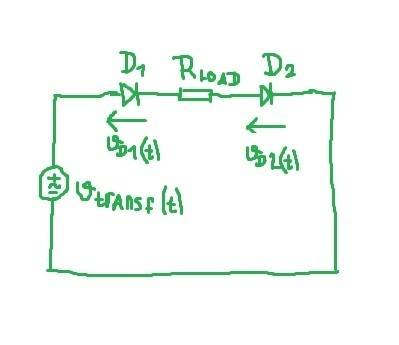
Diodes D1 and D2 are same, same current flow through them so voltages across them are also same.
Since we want to calculate maximum (peak) value of voltage on diodes and peak value of power on diodes, peak value of power on transformer's secondary and lowest value of passive load we can connect on our power supply, we solve this circuit:
VD1max=VD2max=VDmax
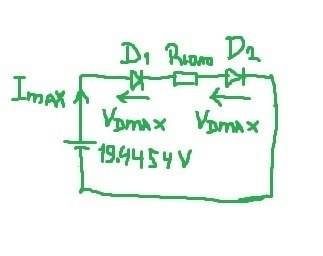
I_m_a_x=I_s(e^{\frac{V_D_m_a_x}{nV_t}}-1)...(1)
V_D_m_a_x=\frac{1}{2}(19.4454-2R_l_o_a_d)...(2)
If we put (2) in (1) we get:
2=1.0025*10^{-12}(e^{\frac{19.4454-2R_l_o_a_d}{2*1.74999*0.02589}}-1)(Vt=0.0258 at temperature 27 degrees Celsius).
If we solve this nonlinear equation in Matlab, we get Rload=8.4395Ohms. This would be lowest passive load value we can connect to our supply. So when Rload=8.4395Ohms, peak value of current in circuit is Imax=2A. In that case, peak value of voltage across diodes will be VDmax=(1/2)*(19.4454-2*8.4395)=1.2832V. When voltage at transformer's output is at peak value 19.4454V and current is 2A, power that is dissipated is Ptransf.max=19.44542*2=38.8908W. For everything to work fine, we should choose some transformer with higher power rating than this. PIV (peak inverse voltage) on diodes is: PIV=Rload*Imax+VDmax=18.1622V<<600V.
Peak value of power on diodes is PD1max=PD2max=PD3max=PD4max=VDmax*Imax=1.2832V*2A=2.5664W.
Output voltage will pulsate from 0v to Imax*Rload=2A*8.4395Ohms=16.8790V.
My calculations match with Multisim. What do you think? What power rating should transformer have exactly? Maybe 50W?
It is necessary now to smooth pulsating voltage. What is best way to do this? Would it be enough to use just one capacitor and one voltage regulator?
Thanks in advance
I want to design DC power supply 12V 2A. Here is what I have done.
Firstly, we need to transform AC main voltage. I will use transformer with ratio Np:Ns=16:1 :
We must choose diodes with maximum forward current more than 2 amperes. I will choose UG8JTHE3/45.. This diode has maximum forward current 8A and maximum reverse voltage 600V, Is=1.0025^(-12)A, Emission Coefficient n=1.74999 (according to Multisim model).
Let's analyse circuit in case e(t)>0. I will not analyse case e(t)<0 since everything is same as in this case (only difference is of course that two other diodes conducts). In this case D1 and D2 are on, while D3 and D4 are off:
Diodes D1 and D2 are same, same current flow through them so voltages across them are also same.
Since we want to calculate maximum (peak) value of voltage on diodes and peak value of power on diodes, peak value of power on transformer's secondary and lowest value of passive load we can connect on our power supply, we solve this circuit:
VD1max=VD2max=VDmax
I_m_a_x=I_s(e^{\frac{V_D_m_a_x}{nV_t}}-1)...(1)
V_D_m_a_x=\frac{1}{2}(19.4454-2R_l_o_a_d)...(2)
If we put (2) in (1) we get:
2=1.0025*10^{-12}(e^{\frac{19.4454-2R_l_o_a_d}{2*1.74999*0.02589}}-1)(Vt=0.0258 at temperature 27 degrees Celsius).
If we solve this nonlinear equation in Matlab, we get Rload=8.4395Ohms. This would be lowest passive load value we can connect to our supply. So when Rload=8.4395Ohms, peak value of current in circuit is Imax=2A. In that case, peak value of voltage across diodes will be VDmax=(1/2)*(19.4454-2*8.4395)=1.2832V. When voltage at transformer's output is at peak value 19.4454V and current is 2A, power that is dissipated is Ptransf.max=19.44542*2=38.8908W. For everything to work fine, we should choose some transformer with higher power rating than this. PIV (peak inverse voltage) on diodes is: PIV=Rload*Imax+VDmax=18.1622V<<600V.
Peak value of power on diodes is PD1max=PD2max=PD3max=PD4max=VDmax*Imax=1.2832V*2A=2.5664W.
Output voltage will pulsate from 0v to Imax*Rload=2A*8.4395Ohms=16.8790V.
My calculations match with Multisim. What do you think? What power rating should transformer have exactly? Maybe 50W?
It is necessary now to smooth pulsating voltage. What is best way to do this? Would it be enough to use just one capacitor and one voltage regulator?
Thanks in advance
Last edited: