Pulsated DC Chopper with Inductive load

  • Thread starter Thread starter dasunx
  • Start date Start date
  • Tags Tags
    Dc Load
Click For Summary

Discussion Overview

The discussion centers on the design and troubleshooting of a pulsated DC chopper circuit with an inductive load. Participants explore issues related to waveform generation, component selection, and measurement techniques, focusing on achieving a specific output waveform across the inductor coil.

Discussion Character

  • Technical explanation
  • Debate/contested
  • Experimental/applied

Main Points Raised

  • One participant questions how to eliminate oscillatory components from the output waveform.
  • Another participant notes that to achieve a square wave across the inductor, a sawtooth current must be supplied, which requires a high resistance source.
  • A third participant seeks clarification on the inductor value, suggesting that the inductor's reactance at the switching frequency may be critical for achieving the desired waveform.
  • Suggestions include replacing the inductor with a resistor matching its reactance and checking for potential issues with long leads, power supply limitations, and oscilloscope connections.
  • Additional recommendations involve adding a capacitor across the power supply to reduce impedance and using a resistor in parallel with the inductor to dampen oscillations.
  • Concerns are raised about the oscilloscope's measurement setup, particularly regarding how the probe connections may affect the displayed voltage readings.

Areas of Agreement / Disagreement

Participants express various viewpoints on how to achieve the desired output waveform, with no consensus reached on the best approach or solution. Multiple competing suggestions and methods are presented, indicating ongoing debate and exploration of the topic.

Contextual Notes

Participants highlight potential limitations in their measurements and setups, including assumptions about component values, the impact of lead lengths, and the oscilloscope's configuration. These factors may influence the accuracy of the observed waveforms.

dasunx
Messages
1
Reaction score
0
TL;DR
Pulsated DC Chopper with Inductive load
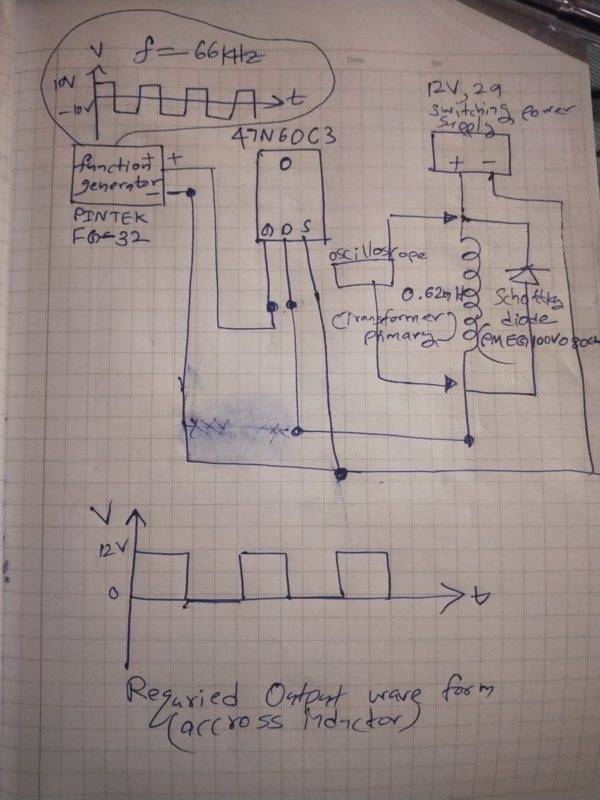
Circuit Diagram
WhatsApp Image 2019-09-21 at 11.06.59 PM.jpeg

Components USED

1. MOSFET ( 47N60C3 ) (https://www.infineon.com/dgdl/Infin...n.pdf?fileId=db3a304412b407950112b42dff93492f)
2. Primary Transformer Coil
3.12V. 2A Switching Power Supply
4.function generator ( currently using 66kHz frequency)
5.oscilloscope
6. Schottky Diode ( PMEG100V060ELPD ) (https://assets.nexperia.com/documents/data-sheet/PMEG100V060ELPD.pdf )

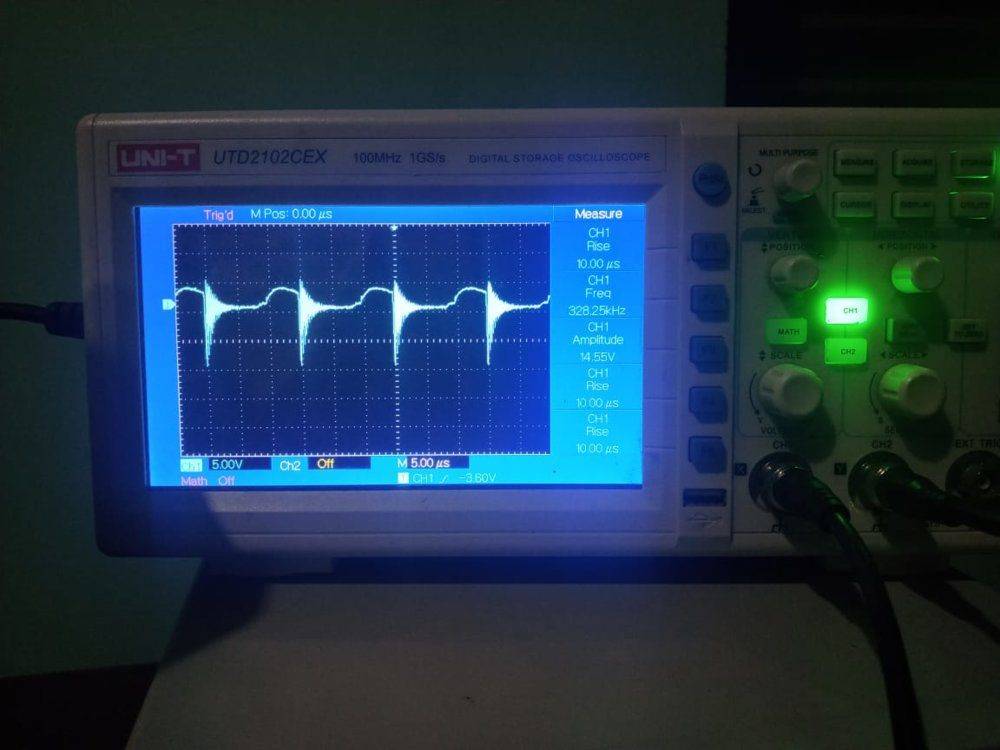
oscilloscope output
WhatsApp Image 2019-09-21 at 11.06.59 PM (4).jpeg

The required output is mentioned with the circuit diagram.

Questions
1.how to remove the oscillatory part of output?
2. how to get full 12v across the Inductor coil?
3.any other possible ways to achieve the above mentioned required waveform across the inductor coil

Extra components Available,
extra 2 of 12v,2A power supply
 
Engineering news on Phys.org
The voltage across an inductor is equal to - dI/dt. So if you want a square wave you need to supply a sawtooth current. This requires a high resistance source.
On the other hand, if you intend to have square wave drive and a resistive load across the inductor, this must have a resistance low enough so that the time constant, L/R, is several cycles.
 
  • Like
Likes   Reactions: dasunx
I can't quite read the inductor value, is it 0.62mH or 0.62nH or 0.62uH?

Based on what the inductor value is, try replacing it with a resistor whose value matches the inductor reactance at the 66kHz switching frequency and see what waveforms you get. Keep the rest of the connections just the same as they were for the photos you posted. Anything other than a nice clean squarewave indicates an instrumentation or equipment problem.

I did a quick evaluation based on 0.62mH, here are some areas to look at:
1) There are long leads between the inductor and the clamping diode
2) The Power Supply may not be able to keep up with the 66kHz varying load
3) The connections to the 'scope are not directly at the inductor

Cheers,
Tom
 
  • Like
Likes   Reactions: dasunx and NascentOxygen
Add a 0.1uF cap across the power supply terminals to lower its impedance.
To soak up that low-energy oscillation, try a resistor parallel to the inductor, maybe 4.7 MΩ, though the oscillations may actually be attributable to the oscilloscope leads.

As Tom.G pointed out, your oscilloscope connections may not be displaying the inductor voltage alone. If you connect the probe to the "bottom" of the inductor, and the oscilloscope's Earth to the common ground, then it will display inductor voltage + the supply's DC voltage, the latter merely constituting a DC offset (if stable).
 
  • Like
Likes   Reactions: dasunx

Similar threads

  • · Replies 9 ·
Replies
9
Views
4K
Replies
5
Views
3K
Replies
3
Views
2K
  • · Replies 13 ·
Replies
13
Views
16K
  • · Replies 12 ·
Replies
12
Views
4K
  • · Replies 7 ·
Replies
7
Views
10K
  • · Replies 8 ·
Replies
8
Views
11K
  • · Replies 4 ·
Replies
4
Views
2K
  • · Replies 10 ·
Replies
10
Views
7K
  • · Replies 7 ·
Replies
7
Views
2K