Designing a Tapered Scissor Arm: Challenges & Solutions

  • Thread starter Thread starter DaveC426913
  • Start date Start date
  • Tags Tags
    Arm
Click For Summary
SUMMARY

The discussion centers on the design challenges of creating a tapered scissor arm, emphasizing that the maximum extensibility is dictated by the smallest arm segment. Participants conclude that tapering is ineffective since larger arms do not extend beyond the smallest arm's limit. Suggestions include altering the geometry of the arm segments and considering different materials like titanium or carbon fiber for enhanced strength. The conversation also touches on the potential for using fusiform designs to improve performance.

PREREQUISITES
  • Understanding of mechanical design principles
  • Familiarity with materials science, particularly regarding strength and flexibility
  • Knowledge of geometric scaling and its implications in design
  • Experience with CAD software for prototyping designs
NEXT STEPS
  • Research the properties of carbon fiber and titanium for structural applications
  • Explore geometric scaling techniques in mechanical design
  • Investigate fusiform design principles and their applications in engineering
  • Learn about the use of PMMA (Poly(methyl methacrylate)) in structural designs
USEFUL FOR

Mechanical engineers, product designers, and hobbyists interested in advanced structural design and material optimization for projects involving scissor arms or similar mechanisms.

DaveC426913
Gold Member
2025 Award
Messages
24,235
Reaction score
8,351
TL;DR
Is it geometrically possible to have an extensible scissor arm that tapers from large to small?
This is what I am calling an extensible scissor arm:
1620340693884.png

This one is symmetrical - the same breadth along this entire length. I'd like to design one that narrows from one end to the other.

I realize that will change the geometry of each section - they will get shorter and shorter - but is it doable?

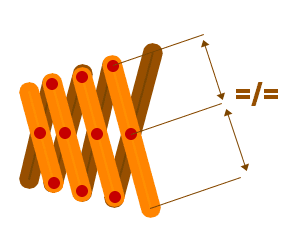
When I imagined it in my head, it was fairly straightforward - a simple incremental scaling-down of the parts, as well as moving each central pivot asymmetrically:
1620342010364.png
But the moment I started sketching it out, it became quite a bit more complicated. The lengths of each spar are not a simple relationship - the scaling factor is shared between left and right (orange and brown) spars in a way that is not immediately apparent. I'll have to experiment, but I'm sort of going by trial and error.I have a gut feeling that the problem I will run into is that the extension amount will be "conserved" from left to right - i.e. a small extension at the right will propagate to form a large extension on the left (like a wave breaking on a sloping beach). The left end will reach its extension limit long before the right end will, meaning its extensibility will be wasted (overengineered).EDIT: Yeah. The more I think about it, the more I see that the maximum extensibility is determined by the smallest arm. Any arms larger than the smallest are wasted. Which is why there's no such thing as a tapered scissor arm.

I'd still be interested in feedback, in case there's a way out of this trap I have not divined yet.
 
Last edited:
Engineering news on Phys.org
A tapered scissor arm may have members scaled in width along the taper. The individual members will not necessarily have the hinge point hole in the exact centre, so extension may also be tapered.
 
  • Like
Likes   Reactions: hutchphd
Baluncore said:
A tapered scissor arm may have members scaled in width along the taper. The individual members will not necessarily have the hinge point hole in the exact centre, so extension may also be tapered.
Yes, as I noted. But it is irrelevant. The idea is dead-on-arrival.

"The maximum extensibility is determined by the smallest arm. Any arms larger than the smallest are wasted."

It means tapering is pointless.

An arm that is (say) 6 inches wide at the base and (say) two inches wide at the tip will not extend any further than an arm that is two inches wide at base and tip.

The reason is because once the tip has reached its own maximum extension, no part of the arm - no matter how wide or long - can extend any further than it already has. Thus, anything wider than 2 inches is wasted.
 
Last edited:
Before I totally close the book on this, I'm exploring one other possibility.

Giving some curve to the component armlets changes the game:
1620360318270.png

Notice how the left end's range is comparable to the right end's range.
 
Baluncore said:
The individual members will not necessarily have the hinge point hole in the exact centre, so extension may also be tapered.
That is what changes the game and makes it possible.
 
  • Like
Likes   Reactions: hutchphd
Baluncore said:
That is what changes the game and makes it possible.
Ill take another look.
 
No it is not possible. Stupid question.
 
Miloje said:
No it is not possible. Stupid question.
Really? I must be hallucinating the one I just built then...
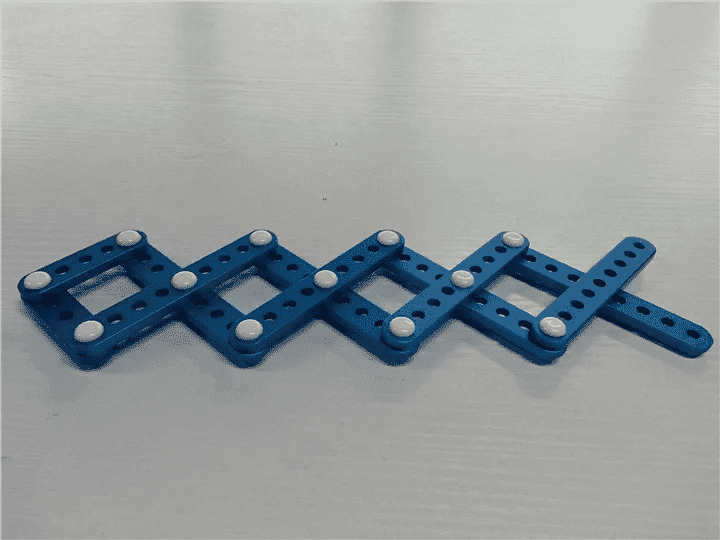
1620421647700.png

The edges of the first diamond are four Lego spots (a unit of measure that will surely be included in the next SI update) long and the edges of the second are two spots long, as per Baluncore's posts. Apologies for the dreadful photography.
 
Last edited:
  • Like
Likes   Reactions: Averagesupernova, DaveC426913, hutchphd and 2 others
And here's a version to @DaveC426913's original design (again, apologies for the terrible photography):
1620423382916.png

Note that the upper image is maximum collapse for this design. Interesting toy, Lego.
 
  • Like
Likes   Reactions: jrmichler
  • #10
DaveC426913 said:
Ill take another look.
Consider a scissor as a pair of identical hinged legs. The hinge pin will be somewhere between the end pins. Each pair of legs has an input length to the hinge, and an output length from the hinge. The ratio of the output to input length sets the rate of taper of that stage of the assembled arm.

There are many degrees of design parameter freedom. The simplest specification is probably that the input length of a pair should be equal to the output length of the previous pair.
Another might be that the width of a leg be scaled in proportion to it's length, which is also good from a leg moment point of view, and packs well when close.
 
  • #11
Ibix said:
View attachment 282731
The edges of the first diamond are four Lego spots (a unit of measure that will surely be included in the next SI update) long and the edges of the second are two spots long, as per Baluncore's posts. Apologies for the dreadful photography.

Yep, the more I design it in my head, the more I see that you're right, and that my original idea - before I second-guessed myself - was right.

Also, thanks for taking the time to make the demo.

Baluncore said:
Another might be that the width of a leg be scaled in proportion to it's length, which is also good from a leg moment point of view, and packs well when close.
I've been considering this. It'd be nice if they were all the same width, for the sake of strength*, but I concur that they won't pack well.

This design ends up having the same problem as every other telescoping design I've made - it gets more delicate (because the end space is cramped) - and therefore weaker - near the ends, . Alas, that is where the worst torque on the arm is.
 
  • #12
DaveC426913 said:
Alas, that is where the worst torque on the arm is.
Scissor legs with fixed sectional profiles tend to break due to bending at the point where the hinge pin passes through.
Are you considering a fusilli-form arm ?
Can the ends be at hinge points ?
 
  • #13
DaveC426913 said:
This design ends up having the same problem as every other telescoping design I've made - it gets more delicate (because the end space is cramped) - and therefore weaker - near the ends, . Alas, that is where the worst torque on the arm is.
So use a different material for the end pieces.
Titanium comes to mind but it is relatively expensive and miserable to work.
Carbon fiber or Glass reinforced polymer/plastic?
There are also some plastics that are amazingly tough, I can't remember any names though. 😥 Maybe someone else here can name a few.

Cheers,
Tom

p.s. Any chance you can tell us what it is to be used for?

edit: One of those 'tough' plastics is PMMA
(Poly(methyl methacrylate))
 
Last edited:
  • #14
Baluncore said:
Are you considering a fusilli-form arm ?
Best with a tomato sauce with 'nduja I think.

Tom.G said:
edit: One of those 'tough' plastics is PMMA
(Poly(methyl methacrylate))
This is nothing more than acrylic/perspex/plexiglass and I wouldn't view it as particularly 'tough' due to its crystalline structure which makes it brittle, however that same structure does make it particularly stiff and therefore a good choice for this application.
 
  • #15
pbuk said:
Best with a tomato sauce with 'nduja I think.
OK, so I got mugged by the autocorrect technology. Fusilli-form was not the correct term.
Instead try the following...
Fusiform, fusoid, cigar-shaped, Spindle-shaped; https://en.wikipedia.org/wiki/Fusiform
 
  • Like
Likes   Reactions: pbuk
  • #16
Tom.G said:
p.s. Any chance you can tell us what it is to be used for?
 

Attachments

  • 240px-8-cell-orig.gif
    240px-8-cell-orig.gif
    426.2 KB · Views: 196
  • #17
Building a ship in a Klein bottle ?
 
Last edited:
  • Like
Likes   Reactions: DaveC426913
  • #18
A variation of such a device would be the lowly bolt cutters. So, contrary to some folks opinion, such a device is not only possible, but well established and in use.

https://images.app.goo.gl/xjkxZpzLPkn4HQ2j6
 
  • Like
Likes   Reactions: Tom.G

Similar threads

  • · Replies 9 ·
Replies
9
Views
2K
  • · Replies 5 ·
Replies
5
Views
4K
  • · Replies 16 ·
Replies
16
Views
3K
  • · Replies 1 ·
Replies
1
Views
4K
  • · Replies 18 ·
Replies
18
Views
3K
  • · Replies 1 ·
Replies
1
Views
1K
  • · Replies 29 ·
Replies
29
Views
13K
  • · Replies 19 ·
Replies
19
Views
3K
  • · Replies 29 ·
Replies
29
Views
8K
  • · Replies 10 ·
Replies
10
Views
3K