Determine the force exerted by the seat on the child at the bottom of the ride

Click For Summary
SUMMARY

The force exerted by the seat on a child riding a Ferris wheel at the bottom of the ride is calculated to be 1.057mg, where mg represents the weight of the child. This calculation incorporates the centripetal acceleration, derived from the formula F = mg(1 + (v²/(rg))). The child moves in a vertical circle with a radius of 14.5 m and a constant speed of 2.85 m/s. For the scenario where the child is midway up the circle, further analysis is required to determine the forces acting on the child.

PREREQUISITES
  • Understanding of centripetal acceleration and its formula (ac = v²/r)
  • Knowledge of Newton's second law of motion (F = ma)
  • Familiarity with gravitational force (weight = mg)
  • Basic concepts of circular motion in physics
NEXT STEPS
  • Calculate the forces acting on an object in circular motion at different points in the circle
  • Explore the concept of net force in circular motion scenarios
  • Review the effects of varying speed on centripetal force
  • Watch the Standupmaths video mentioned for visual understanding of rotational motion
USEFUL FOR

This discussion is beneficial for physics students, educators, and anyone interested in understanding the dynamics of circular motion and the forces involved in rides like Ferris wheels.

Khaliya Ross
A child of mass m rides on a Ferris wheel as shown in figure (a). The child moves in a vertical circle of radius 14.5 m at a constant speed of 2.85 m/s.
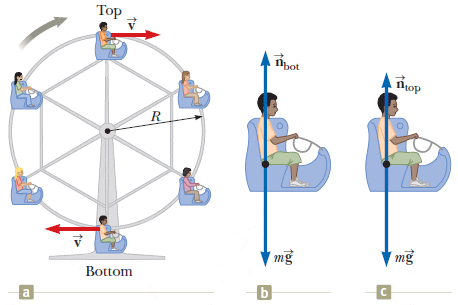
6-ae-05.gif

Determine the force exerted by the seat on the child at the bottom of the ride. Express your answer in terms of the weight of the child mg.

I did
F= nbottom-mg=mac
F= mg + mac
F= mg( 1+ (mac/mg))
F= mg(1+ (ac/g)
ac=v2/r
F= mg(1+(v2/rg))
F= mg(1+(2.852/(14.5*9.8)))
F= mg(1+.057)
F=1.057mg

and I got this right.

Calculate the magnitude of the force on the child causing the centripetal acceleration if the ride is midway up the circle (on his way up). Express your answer in terms of mg.

I am confused in how to start this problem and what forces I should use.
 
Physics news on Phys.org
I think this should be in the homework section, rather than General Physics. Do you know what direction the acceleration it in, for rotational motion? In the meantime, you may find this Standupmaths video useful.
 

Similar threads

  • · Replies 1 ·
Replies
1
Views
1K
  • · Replies 17 ·
Replies
17
Views
2K
Replies
5
Views
6K
Replies
6
Views
7K
  • · Replies 9 ·
Replies
9
Views
5K
  • · Replies 1 ·
Replies
1
Views
4K
  • · Replies 1 ·
Replies
1
Views
15K
  • · Replies 1 ·
Replies
1
Views
2K
  • · Replies 3 ·
Replies
3
Views
2K
  • · Replies 9 ·
Replies
9
Views
16K