Determine the force in the bar CB

Click For Summary
SUMMARY

The discussion centers on determining the force in bar CB using two methods, highlighting the importance of the orientation of the bars involved. The participants clarify that the first method is valid only if bar CB is perpendicular to bar ACD, while the second method applies when the rods are free to rotate about points A and B. The consensus is that the second method is the correct approach for the given scenario, as the weights of the rods are neglected and the connection at point C is crucial for accurate calculations.

PREREQUISITES
  • Understanding of static equilibrium principles
  • Knowledge of free body diagrams
  • Familiarity with normal forces in mechanics
  • Concept of rotational motion and constraints in structures
NEXT STEPS
  • Study the principles of static equilibrium in mechanical systems
  • Learn how to construct and analyze free body diagrams
  • Explore the effects of frictionless surfaces on force interactions
  • Investigate the mechanics of pinned connections in structures
USEFUL FOR

Engineering students, mechanical engineers, and anyone involved in structural analysis or mechanics will benefit from this discussion, particularly those focusing on force determination in rigid body systems.

ClearWhey
Messages
19
Reaction score
4
Homework Statement
Determine the force in the bar CB. The own weights can be neglected. Look at the first picture for the question.
Relevant Equations
Look at the second picture for my equations and results.
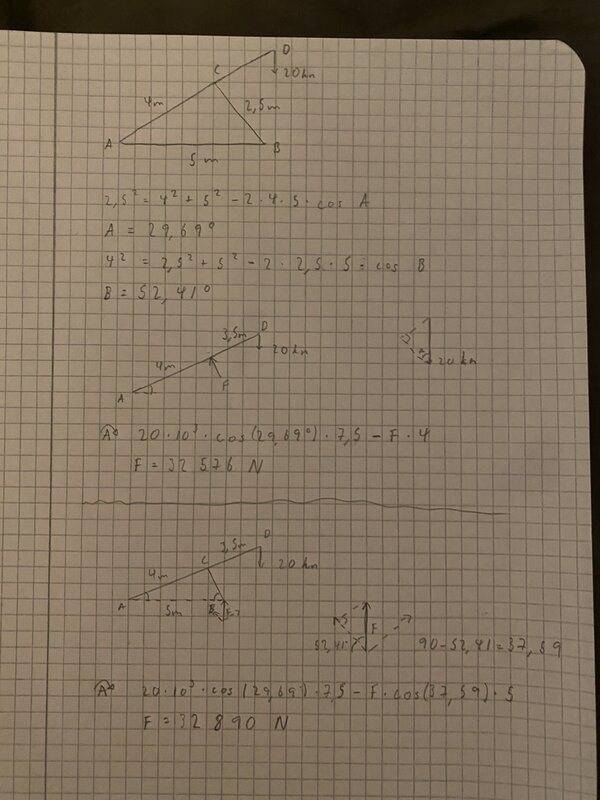
I solved this with two methods as you can see down below in the picture. Which is the correct way?

I remember I learned in class you could use both ways but why am I getting different results?
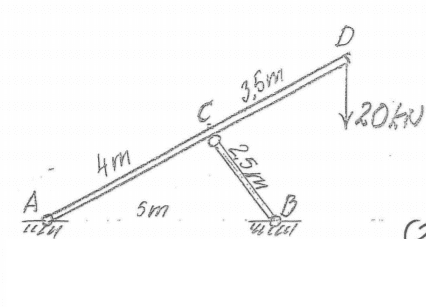
Solve.png


IMG_5175.jpg
 
Physics news on Phys.org
Did you assume that F acts perpendicular to bar ACD in your first method?
 
  • Like
Likes   Reactions: ClearWhey
For clarification, can you describe the type of connection or linkage at points A, B, and C.
 
  • Like
Likes   Reactions: ClearWhey
TSny said:
Did you assume that F acts perpendicular to bar ACD in your first method?

I actually didn't, just assumed the force would be that way if you removed the bar CB. But now that you write this I realize that method 1 only works if bar CB was perpendicular right?

Does it mean the second method is the right one?

TSny said:
For clarification, can you describe the type of connection or linkage at points A, B, and C.

Sorry but my english is not great. I have no idea what you mean with this. Thanks for helping me tho!
 
It's not clear to me what's going on at point C. I see two options.

Option 1: The long rod is resting against the rounded, frictionless end of the short rod at C. The other end of the short rod is fixed in place at B so that the short rod can't rotate about B.

Option 2: The rods are free to rotate about points A and B. The two rods are pinned together at C so that they are free to rotate about the pin. (It doesn't look like the two rods are pinned together in the figure.)

Since you are told to neglect the weights of both rods, I think it's probably option 2 that's intended. Your first solution would apply to option 1. Your second solution would apply to option 2.
 
  • Like
Likes   Reactions: ClearWhey
TSny said:
It's not clear to me what's going on at point C. I see two options.

Option 1: The long rod is resting against the rounded, frictionless end of the short rod at C. The other end of the short rod is fixed in place at B so that the short rod can't rotate about B.

Option 2: The rods are free to rotate about points A and B. The two rods are pinned together at C so that they are free to rotate about the pin. (It doesn't look like the two rods are pinned together in the figure.)

Since you are told to neglect the weights of both rods, I think it's probably option 2 that's intended. Your first solution would apply to option 1. Your second solution would apply to option 2.

Wow I didn't know it was this complicated haha. Thanks for clarifying it to me, now I understand how to think about these kind of questions. Thanks for the help!
 
TSny said:
It's not clear to me what's going on at point C. I see two options.

Option 1: The long rod is resting against the rounded, frictionless end of the short rod at C. The other end of the short rod is fixed in place at B so that the short rod can't rotate about B.

Option 2: The rods are free to rotate about points A and B. The two rods are pinned together at C so that they are free to rotate about the pin. (It doesn't look like the two rods are pinned together in the figure.)

Since you are told to neglect the weights of both rods, I think it's probably option 2 that's intended. Your first solution would apply to option 1. Your second solution would apply to option 2.

I also have one more question about the way I solved it the first time. I can only remove the rod CB and write a force F like that if the rod CB was perpendicular right?
 
ClearWhey said:
I also have one more question about the way I solved it the first time. I can only remove the rod CB and write a force F like that if the rod CB was perpendicular right?
I'm not sure what you mean by removing the rod CB. You are interested in the direction of the force F that rod CB exerts on rod AD. Suppose rod AD rests against the end of rod CB as shown below. This is option 1 in post #5.
1606363913735.png


If the surfaces are frictionless at the point of contact, can you deduce the direction of the force F? In the figure, I've exaggerated the fact that the two rods are not perpendicular to each other.
 
TSny said:
I'm not sure what you mean by removing the rod CB. You are interested in the direction of the force F that rod CB exerts on rod AD. Suppose rod AD rests against the end of rod CB as shown below. This is option 1 in post #5.
View attachment 273143

If the surfaces are frictionless at the point of contact, can you deduce the direction of the force F? In the figure, I've exaggerated the fact that the two rods are not perpendicular to each other.

I don't know the word in english but by removing I mean when you draw the object and the forces (what I learned in class) you can sometimes remove certain objects and then draw the force it makes on the other object. Hope you understand what I mean.

If the rod CB was perpendicular for instance it would be easier to just remove it and then draw a force F that will impact rod AD. Then calculate force F from that instead of drawing the whole figure and calculate force F from point B right? Then you have to use cos or tan and so on...
 
  • #10
ClearWhey said:
I don't know the word in english but by removing I mean when you draw the object and the forces (what I learned in class) you can sometimes remove certain objects and then draw the force it makes on the other object. Hope you understand what I mean.
Ok. I think you are describing the idea of drawing a free body diagram for each rod.

If the rod CB was perpendicular for instance it would be easier to just remove it and then draw a force F that will impact rod AD. Then calculate force F from that instead of drawing the whole figure and calculate force F from point B right? Then you have to use cos or tan and so on...
If rod AD rests against rod BC and if there is no friction between the rods, then there is only a normal force between the surfaces at the point of contact. So F is the normal force that rod BC exerts on AD.
 
  • #11
TSny said:
Ok. I think you are describing the idea of drawing a free body diagram for each rod.

Yeah that is what I meant.

TSny said:
If rod AD rests against rod BC and if there is no friction between the rods, then there is only a normal force between the surfaces at the point of contact. So F is the normal force that rod BC exerts on AD.

Yes, like I thought. Thanks for the explanation!
 
  • Like
Likes   Reactions: TSny

Similar threads

  • · Replies 14 ·
Replies
14
Views
2K
Replies
3
Views
1K
Replies
8
Views
1K
Replies
4
Views
2K
  • · Replies 9 ·
Replies
9
Views
1K
  • · Replies 11 ·
Replies
11
Views
923
Replies
3
Views
1K
  • · Replies 12 ·
Replies
12
Views
2K
Replies
5
Views
2K
  • · Replies 6 ·
Replies
6
Views
2K