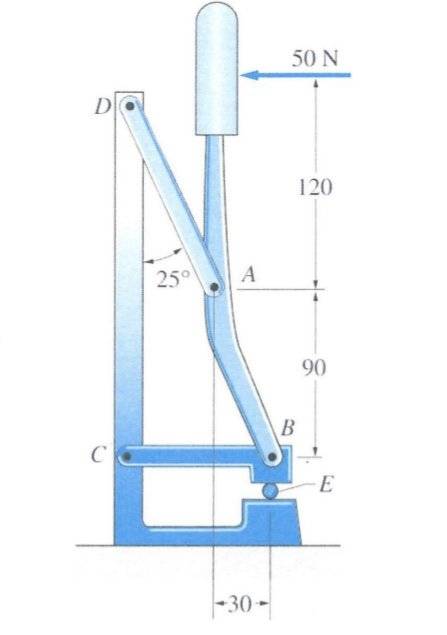
What is the resulting force between the beam CB and E?

Click For Summary

Homework Help Overview

The discussion revolves around the forces acting on a beam system, specifically focusing on the interaction between beam CB and point E. Participants are examining the implications of forces and moments in a static equilibrium context, referencing Newton's laws and the geometry of the setup.

Discussion Character

  • Exploratory, Assumption checking, Conceptual clarification

Approaches and Questions Raised

  • Participants are discussing the assumptions made regarding the vertical and horizontal forces at points A and B, questioning the implications of these forces on the moments calculated about point B. There is also exploration of how to resolve forces into components and their respective contributions to moments.

Discussion Status

The discussion is ongoing, with participants providing guidance on how to approach the problem by considering both vertical and horizontal components of forces. Some participants have confirmed calculations and shared insights on the relationship between forces and moments, but there is still exploration of the reasoning behind certain assumptions and methods.

Contextual Notes

Participants are navigating through potential misunderstandings related to the treatment of horizontal and vertical forces in the context of moments. There is mention of specific distances and angles that may influence the calculations, as well as references to previous learning materials that may have led to confusion.

ClearWhey
Messages
19
Reaction score
4
Homework Statement
What is the resulting force between the beam CB and E? Look at the first picture!
Relevant Equations
Look below on picture two for my equations.
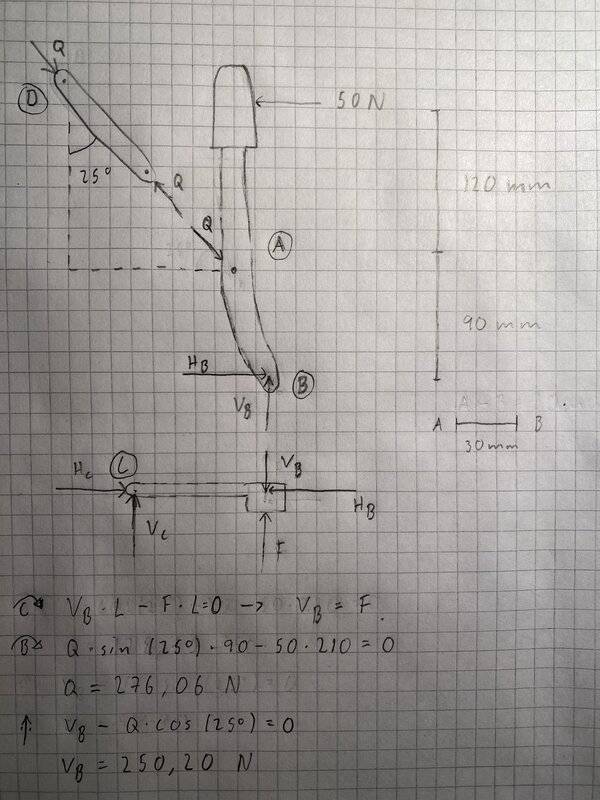
I assumed that the vertical force at point B would be the same as the force between beam CB and E because of Newtons law. Did I assume wrong? Look below for my calculations and answer which I got to 250N. I don’t know the correct answer but assume someone here can tell me if I solved the problem correctly?

Thanks in advance for the all the help!
CCCE7CCA-40B7-4453-B439-B650575A998E.jpeg
6AEC516B-176F-461E-B93C-8C2F86186454.jpeg
 
Physics news on Phys.org
Welcome to PF!

1600215949117.png


Looks like you assumed that point A is vertically above point B. That is, you did not take into account the 30 unit horizontal displacement between A and B.
 
  • Like
Likes   Reactions: ClearWhey
TSny said:
Welcome to PF!

View attachment 269480

Looks like you assumed that point A is vertically above point B. That is, you did not take into account the 30 unit horizontal displacement between A and B.

Thank you and thanks for trying to help me! What should I do? Have Not encountered a problem like this before. Btw did I assume right that by solving the vertical force at B I will get the force on E or is that wrong too?
 
ClearWhey said:
Thank you and thanks for trying to help me! What should I do? Have Not encountered a problem like this before. Btw did I assume right that by solving the vertical force at B I will get the force on E or is that wrong too?
@TSny is pointing out that the vertical component of compression Q acting on A also has a moment about B.
 
  • Like
Likes   Reactions: ClearWhey
ClearWhey said:
Thank you and thanks for trying to help me! What should I do? Have Not encountered a problem like this before.
What if you find the horizontal and vertical components of the force ##\vec Q## at point A? Can you find the moment of each of these components about point B?

Btw did I assume right that by solving the vertical force at B I will get the force on E or is that wrong too?
Yes. You got this by considering moments about C. Looks right to me.
 
  • Like
Likes   Reactions: ClearWhey
TSny said:
What if you find the horizontal and vertical components of the force ##\vec Q## at point A? Can you find the moment of each of these components about point B?

Yes. You got this by considering moments about C. Looks right to me.

English is not my native language so I have some difficulties understanding your sentence so sorry if I’m missunderstanding. But I take it you mean I should get the vertical and horizontal forces at A? I did that if you look at the next to last equation, took Q which I got from previous equations and times cos(25) to get the vertical force at point A.
 
ClearWhey said:
English is not my native language so I have some difficulties understanding your sentence so sorry if I’m missunderstanding. But I take it you mean I should get the vertical and horizontal forces at A? I did that if you look at the next to last equation, took Q which I got from previous equations and times cos(25) to get the vertical force at point A.
Yes, but you did not include it your sum of moments about B.
 
  • Like
Likes   Reactions: ClearWhey
When you took moments (torques) about point B, you did not correctly find the total moment (torque) due to force Q. The horizontal component of Q has a nonzero moment about A and the vertical component of Q also has a nonzero moment about A. The part of your work that I circled in orange in post #2 is the moment due to the horizontal component of Q. You need to include the moment due to the vertical component of Q.
 
  • Like
Likes   Reactions: ClearWhey
TSny said:
When you took moments (torques) about point B, you did not correctly find the total moment (torque) due to force Q. The horizontal component of Q has a nonzero moment about A and the vertical component of Q also has a nonzero moment about A. The part of your work that I circled in orange in post #2 is the moment due to the horizontal component of Q. You need to include the moment due to the vertical component of Q.

From what I learned from the book because the force 50N is horizontal I only need to add/subtract the horizontal force from Q if I choose to take the moment from point B. But now you say I need to add the vertical force from point A too? Why? And do I just add the vertical force to the equation?
 
  • #10
ClearWhey said:
From what I learned from the book because the force 50N is horizontal I only need to add/subtract the horizontal force from Q
Then you need to unlearn that because you must have misunderstood.
Three forces act on that member: the horizontal 50N, the force Q acting along DA and the reaction force at B.
The force at B has no moment about B; the 50N is purely horizontal, so is easy.
Because you know the horizontal and vertical displacements of A from B, the simplest way to deal with Q is to split it into horizontal and vertical components and express the moment each has about B. The horizontal component has a clockwise moment but the vertical component has an anticlockwise moment. Indeed, since the line DA projected passes very close to B, the two moments must almost cancel.
 
  • Like
Likes   Reactions: ClearWhey
  • #11
haruspex said:
Then you need to unlearn that because you must have misunderstood.
Three forces act on that member: the horizontal 50N, the force Q acting along DA and the reaction force at B.
The force at B has no moment about B; the 50N is purely horizontal, so is easy.
Because you know the horizontal and vertical displacements of A from B, the simplest way to deal with Q is to split it into horizontal and vertical components and express the moment each has about B. The horizontal component has a clockwise moment but the vertical component has an anticlockwise moment. Indeed, since the line DA projected passes very close to B, the two moments must almost cancel.

Alright I understand what you mean now and got the answer to 877N, confirmed with a friend and he got the same.

Now I understand you need to take into account the vertical and horizontal forces on a force that is skewed (can’t find another word to describe force Q).

Can you please explain to me why in this problem my teacher only took into account the vertical force on N and not the horizontal too when she took moment on A?

The problem was to find the forces at point A and point B.
Thanks for taking your time helping me!

4ECD86CC-8005-4DA7-BAC0-ADD395E776E2.jpeg
66856B87-F0F1-481D-9EAB-A00AFFAB24EF.jpeg
 
  • #12
I assume you mean the force acting up at 45 degrees at point D.
If you resolve that into horizontal and vertical components, the horizontal component acts along ADC, so has no moment about A.
There are other ways of calculating moments. Here, instead of resolving N, we could just multiply N by its lever arm, i.e. the perpendicular distance from its line of action to A. That gives ##N (\frac a{\sqrt 2})##, which is the same result.
 
  • Like
Likes   Reactions: ClearWhey
  • #13
haruspex said:
I assume you mean the force acting up at 45 degrees at point D.
If you resolve that into horizontal and vertical components, the horizontal component acts along ADC, so has no moment about A.
There are other ways of calculating moments. Here, instead of resolving N, we could just multiply N by its lever arm, i.e. the perpendicular distance from its line of action to A. That gives ##N (\frac a{\sqrt 2})##, which is the same result.

Ohh now I get it, if the force Q had been straight above point B then I would ’t need to take the horizontal force into account? Did I understand it right?
 
  • #14
ClearWhey said:
Ohh now I get it, if the force Q had been straight above point B then I would ’t need to take the horizontal force into account? Did I understand it right?
You wouldn't need to take the vertical component of Q into account.
 
  • Like
Likes   Reactions: ClearWhey
  • #15
TSny said:
You wouldn't need to take the vertical component of Q into account.

Yes the vertical component, wrote wrong. Thanks for all the help!
 
  • Like
Likes   Reactions: TSny

Similar threads

  • · Replies 8 ·
Replies
8
Views
1K
  • · Replies 6 ·
Replies
6
Views
3K
  • · Replies 2 ·
Replies
2
Views
1K
  • · Replies 1 ·
Replies
1
Views
2K
Replies
7
Views
2K
  • · Replies 10 ·
Replies
10
Views
2K
  • · Replies 8 ·
Replies
8
Views
5K
  • · Replies 21 ·
Replies
21
Views
4K
Replies
7
Views
2K
  • · Replies 2 ·
Replies
2
Views
2K