Determine the shunt field current in a magnetic circuit

Click For Summary
SUMMARY

The discussion focuses on determining the shunt field current in a magnetic circuit, specifically analyzing the effects of uniformity in cross-sectional areas within a toroidal core. Participants debated the implications of assuming uniform cross-section versus varying areas, concluding that a uniform area leads to maximum magnetic flux density utilization. The net cross-sectional area of the flux path is confirmed to be 200 cm², with considerations for the pole area being double that of the left and right branches. The analysis emphasizes the importance of BH curve characteristics and practical applications in magnetic circuit design.

PREREQUISITES
  • Understanding of magnetic circuits and flux density
  • Familiarity with BH curve characteristics
  • Knowledge of reluctance and permeability in magnetic materials
  • Basic principles of analog circuits and magnetic field calculations
NEXT STEPS
  • Research the calculation of magnetic reluctance in circuits
  • Learn about the effects of eddy current and hysteresis loss in magnetic materials
  • Explore the design considerations for toroidal cores in magnetic circuits
  • Study the application of Ampere's Law in magnetic circuit analysis
USEFUL FOR

Electrical engineers, students in electromagnetism, and professionals involved in magnetic circuit design and analysis will benefit from this discussion.

Fatima Hasan
Messages
315
Reaction score
14
Homework Statement
Written below.
Relevant Equations
Equations are attached below.
Problem Statement :
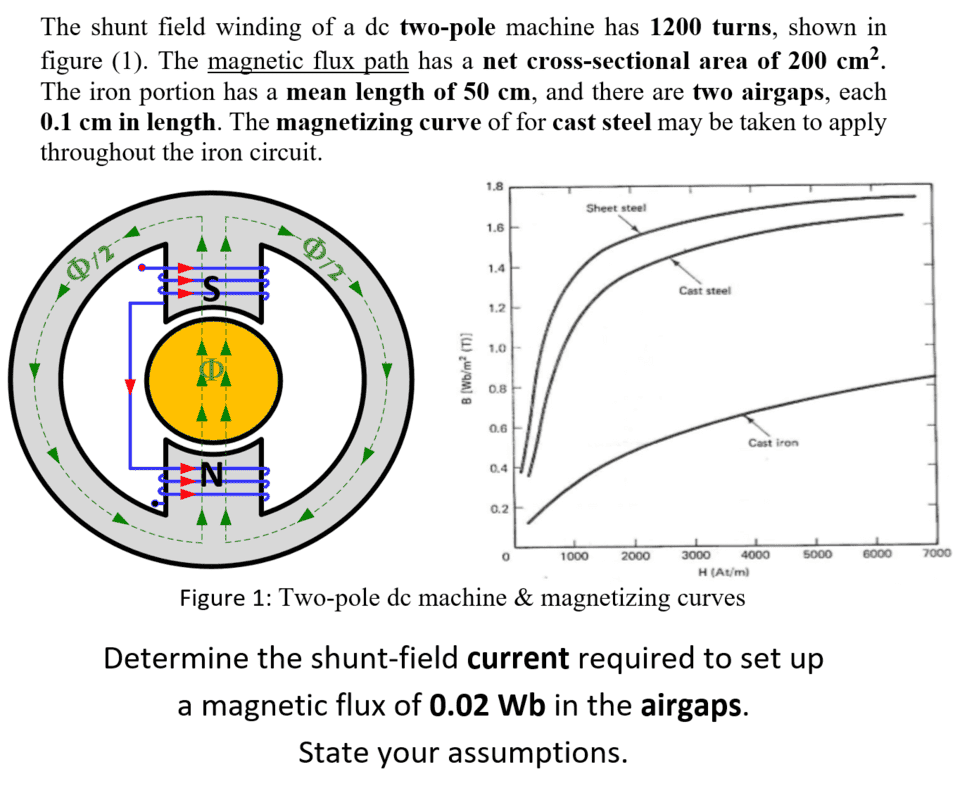
Problem-Statement.png


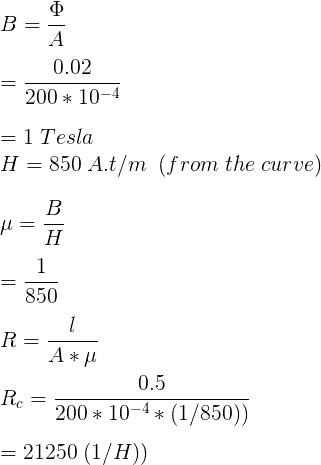
Here's my attempt :
* By assuming that the fringing and leakage effects are ignored.
Solution.gif


I find the flux density , the permeability and the reluctance of the iron , but then I get stuck .
Any help would be greatly appreciated .
 

Attachments

  • Equations.gif
    Equations.gif
    1.1 KB · Views: 269
Last edited:
Physics news on Phys.org
I tried to solve it , and that's what I got :
Analog Circuit :

Analog Circuit.JPG


02*89577.47154%20%5C%5C%5C%5Ci%3D1.49%5Capprox%201.gif


That's what I got , but I am not sure if my answer is correct or not .
I want to confirm my answer .
 
The statement states that the flux path has a net cross-sectional area of 200 cm^2.
Based on this statement, I am a bit confused about the assumption that the cross-sectional area of left branch and right branch of the toroidal core are the same as the cross-sectional area of the air gaps.
 
Last edited:
alan123hk said:
The statement states that the flux path has a net cross-sectional area of 200 cm^2.
Based on this statement, I am a bit confused about the assumption that the cross-sectional area of left branch and right branch of the toroidal core are the same as the cross-sectional area of the air gaps.
Yes it's not given. So I would assume the cross-section is uniform thruout the magnetic path, the drawing strongly suggesting otherwise notwithstanding.
 
I agree with alan123hk: the "path" has to be the area for indicated path. That means the pole area has to be double=400 cm^2
Then n*I=Hfe*Lfe+B/μo*2*airgaplengs [n=number of turns]
 
Case 1 : the area is uniform throughout the magnetic path
Case 2 : the area of the pole is twice that of the left/right branch

Assume that the entire magnetic circuit has the same BH curve characteristics

In case 1, the B in the pole is twice that of the B in the left/right branch, and since the pole becomes bottleneck, the maximum magnetic flux density in the left/right branch may not be fully utilized.

In case 2, the entire magnetic circuit has the same B everywhere, there is no bottleneck, and the maximum magnetic flux density can be achieved throughout the entire magnetic circuit.

Of course, if uniform magnetic flux density is not the primary concern, then case 1 is still the choice in practical applications, since there may be many other factors to be considered, such as mechanical strength and reducing eddy current/hysteresis loss.
 
Last edited:

Similar threads

  • · Replies 3 ·
Replies
3
Views
4K
  • · Replies 1 ·
Replies
1
Views
1K
  • · Replies 7 ·
Replies
7
Views
2K
  • · Replies 1 ·
Replies
1
Views
4K
  • · Replies 41 ·
2
Replies
41
Views
7K
  • · Replies 4 ·
Replies
4
Views
1K
  • · Replies 1 ·
Replies
1
Views
2K
  • · Replies 8 ·
Replies
8
Views
7K
  • · Replies 16 ·
Replies
16
Views
4K
  • · Replies 20 ·
Replies
20
Views
3K