Determing the center of gravity of a shaded section

Click For Summary

Homework Help Overview

The discussion revolves around determining the center of gravity of a shaded section using the theorem of Pappus Guldinus, with a specific focus on calculations involving the area and volume related to a geometric figure defined by the Y-axis and dimensions involving R.

Discussion Character

  • Exploratory, Assumption checking, Mathematical reasoning

Approaches and Questions Raised

  • Participants explore various methods to calculate the area and center of gravity, questioning the assumptions about the geometric configuration and the relationship between the Y-axis and the dimensions of the figure. Some participants suggest writing expressions in terms of R before substituting numerical values to facilitate understanding.

Discussion Status

The discussion includes attempts to clarify the setup of the problem, with some participants providing insights into the geometric construction and others questioning the accuracy of the assumptions based on the provided image. There is ongoing exploration of the calculations, with participants offering corrections and suggestions for improvement.

Contextual Notes

Participants note the potential ambiguity in the diagram and the lack of explicit information regarding angles and relationships between the axes and dimensions, which may affect the calculations and interpretations of the problem.

Guillem_dlc
Messages
188
Reaction score
17
Homework Statement
Determine the volume of the shaded area around the Y-axis by using the theorem of Pappus Guldinus, where value of R = 143,3 cm.

a) Determine the area of the shaded section.

b) Determine the center of gravity of the shaded section.

c) Detrmine the volume by using the theorem of Pappus Guldinus.
Relevant Equations
theorem of Pappus Guldinus, center of gravity
Determine the volume of the shaded area around the Y-axis by using the theorem of Pappus Guldinus, where value of R = 143,3 cm.
a) Determine the area of the shaded section.
b) Determine the center of gravity of the shaded section.
c) Detrmine the volume by using the theorem of Pappus Guldinus.
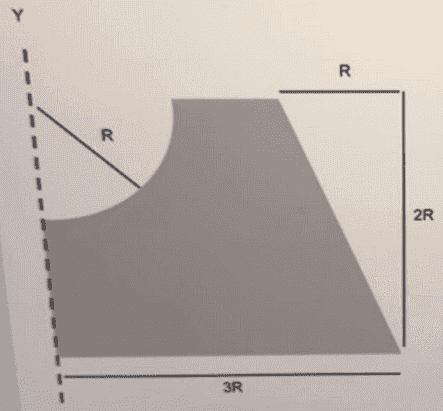
Captura de pantalla de 2020-04-24 21-08-20.png


My attempt at the solution:

a) ##A_T=2R\cdot 2R-\dfrac14 \cdot \pi \cdot R^2+\dfrac{R\cdot 2R}{2}##
##A_T=4R^2-\dfrac{\pi \cdot R^2}{4}+R^2=4\cdot 143,3^2-\dfrac{\pi \cdot 143,3^2}{2}+143,3^2=86546,39\, \textrm{cm}^2=\boxed{8,65\, \textrm{m}^2}##

b) I consider three figures to calculate the centres of gravity:
Figure 1 (Rectangular triangle with side R and hypotenuse 2R) --> ##\bar{x}=2R+\dfrac{R}{3}=2\cdot 143,3+\dfrac{143,3}{3}=334,36\, \textrm{cm}##
##\bar{y}=\dfrac{2R}{3}=\dfrac{2\cdot 143,3}{3}=95,53\, \textrm{cm}##
Figure 2 (Square of side 2R) --> ##\bar{x}=\dfrac{2R}{2}=R=143,3\, \textrm{cm}##
##\bar{y}=\dfrac{2R}{2}=R=143,3\, \textrm{cm}##
Figure 3 (sector of circle)--> ##\bar{x}=\dfrac{4r}{3\pi}=\dfrac{4\cdot 143,3}{3\pi}=60,82\, \textrm{cm}##
##\bar{y}=2R-\dfrac{4R}{3\pi}=2\cdot 143,3-\dfrac{4\cdot 143,3}{3\pi}=225,78\, \textrm{cm}##
Then:
##\bar{x}=\dfrac1A\sum_{i=1}^n \bar{x_i}A_i=\dfrac{334,36\cdot 143,3^2+143,3\cdot 4\cdot 143,3^2-60,82\cdot \frac{\pi \cdot 143,3^2}{2}}{86546,39}=192,67##

This last result would be correct?

Thanks
 
Physics news on Phys.org
The image seems to show the Y axis as at some angle to the side of length 2R. But there does not seem to be enough information to determine that angle.
Are they parallel really, and the image is taken at some angle to the page?
 
haruspex said:
The image seems to show the Y axis as at some angle to the side of length 2R. But there does not seem to be enough information to determine that angle.
Are they parallel really, and the image is taken at some angle to the page?

I think it's constructed from a rectangle of dimensions 3R x 2R attached to the y-axis like a flag, then with a right triangle removed from the right and a quarter circle removed from the top left.
 
etotheipi said:
I think it's constructed from a rectangle of dimensions 3R x 2R attached to the y-axis like a flag, then with a right triangle removed from the right and a quarter circle removed from the top left.
Yes, if the 2R and Y axis are indeed parallel.
@Guillem_dlc , you make life hard for yourself and anyone reading your work by plugging in numbers much too soon. Write it out again all in terms of R. Don't plug in its value until the very end.
There are lots of advantages to this style, one of which is that more readers will try to help you.
 
  • Like
Likes   Reactions: etotheipi
haruspex said:
Yes, if the 2R and Y axis are indeed parallel.

Ah, I see what you mean. I guess since no further information is given we just have to assume it's sloppiness on the question setter's part!

As an aside, I must admit I'd never heard of 'Pappus-Guldinus' but the result looks almost too simple to be true! I haven't read through the proof yet but at the moment it seems a bit like magic. Add that to the fact that when I said the name out loud my furniture started floating...
 
etotheipi said:
assume it's sloppiness on the question setter's part!
No, I wouid guess it is reasonably obvious in the original diagram, but the distortion in the way the photo has been taken makes it hard to believe.
 
  • Like
Likes   Reactions: etotheipi
haruspex said:
The image seems to show the Y axis as at some angle to the side of length 2R. But there does not seem to be enough information to determine that angle.
Are they parallel really, and the image is taken at some angle to the page?
Yes, Y and 2R are parallel.
 
haruspex said:
Yes, if the 2R and Y axis are indeed parallel.
@Guillem_dlc , you make life hard for yourself and anyone reading your work by plugging in numbers much too soon. Write it out again all in terms of R. Don't plug in its value until the very end.
There are lots of advantages to this style, one of which is that more readers will try to help you.
Okay, I'll do it by leaving R indicated and I'll pass it around. You're absolutely right.
 
etotheipi said:
Ah, I see what you mean. I guess since no further information is given we just have to assume it's sloppiness on the question setter's part!

As an aside, I must admit I'd never heard of 'Pappus-Guldinus' but the result looks almost too simple to be true! I haven't read through the proof yet but at the moment it seems a bit like magic. Add that to the fact that when I said the name out loud my furniture started floating...
Yes
 
  • #10
etotheipi said:
As an aside, I must admit I'd never heard of 'Pappus-Guldinus' but the result looks almost too simple to be true! I haven't read through the proof yet but at the moment it seems a bit like magic. Add that to the fact that when I said the name out loud my furniture started floating...
:smile:
 
  • Like
Likes   Reactions: etotheipi
  • #11
Writing in terms of ##R##:

Captura de pantalla de 2020-04-26 01-47-12.png


a) ##A_T=2R\cdot 2R-\dfrac14 \pi R^2+\dfrac{R2R}{2}=4R^2-\dfrac{\pi R^2}{4}+R^2=\dfrac{16R^2-\pi R^2+4R^2}{4}=\dfrac{R^2\cdot (20-\pi)}{4}=\dfrac{20R^2-\pi R^2}{4}=143,3\, \textrm{cm}=1,433\, \textrm{m}##

b) Centers of gravity:
- Figure 1: ##\bar{x}=2R+\dfrac{R}{3}=\dfrac{6R+R}{3}=\dfrac{7R}{3}##
- Figure 2: ##\bar{x}=\dfrac{2R}{2}=R##
- Figure 3: ##\bar{x}=\dfrac{4R}{3\pi}##
Then:
##\bar{x}=\dfrac1A \sum_{i=1}^n \bar{x_i}\cdot A_i=\dfrac{\frac{7R}{3}+R+\frac{4R}{3\pi}}{\frac{20R^2-\pi R^2}{4}}=\dfrac{\frac{7R+3R}{3}+\frac{4R}{3\pi}}{\frac{20R^2-\pi R^2}{4}}=\dfrac{\pi (7R+3R)+4R}{3\pi}: \dfrac{20R^2-\pi R^2}{4}=\dfrac{4\pi \cdot (7R+3R)+16R}{3\pi \cdot (20R^2-\pi R^2)}=\dfrac{R\cdot (4\pi \cdot (7+3)+16)}{3\pi R^2(20-\pi)}=\dfrac{40\pi +16}{3\pi R(20-\pi)}=\dfrac{40\pi +16}{3\pi \cdot 143,3(20-\pi)}=0,622\, \textrm{m}##

So I know the result is not right but I can't find the mistake.
 
  • #12
Guillem_dlc said:
##\bar{x}=\dfrac1A \sum_{i=1}^n \bar{x_i}\cdot A_i=\dfrac{\frac{7R}{3}+R+\frac{4R}{3\pi}}{\frac{20R^2-\pi R^2}{4}}##
What you have written in the numerator is ##\sum_{i=1}^n \bar{x_i}##, not ##\sum_{i=1}^n \bar{x_i}\cdot A_i##.
 
  • #13
haruspex said:
What you have written in the numerator is ##\sum_{i=1}^n \bar{x_i}##, not ##\sum_{i=1}^n \bar{x_i}\cdot A_i##.
##\bar{x}=\dfrac{\frac{7R}{3}\cdot R^2+R\cdot 4R^2-\frac{4R}{3\pi}\cdot \frac{\pi R^2}{4}}{\frac{20R^2-\pi R^2}{4}}=\dfrac{\frac{7R^3}{3}+4R^3-\frac{4\pi R^3}{12\pi}}{\frac{R^2\cdot (20-\pi)}{4}}=\dfrac{\frac{7R^3}{3}+4R^3-\frac{R^3}{3}}{\frac{R^2\cdot (20-\pi)}{4}}=\dfrac{\frac{7R^3+12R^3-R^3}{3}}{\frac{R^2\cdot (20-\pi)}{4}}=\dfrac{18R^3}{3}:\dfrac{R^2\cdot (20-\pi)}{4}=\dfrac{72R^3}{3R^2\cdot (20-\pi)}=\dfrac{24R}{20-\pi}##
Then,
##\bar{x}=\dfrac{24\cdot 143,3}{20-\pi}=204,005\rightarrow \boxed{2,04\, \textrm{m}}##

Now, is it correct?
 
  • #14
Guillem_dlc said:
##\bar{x}=\dfrac{\frac{7R}{3}\cdot R^2+R\cdot 4R^2-\frac{4R}{3\pi}\cdot \frac{\pi R^2}{4}}{\frac{20R^2-\pi R^2}{4}}=\dfrac{\frac{7R^3}{3}+4R^3-\frac{4\pi R^3}{12\pi}}{\frac{R^2\cdot (20-\pi)}{4}}=\dfrac{\frac{7R^3}{3}+4R^3-\frac{R^3}{3}}{\frac{R^2\cdot (20-\pi)}{4}}=\dfrac{\frac{7R^3+12R^3-R^3}{3}}{\frac{R^2\cdot (20-\pi)}{4}}=\dfrac{18R^3}{3}:\dfrac{R^2\cdot (20-\pi)}{4}=\dfrac{72R^3}{3R^2\cdot (20-\pi)}=\dfrac{24R}{20-\pi}##
Then,
##\bar{x}=\dfrac{24\cdot 143,3}{20-\pi}=204,005\rightarrow \boxed{2,04\, \textrm{m}}##

Now, is it correct?
Looks right.
 
  • Like
Likes   Reactions: sysprog and Guillem_dlc
  • #15
Please think of Pappus' simple and brilliant idea as a clue to doing the triple integral that you have to do when you are modeling Homer Simpson eating a donut. When does the centroid exit the empty space at the donut hole and actually enter the material of the remaining portion of the donut (torus/toroid)? The theorem is like if an anaconda swallowed a DVD and had to pass it at maximum area all the way down its alimentary canal.
 

Similar threads

  • · Replies 6 ·
Replies
6
Views
1K
  • · Replies 10 ·
Replies
10
Views
2K
  • · Replies 2 ·
Replies
2
Views
2K
Replies
9
Views
2K
  • · Replies 3 ·
Replies
3
Views
3K
  • · Replies 7 ·
Replies
7
Views
2K
Replies
27
Views
4K
Replies
4
Views
2K
Replies
4
Views
4K
  • · Replies 13 ·
Replies
13
Views
4K