How do I solve for the centroid of a function with a given range?

Click For Summary
To solve for the centroid of the function Y(x) = 96.4x(100-x) over the interval (0, 93.7) cm, the area bounded by the function and the x-axis must first be calculated. The bar{x} and bar{y} coordinates of the centroid can be determined by integrating with respect to x, considering the height of the function. The first moment of area in the y-direction can be expressed as δS_y = (1/2)f(x)²δx, which allows for integration across the specified limits. The discussion emphasizes the importance of using integration techniques to find the centroid coordinates effectively.
Guillem_dlc
Messages
188
Reaction score
17
Summary:: I'm solving an exercise.

I have the following center of gravity problem:

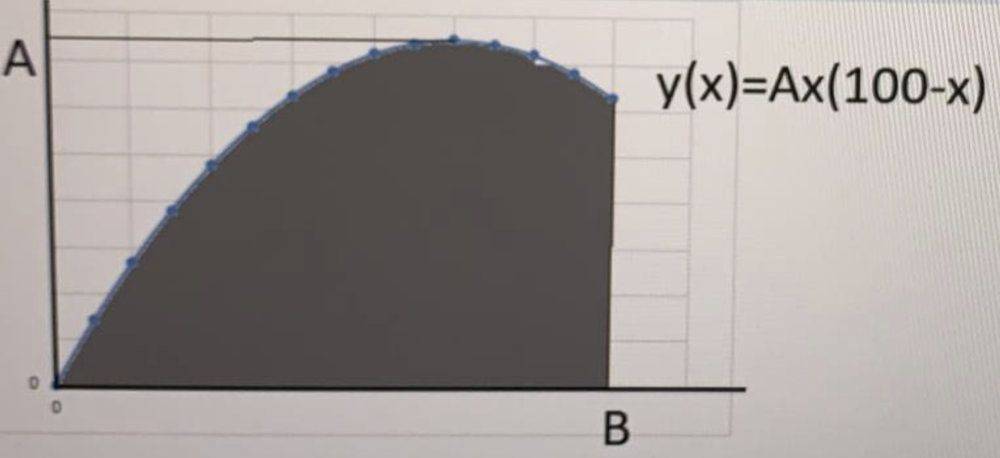
Having the function Y(x)=96,4*x(100-x) cm, where X is the horizontal axis and Y is the vertical axis, ranged between the interval (0, 93,7) cm. Determine:
a) Area bounded by this function, axis X and the line X=93,7 (in cm2)
b) The bar{x} coordinate of its centroid (in cm)
c) The bar{y} coordinate of its centroid (in cm)
8BDE096C-6720-494B-A873-4C2146EC05C5.jpeg

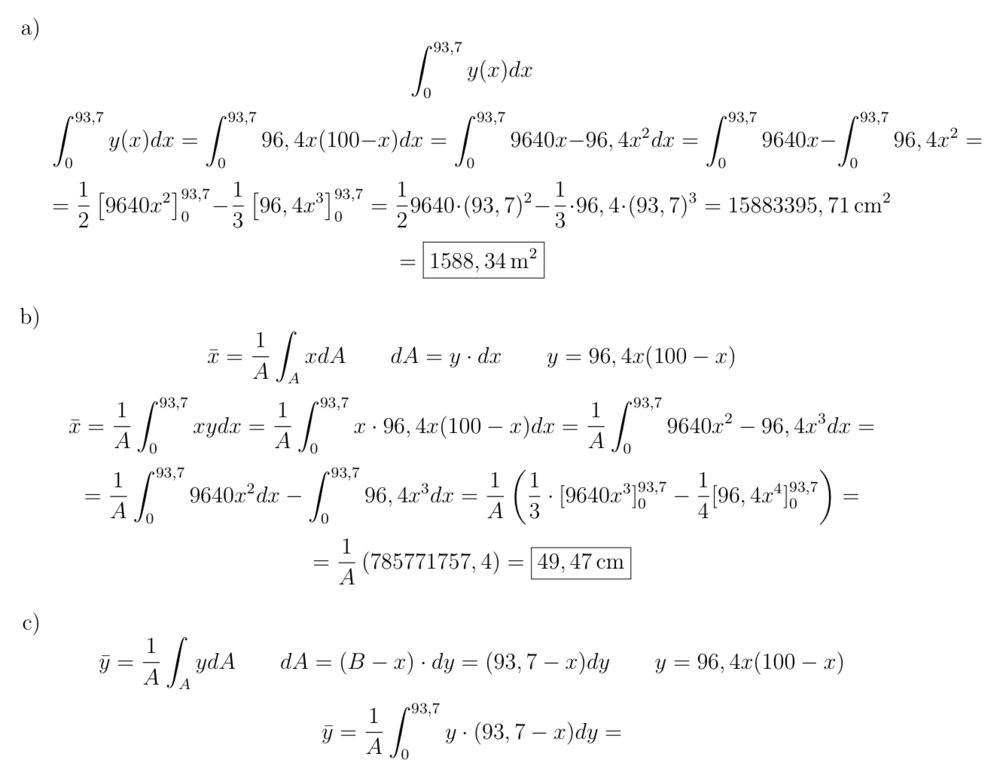
My attempt at resolution:

7AE6BF30-7086-4851-ADC1-1F6E4D77391B.jpeg

How can I calculate the last section if I can't clear the x?

Thanks!
 
Physics news on Phys.org
Guillem_dlc said:
How can I calculate the last section if I can't clear the x?
You are given y as a function of x, ##y = 96.4x(100 - x)##. Solve this equation for x in terms of y.
IOW, you have y = f(x), Solving for x gives you ##x = f^{-1}(y)##.
 
Mark44 said:
You are given y as a function of x, ##y = 96.4x(100 - x)##. Solve this equation for x in terms of y.
IOW, you have y = f(x), Solving for x gives you ##x = f^{-1}(y)##.
Okay perfect thank you!
 
You can do it with the inverse that can sometimes be unwieldy if the function is complicated. You can also find ##\bar{y}## by integrating wrt ##x##. Consider a vertical strip of width ##\delta x## and height ##f(x)##, then the incremental change in the first moment of area in the ##y## direction is

##\delta S_y = \frac{1}{2} {f(x)}^2 \delta x##

and then you can just integrate up over your limits and divide by the total area.
 
Last edited by a moderator:
etotheipi said:
You can do it with the inverse but as an additional point that might sometimes be a little unwieldy if the function is complicated. You can also find ##\bar{y}## by integrating wrt ##x##. Consider a vertical strip of width ##\delta x## and height ##f(x)##, then the incremental change in the first moment of area in the ##y## direction is

##\delta S_y = \frac{1}{2} {f(x)}^2 \delta x##

and then you can just integrate up over your limits and divide by the total area.
Yes, I applied this second method in the end, i.e. integrating with respect to ##x## and considering that ##y## was in the middle of the differential.
 
The book claims the answer is that all the magnitudes are the same because "the gravitational force on the penguin is the same". I'm having trouble understanding this. I thought the buoyant force was equal to the weight of the fluid displaced. Weight depends on mass which depends on density. Therefore, due to the differing densities the buoyant force will be different in each case? Is this incorrect?

Similar threads

  • · Replies 19 ·
Replies
19
Views
2K
  • · Replies 2 ·
Replies
2
Views
2K
  • · Replies 1 ·
Replies
1
Views
6K
  • · Replies 2 ·
Replies
2
Views
22K
  • · Replies 19 ·
Replies
19
Views
29K
  • · Replies 20 ·
Replies
20
Views
8K
Replies
1
Views
1K
  • · Replies 11 ·
Replies
11
Views
2K
Replies
4
Views
2K
  • · Replies 8 ·
Replies
8
Views
2K