Determining orthonormal states to a non-zero inner product

Click For Summary

Homework Help Overview

The discussion revolves around determining orthonormal states in the context of quantum mechanics, specifically regarding the inner product of states and normalization conditions. The original poster attempts to find an orthonormal state to |b> and questions the validity of their calculations related to the inner product and normalization of states |a> and |b>.

Discussion Character

  • Exploratory, Assumption checking, Conceptual clarification

Approaches and Questions Raised

  • Participants explore the implications of assuming states |a> and |b> are normalized, with some questioning the necessity of this assumption. There are discussions about the normalization of the state |x> and its relationship to |b>, as well as the conditions under which orthonormality holds.

Discussion Status

The discussion is ongoing, with participants providing insights and raising questions about normalization and orthogonality. Some participants suggest reconsidering the assumptions made about the states involved, while others point out specific cases that could affect the conclusions drawn.

Contextual Notes

There are references to specific conditions under which the problem may behave differently, such as when certain parameters equal zero or one. The original poster's calculations and assumptions are under scrutiny, particularly regarding the normalization of quantum states.

electrogeek
Messages
14
Reaction score
1
Moved from a technical forum,
Hi everyone,

I was attempting the following past paper question below:
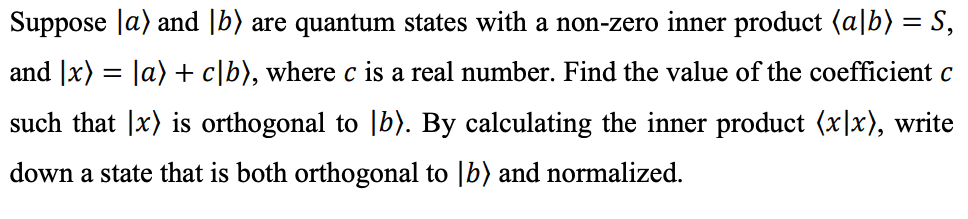
Screenshot 2020-04-09 at 12.11.31.png

I have found a value for the coefficient c and I think I have calculated the inner product of <x|x>. I've attached my workings below. But I'm not sure what to do next to answer the last part of the question which asks about finding an orthonormal state to |b>. Am I right to say that <a|a> and <b|b> are equal to one or is my <x|x> calculation wrong?
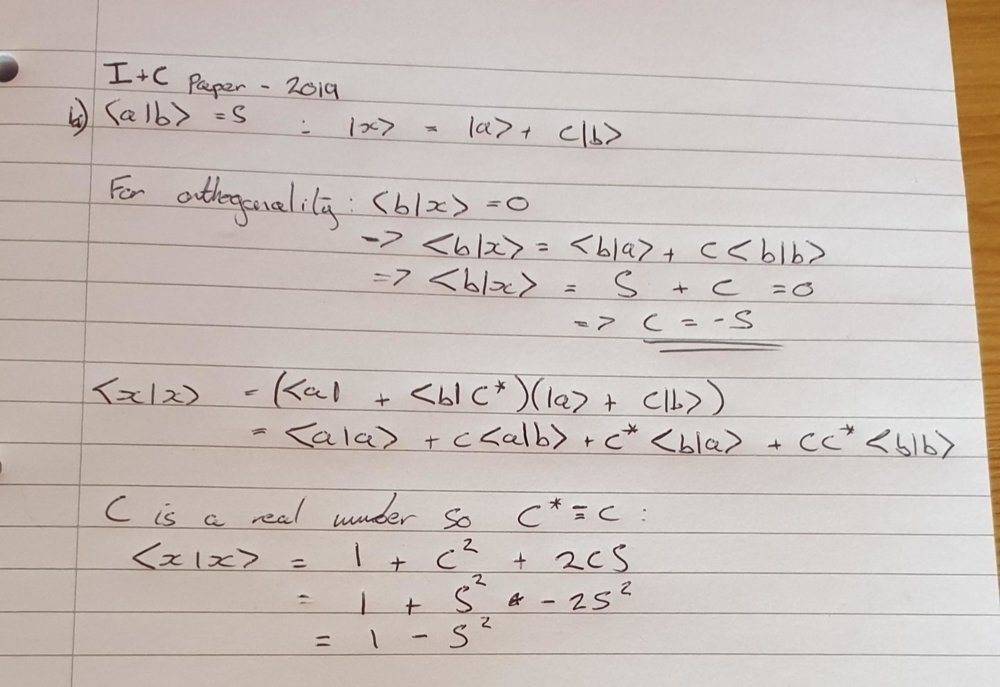
20200409_121226.jpg
 
Physics news on Phys.org
Is it really necessary to make this assumption ? You already made use of it in the first part, when you said ##C\langle b|b\rangle = C## !

What if ##|a\rangle## and ##|b\rangle## are not normalized ?
 
BvU said:
What if ##|a\rangle## and ##|b\rangle## are not normalized ?
One might argue that if they are quantum states, then that implies they are normalized.
 
I've had a think about it and would I be right in saying that the state |x> / <x|x> would be orthonormal to |b>?
 
electrogeek said:
I've had a think and would I be right in saying that the state |x>/<x|x> would be orthonormal to |b>?
If ##|x \rangle## is orthogonal to ##|b \rangle##, then the normalized state ##\frac{|x \rangle}{\langle x|x \rangle^{1/2}}## must be orthogonal to ##|b \rangle##.

Your term "orthonormal to ##|b \rangle##" has no meaning.

There is, however, one exceptional case that you should have picked up on. What happens if ##1 - S^2 = 0##?
 
Last edited:
Would |x> / sqrt(<x|x>) both normalised and orthogonal to |b> then instead?
 
electrogeek said:
Would |x> / sqrt(<x|x>) both normalised and orthogonal to |b> then instead?
Yes, you're right it should be the square root there. I'll change it.

PS it's a strange question since: a) everything works with ##S = 0##; b) it works perfectly well with ##S, c## as complex numbers; c) It doesn't work with ##|S| = 1##, which is the case where ##|a \rangle## and ##|b \rangle## are the same state (up to a phase factor).

It shouldn't have been "non-zero ##S##", it should have been ##|S| \ne 1## in the question.
 
PeroK said:
Yes, you're right it should be the square root there. I'll change it.

PS it's a strange question since: a) everything works with ##S = 0##; b) it works perfectly well with ##S, c## as complex numbers; c) It doesn't work with ##|S| = 1##, which is the case where ##|a \rangle## and ##|b \rangle## are the same state (up to a phase factor).

It shouldn't have been "non-zero ##S##", it should have been ##|S| \ne 1##.

Ah brilliant! Thanks for the help. :)
 

Similar threads

Replies
16
Views
3K
  • · Replies 3 ·
Replies
3
Views
2K
  • · Replies 1 ·
Replies
1
Views
2K
  • · Replies 8 ·
Replies
8
Views
4K
Replies
16
Views
3K
  • · Replies 13 ·
Replies
13
Views
4K
  • · Replies 21 ·
Replies
21
Views
2K
  • · Replies 3 ·
Replies
3
Views
2K
  • · Replies 6 ·
Replies
6
Views
2K
  • · Replies 3 ·
Replies
3
Views
3K