Undergrad Determining Relative Position of Space Object to Earth

Click For Summary
To determine the relative position of a space object to Earth, one can use orbital data from a NASA API to calculate the object's right ascension and declination. This information allows for the conversion to geographic coordinates, indicating where the object is directly overhead, such as above New York. Understanding the object's orbit type—whether it is elliptical, parabolic, or hyperbolic—is also essential for accurate positioning. The discussion emphasizes the importance of knowing the coordinates of the space object and Earth to apply the correct mathematical formulas for distance and position. Overall, with the right data and calculations, determining the object's position relative to Earth is feasible.
Py3_3
Messages
1
Reaction score
0
Hello,

i'm doing a project where the goal is to get the relative position of a space object to the earth, roughly. Basically, i want to say that this object is currently e.g. above New York.

The data for any given space object that i have is
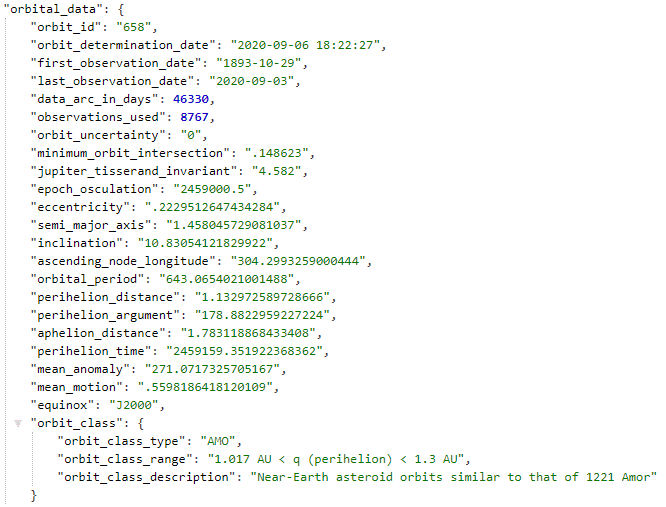
3g8khyf.png

(It's sourced from an NASA API). The specific values are not important, just an example object.

I know nothing about how orbits are calculated and such, but I'm a pretty math-savvy guy and i'd be willing to research and learn it myself. But i don't want to spend 3 days digging into this stuff only to realize that what i want to do is not possible with the information i have.

So basically my question is the title. Also if you want to give me some pointers which of those values are important to me that would be amazing too.

Thanks in advance!

<Moderator's note: do not use external image servers. Upload your images to PhysicsForums.>
 
Last edited by a moderator:
Astronomy news on Phys.org
I think that if you want the relative position of it in relation to other space objects like the earth, the sun, the moon then first i think it has to stay in the same relative position. But the Earth and the moon are moving. Their positions change.

If you want you can calculate the distances of the space object from the moon, the sun and the earth. This i think may give you somehow its position relative to those space objects. The mathematical formula for the distance of two points(earth and the space object for example) in three dimensions of euclidean space is d=((x1-y1)2+ (x2-y2)2+(x3-y 3)2)1/2 where x=(x1,x2,x3) and y=(y1,y2,y3) are the coordinates of the points.

You substitute in the coordinates of x,y the corresponding coordinates of your space objects and you have their distance. If you have the distance of this space object from the Earth's ground is this ok?

If you want the orbit of a space object, i think its path to be an orbit it has to be regular repeating around another space object. Check the formulas of orbital mechanics if you want. Is it an elliptic, parabolic, hyperbolic orbit? Is it a free or conic orbit?

Is this for professional purposes? You have a professional project on this? It may not be for professional purposes i am just asking.

I do not know if i helped. I hope i did.
 
Py3_3 said:
Basically, i want to say that this object is currently e.g. above New York.

This should be fairly straight forward. The orbital data from NASA should allow you to calculate the right ascension and declination of an object at the current (or any other) time. Once you have the RA and Dec you can calculate the longitude and latitude of the point on the Earth where the object is at zenith.

I don't have references, but Google will give you the math and code examples for doing this.
 
I think what i wrote is not applicable about the distances of these space objects because someone should have their coordinates in a coordinate system. I am sorry for that.
 
UC Berkely, December 16, 2025 https://news.berkeley.edu/2025/12/16/whats-powering-these-mysterious-bright-blue-cosmic-flashes-astronomers-find-a-clue/ AT 2024wpp, a luminous fast blue optical transient, or LFBOT, is the bright blue spot at the upper right edge of its host galaxy, which is 1.1 billion light-years from Earth in (or near) a galaxy far, far away. Such objects are very bright (obiously) and very energetic. The article indicates that AT 2024wpp had a peak luminosity of 2-4 x...

Similar threads

  • · Replies 14 ·
Replies
14
Views
3K
  • · Replies 1 ·
Replies
1
Views
2K
  • · Replies 8 ·
Replies
8
Views
2K
  • · Replies 15 ·
Replies
15
Views
3K
Replies
17
Views
4K
  • · Replies 8 ·
Replies
8
Views
2K
  • · Replies 8 ·
Replies
8
Views
2K
  • · Replies 2 ·
Replies
2
Views
2K
  • · Replies 36 ·
2
Replies
36
Views
8K
  • · Replies 8 ·
Replies
8
Views
6K