Determining speed at an angle using an energy balance

Click For Summary

Homework Help Overview

The discussion revolves around determining the speed of a ball at an angle using energy conservation principles in the context of vertical circular motion. Participants are exploring the relationship between potential and kinetic energy as the ball moves through its trajectory.

Discussion Character

  • Exploratory, Assumption checking, Conceptual clarification

Approaches and Questions Raised

  • Participants discuss the calculation of height using trigonometric functions and the implications of energy conservation. Questions are raised about the physical meaning of certain calculations and the assumptions regarding speed changes during the ball's descent.

Discussion Status

The conversation has evolved with participants questioning initial calculations and assumptions. Some have provided insights into the importance of correctly identifying the height in the energy balance equation. There is acknowledgment of a mistake in height measurement, leading to a reevaluation of the approach.

Contextual Notes

Participants note the significance of initial potential energy in the calculations and the relevance of understanding the geometry of the situation. There is a mention of a specific formula related to vertical circular motion that may aid in future calculations.

BiggestAfrica
Messages
10
Reaction score
1
Homework Statement
A 4.1 kg ball is spun on a thin cord in a vertical circle having 4.12 m radius. It has a speed of 17.5 m/s at the highest point of the circle. Take zero potential energy at the lowest point and use the 45 degree angle measured with respect to the vertical as shown. The acceleration of gravity is 9.8 m/s^2.

Calculate the speed of the ball at angle 45 degrees.
Relevant Equations
Ko = Kf + Uf
.5(m)(vo^2) = (.5)(m)(vf^2) + mgh
I first found the height of the ball after it's passed the 45 degree angle by doing 4.12*sin(45) = 2.9133, and plugged in the rest of the variables (masses cancel)

.5(m)(vo^2) = (.5)(m)(vf^2) + mgh
(17.5^2)(.5) = (.5)(vf^2)(9.8*2.9133)
vf = 15.7845, however this is incorrect

I don't understand where I'm going wrong, so any help would be greatly appreciated!
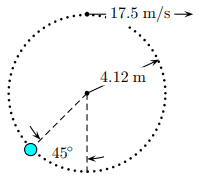
Screenshot_6.png
 
Physics news on Phys.org
Your answer is a smaller speed than it started with. Do things normally speed up or slow down as they fall?

What does your calculation ##4.12 \sin(45)m## physically represent?
 
PeroK said:
Your answer is a smaller speed than it started with. Do things normally speed up or slow down as they fall?

What does your calculation ##4.12 \sin(45)m## physically represent?

Things generally speed up, and the calculation represents the height of the ball. I also realized that there should be initial potential energy (since height is 8.24 at the initial velocity of 17.5), so I calculated the final velocity while taking initial potential energy into account, and got an incorrect velocity of 20.2646m/s (although it is now greater than 17.5).
 
BiggestAfrica said:
Things generally speed up, and the calculation represents the height of the ball.
Are you sure? Why don't you mark the height of the ball on your diagram. In what way is that ##4.12 \sin(45)m##?
 
  • Like
Likes   Reactions: BiggestAfrica
PeroK said:
Are you sure? Why don't you mark the height of the ball on your diagram. In what way is that ##4.12 \sin(45)m##?

I figured it out, thanks! Mass was never used in the calculation, but I was using the wrong height for my calculations, using the height of the triangle itself rather than subtracting the height of the triangle from the radius (4.12 - 2.1933 = 1.2067).

e.png
 
BiggestAfrica said:
I figured it out, thanks! Mass was never used in the calculation, but I was using the wrong height for my calculations, using the height of the triangle itself rather than subtracting the height of the triangle from the radius (4.12 - 2.1933 = 1.2067).

View attachment 257123
A useful thing to remember is that for vertical circular motion like this, or for a pendulum, we have:
$$h = R(1- \cos \theta)$$
Where ##h## is the height above the lowest point.

Note that it works all the way round. At the top of the swing ##\theta = 180## degrees and, as expected, we have:
$$h = R(1 - (-1)) = 2R$$
This formula comes up frequently. Even if you don't memorise it, it's useful to recognise it when you see it.

Note that in this case ##\sin(45) = \cos(45)## so if that was an error on your part it didn't matter! But, it really should have been ##\cos(45)##.
 
  • Like
Likes   Reactions: BiggestAfrica

Similar threads

Replies
1
Views
1K
Replies
10
Views
3K
  • · Replies 6 ·
Replies
6
Views
2K
  • · Replies 9 ·
Replies
9
Views
1K
Replies
9
Views
2K
Replies
44
Views
7K
  • · Replies 3 ·
Replies
3
Views
3K
  • · Replies 5 ·
Replies
5
Views
2K
  • · Replies 12 ·
Replies
12
Views
2K