Determining the Brake Caliper Force for a Car

  • Context: Automotive 
  • Thread starter Thread starter Miss Mechy
  • Start date Start date
  • Tags Tags
    Brake Car Force
Click For Summary
SUMMARY

The discussion focuses on determining the brake caliper force for a small motorsport car, specifically the moment force required to stop the vehicle. Two distinct equations were used: one based on brake caliper capabilities and pedal input force, and another using gravitational force and acceleration. The results differed due to the equations addressing different aspects of braking dynamics. The key takeaway is that the maximum braking force is dictated by tire friction, and accurate calculations require a comprehensive free body diagram (FBD) that includes all relevant forces and moments.

PREREQUISITES
  • Understanding of brake caliper mechanics and performance
  • Knowledge of free body diagram (FBD) construction
  • Familiarity with Newton's laws of motion, particularly F = ma
  • Basic principles of tire friction and vehicle dynamics
NEXT STEPS
  • Learn how to construct and analyze free body diagrams (FBDs) for vehicle dynamics
  • Study the relationship between tire friction and braking force in motorsport applications
  • Explore the impact of weight distribution on braking performance
  • Investigate the effects of brake system design on caliper force calculations
USEFUL FOR

Automotive engineers, motorsport technicians, and students studying vehicle dynamics who are interested in optimizing braking systems and understanding the forces at play in high-performance vehicles.

Miss Mechy
Messages
3
Reaction score
0
Hi, I am trying to work out the calliper breaking force of a small motorsport car i.e. the moment force needed to be exerted at a given distance on the wheel to bring the car to a stop.

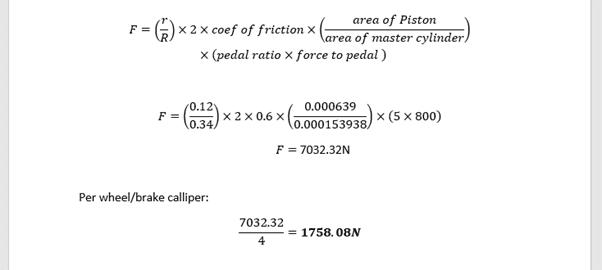
I initial calculated the force using an equation which highlighted the specific capabilities of the brake calliper, along with the input force of the pedals (Disregarding weight distribution) as shown below:
upload_2019-3-11_22-49-1.png


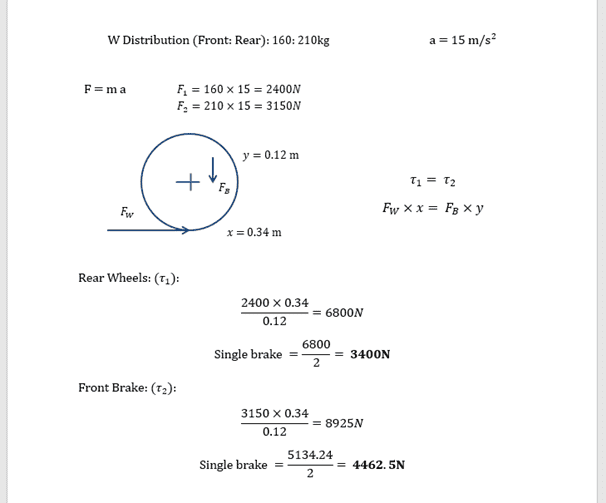
I then tried to validate this value by using a more basic equation, using the g and weight of the car, with no specific brake calliper parameters.
upload_2019-3-11_22-50-23.png


Although two completely different solutions, should both not be of similar value? Are my calculations correct for either of the solutions? Or if in fact they are does anyone know why they are so different?

(I am aware wheel lock is not made apparent in either solutions)
 

Attachments

  • upload_2019-3-11_22-49-1.png
    upload_2019-3-11_22-49-1.png
    7 KB · Views: 2,517
  • upload_2019-3-11_22-50-23.png
    upload_2019-3-11_22-50-23.png
    10.9 KB · Views: 2,603
Engineering news on Phys.org
You are doing the right thing when you cross check your work. In this case, you got two different answers because you solved two different problems. Rather than give you the answer (this sure looks like a homework problem), I'll give you some hints:

1) Always start a problem like this with a free body diagram (FBD). The diagram can be a simple pencil sketch. It needs to include all given information - weight, acceleration, etc.

2) Think carefully about what information you are given, and what you are trying to find. Then, and only then, think about what equation(s) relate what you know to what you want to find. Many times it is helpful to add a note to the FBD stating exactly what you are supposed to find.

3) Always label your answers with what the number represents: Vehicle speed, vehicle deceleration rate, braking force at the road, braking force at the caliper, caliper squeezing force, etc.

4) A vehicle acceleration of 15 m/sec^2 is truly impressive.

5) When the brakes brake, the vehicle slows down. When the brakes break, it does not slow down.
 
  • Like
Likes   Reactions: anorlunda
I am working on the stub axle and upright of the car and am trying to check the force someone else has calculated is indeed correct. Specifically what I'm trying to find is the force at the calliper/upright joint.

I thought these two equations would give the same answer, but even by taking further consideration into the FBD I can't seem to find the comparable equations I need.

Before finding another comparable solution may I first ask if we take the 1758.08N force and re-times it by (0.34m/0.12m) = 4981.23 and then times it by 0.1m (the upright-callipers joint distance from centre) am I getting the right force for the upright - calliper joint here? Or do I just need to replace 0.12m with 0.1m in the previous equation?

And yeah sorry, obviously "braking" I'm looking for haha.
 
Show us the following FBD's:
1) The entire vehicle (F = ma, reaction forces at the ground). Reaction forces include braking force and gravity.
2) The front wheel assembly. This FBD includes the mounting.
3) The rear wheel assembly.

When the FBD's are correct, everything else will fall into place.
 
upload_2019-3-12_18-28-51.png
 

Attachments

  • upload_2019-3-12_18-28-51.png
    upload_2019-3-12_18-28-51.png
    46.6 KB · Views: 1,629
Miss Mechy said:
Although two completely different solutions, should both not be of similar value? Are my calculations correct for either of the solutions? Or if in fact they are does anyone know why they are so different?
The ##F = 70332.32 N## of the first equation is actually equivalent of the ##F_w## of the second equation for one wheel (i.e. force at the tire contact patch).
  • The first equation is evaluating what force the braking system can produce based on the brake pad friction force;
  • The second equation is evaluating what force is required by the tire (which should be based on the tire friction force; the deceleration will be govern by the friction force).
The logical conclusion from looking at those results is that the braking system requires less brake pedal force to achieve the desired tire performance.

In any circumstance, as long as the wheels turn, the maximum force will be dictated by the tire friction force (your second equation). If the wheel locks up, then you will have extra internal forces acting on your caliper (but not at the tire) if the driver pushes harder on the pedal (your first equation, without the ##\frac{r}{R}\times 2 \times coef\ of\ friction##).
 
If you take a sum of moments about either tire contact patch in the whole car FBD, you will find that the tire normal force is not 210/160 kg. The maximum braking force of each tire is proportional to the tire normal force. This will be the actual braking force in a properly balanced brake system, or a brake system with a working antilock system. The total braking force, of course, is equal to ma. Assuming that tire normal force is the same at both constant speed and heavy braking simplifies the calculations, but is not correct. You will have to decide if simple is good enough, or if you need to be correct. Add the numbers to the whole car FBD. Put in the actual numbers, not (for example) F = ma for the deceleration force. Remember that a correct FBD will have horizontal forces add to zero, vertical forces add to zero, and that the sum of moments about any point will equal zero.

If you are designing the wheel assembly attachment to the suspension, you now have the forces and moments at that joint. The brake pad forces are internal forces, and not part of this calculation. This will be a pair of separate FBD's from the FBD's for the braking force on the brake pads.

If you are only concerned with the forces on the brake pads, you need only the wheel braking force, tire radius, and distance from center of rotation to the centroid of the brake pad. The calculation is a sum of moments about the axle centerline. Total of five FBD's at this point.
 
  • Like
Likes   Reactions: TheCondor, anorlunda and jack action

Similar threads

  • · Replies 42 ·
2
Replies
42
Views
4K
Replies
3
Views
2K
  • · Replies 12 ·
Replies
12
Views
6K
Replies
10
Views
3K
  • · Replies 14 ·
Replies
14
Views
2K
  • · Replies 15 ·
Replies
15
Views
7K
  • · Replies 3 ·
Replies
3
Views
2K
  • · Replies 14 ·
Replies
14
Views
10K
  • · Replies 18 ·
Replies
18
Views
7K
  • · Replies 5 ·
Replies
5
Views
2K