How to calculate hydraulic disc brake size using actuation force?

Click For Summary

Discussion Overview

The discussion revolves around calculating the appropriate size for hydraulic disc brakes in a go-kart, using the force of actuation and various vehicle specifications. Participants explore the implications of braking force, torque, and stopping distance, while considering the effects of different parameters such as friction coefficients and weight distribution.

Discussion Character

  • Technical explanation
  • Debate/contested
  • Mathematical reasoning

Main Points Raised

  • One participant seeks to calculate brake size based on the force of actuation and stopping distance of 2.5 meters, providing detailed calculations for braking force and torque.
  • Another participant suggests that brake area primarily affects heat dissipation and that calculating minimum area is complex due to various factors like material conductivity and stopping events.
  • Several participants express skepticism about achieving a deceleration of 4g given the specified coefficient of friction and weight transfer during braking.
  • Concerns are raised about the feasibility of stopping within 2.5 meters, with suggestions that this distance should be an outcome of braking rather than a starting point for calculations.
  • Participants discuss the need for additional braking mechanisms or adjustments to assumptions about speed and friction to meet the stopping distance requirement.
  • One participant points out that with a friction coefficient of 1, the stopping distance would be unrealistic for the given speed and conditions.
  • There is a suggestion to consider changing assumptions about speed or friction to achieve the desired stopping distance, or to incorporate alternative stopping methods.

Areas of Agreement / Disagreement

Participants generally disagree on the feasibility of achieving the specified stopping distance of 2.5 meters under the given conditions. Multiple competing views exist regarding the necessary parameters and calculations for brake design.

Contextual Notes

Participants highlight limitations in the assumptions made, such as the coefficient of friction between the tires and the road, and the speed at which brakes are applied. There are unresolved mathematical steps regarding the relationship between brake system dimensions and stopping distance.

Who May Find This Useful

This discussion may be useful for individuals involved in the design of braking systems, particularly in automotive or go-kart applications, as well as those interested in the practical implications of physics in engineering design.

Hammad
Messages
22
Reaction score
1
hello,

How do i calculate brake size using force of actuation?

im designing a hydraulic disc braking system (only one rotor caliper located in the middle of drive shaft) for go kart and using simple pascal law, i have calculated the force of actuation of the hydraulic brake that is the force exerted by the piston on the brake pads. i have also calculated the maximum braking force and torque of the vehicle:

design of system:
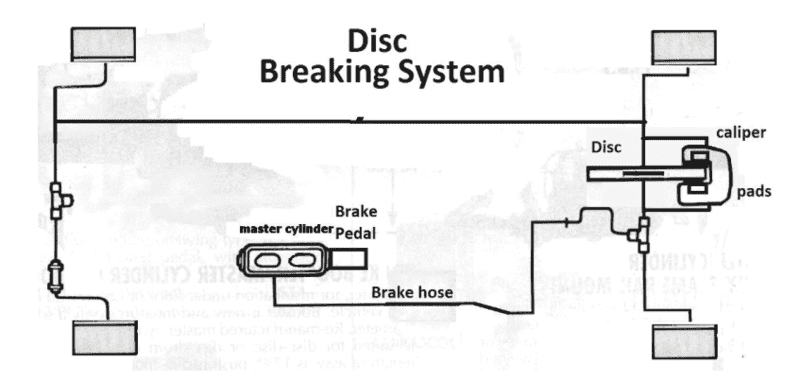
upload_2017-11-17_22-12-10.png


now i want to calculate the brake size which should be able to stop the vehicle at 2.5 meter distance.

the kart specs are given below

-----------------------

The engine is 3.5 HP, 127 CC
total weight 170 Kg (loading condition)
stopping distance = 2.5 meters
Pedal ratio = 4:1
Pedal force = 300 N

The calculation i have done for maximum brake torque, force of actuation and brake torque using pedal ratio and pedal force is given below

assuming:

Area of piston = 0.00309677 m2
radius of rotor/disc = 0.07 m
distance from centre of piston to centre of wheel = 0.039
coefficient of friction onbetween pads and rotor = 0.61Force on master cylinder = 300 * 4 = 1200 N

Fbp= Fd * pedal ratio
Fd = input force on the brake pedal
Fbp= output force from brake pedal
Fbp=300 * 4 = 1200
Pmc= Fbp / Amc
Pmc = pressure exerted by master cylinder
Amc =effective piston area of the master sylinder
Pmc = 1200/0.000387096
Pmc = 31 x 10 4
Pcal = Pmc
Pcal = pressure exerted by caliper
Fcal = Pcal * Acal
Acal = area of the one side of the caliper
Fcal = 387500* (0.00309677)
Fcal = 9600N

T = 2 μ F r

T = 2 * 0.61 * 9600 * (0.07-0.031)
Breaking Torque = 456.77 N.m

xxxxxxxxxxxxxxxxxxxxx

maximum braking Force and torque at stopping distance of 2.5 m:

assuimg:
wheel radius = 0.125 m
coefficient of friction btw tyre and road = 0.5

0 = u 2 + 2as
u = 50 km/hr
s = stopping distance = 2.5 meters
a = deceleration = 38.58 m/s2
F= ma =170 x 38.58= 6.5 KN
T = 2uFr
u = coefficient of friction = 0.61
r = radius of wheel = 0.25/2 m = 0.125 m
T = 2*0.5*6500*0.125
T = 812.5 N.m

How do i now calculate the size of the brakes?
 

Attachments

  • upload_2017-11-17_22-12-10.png
    upload_2017-11-17_22-12-10.png
    37.1 KB · Views: 3,462
Last edited:
Engineering news on Phys.org
I believe brake area is only important in avoiding brake fade caused by overheating. The greater the area the better the heat is spread and dissipated. Calculating the minimum area is complicated because it will depend on many variables... conductivity of the materials, total KE to be absorbed in stopping from maximum speed, heat build up from multiple stopping events in a short time, ambient temperature...
 
  • Like
Likes   Reactions: Hammad
Hammad said:
a = deceleration = 38.58 m/s2
Hammad said:
coefficient of friction btw tyre and road = 0.5
Difficult to see how to get a deceleration of 4g when the tyre coefficient of friction is less the one... especially when braking only 1/2 of the tyres, and with the weight transfer to the front during braking.
 
  • Like
Likes   Reactions: Hammad, BvU and haruspex
Tom.G said:
Difficult to see how to get a deceleration of 4g when the tyre coefficient of friction is less the one... especially when braking only 1/2 of the tyres, and with the weight transfer to the front during braking.
Yes, I hadn't read through the calculations.
@Hammad , it does not matter how much braking torque you develop once you exceed mgμs of braking force. You will simply skid.
4g strikes me as unreasonable. A typical road car manages less than 1g on a dry road.
 
  • Like
Likes   Reactions: Hammad
Hammad said:
stopping distance = 2.5 meters
That might not be the place to start the calculations.
Normally, stopping distance would be an outcome of the braking.

Unless of course one wants to through out some sort of grabbing anchor, penetrate a stick into the ground, or drive through an energy absorbing substance such as snow, sand, mud, or traffic barrier, in which case the brakes aren't needed to stop.
 
  • Like
Likes   Reactions: Hammad
Tom.G said:
Difficult to see how to get a deceleration of 4g when the tyre coefficient of friction is less the one... especially when braking only 1/2 of the tyres, and with the weight transfer to the front during braking.

so how do i achive the stopping distance of 2.5 meters?

any suggestions in the design?
 
haruspex said:
Yes, I hadn't read through the calculations.
@Hammad , it does not matter how much braking torque you develop once you exceed mgμs of braking force. You will simply skid.
4g strikes me as unreasonable. A typical road car manages less than 1g on a dry road.

2.5 meters is the stopping distance on the basis of which i have to determine the size of the brakes

what do you think i should do?
 
256bits said:
That might not be the place to start the calculations.
Normally, stopping distance would be an outcome of the braking.

Unless of course one wants to through out some sort of grabbing anchor, penetrate a stick into the ground, or drive through an energy absorbing substance such as snow, sand, mud, or traffic barrier, in which case the brakes aren't needed to stop.

The question states, can you give me advice on where to start calculations so that i can design brakes to stop go kart at 2.5 meter distance?

Go kart has sprocket ratio 0.66:1 and transmission efficiency 80%. The engine model is 3.5HP 127cc, which has torque 7.5 Nm to drive
the Go-Kart with total weight 170 kgs (loading condition).

1) Calculate the maximum braking torque

2) calculate its braking torque if the pedal ratio is 4:1 and the pedal force is 300 N and choose brake material

3) design the brake system. Calculate the required brake size and disc brake size. The coefficient of friction for the selected brake material is applied based on above. Show by calculation that the proposed brake system is capable of stopping the Go-Kart within 2.5 metres stopping distance.
 
Hammad said:
The question states,
there's nothing there about speed at which the brakes are applied or coefficient of friction between tyre and road.
 
  • Like
Likes   Reactions: Hammad
  • #10
haruspex said:
there's nothing there about speed at which the brakes are applied or coefficient of friction between tyre and road.

i have assumed as 50 km/hr and coefficient of friction btw tire and road as 0.9 under dry conditions.
 
Last edited:
  • #11
Well, I see a 50 km/h. That's 14 m/s. And a friction coefficient that doesn't allow a lot of deceleration.
You'll need front braking too -- and even then: a friction coefficient of 1 allows deceleration at ##g## or ##\approx## 10 m/s2.
With ##{1\over 2} m v^2 = \mu mg d## it's easy to calculate that for ##\mu = 1## the stopping distance is at least 19 m.

2.5 m is simply unrealistic.

http://www.2pass.co.uk/stopping-distance.htm#.WhFvZ0riZEY
 
  • Like
Likes   Reactions: Hammad
  • #12
Hammad said:
i have assumed as 50 km/hr and coefficient of friction btw tire and road as 0.9 under dry conditions.
To stop in 2.5m you will need to change one or both of those assumptions. Pick one and calculate the other.

Edit: or include an anchor in the brake system.
 
  • Like
Likes   Reactions: Hammad
  • #13
haruspex said:
To stop in 2.5m you will need to change one or both of those assumptions. Pick one and calculate the other.

Edit: or include an anchor in the brake system.

yes i was thinking about that, the maximum speed i can use is 25 km/hr not more even with 1g deceleration
 
  • #14
BvU said:
Well, I see a 50 km/h. That's 14 m/s. And a friction coefficient that doesn't allow a lot of deceleration.
You'll need front braking too -- and even then: a friction coefficient of 1 allows deceleration at ##g## or ##\approx## 10 m/s2.
With ##{1\over 2} m v^2 = \mu mg d## it's easy to calculate that for ##\mu = 1## the stopping distance is at least 19 m.

2.5 m is simply unrealistic.

http://www.2pass.co.uk/stopping-distance.htm#.WhFvZ0riZEY

thanks for the detailed reply,

the only factor which i can directly put in calculations is the coefficient of friction of tire road speed of car,

but i have calculated the coefficient of friction of pad (by material selection) force of actuation, the size of rotor, the master cylinder bore, area of piston

from the link you posted and the formulas, it doesn't seem that the braking system design directly relate to the stopping distance.

is there any method to calculate the stopping distance using braking system dimensions and its material friction coefficients?

is there any way i can relate the design dimensions, properties to the deceleration value and then calculate the stopping distance?

thanks
 
Last edited:
  • #15
Hammad said:
thanks for the detailed reply,

the only factor which i can directly put in calculations is the coefficient of friction of tire road speed of car,

but i have calculated the coefficient of friction of pad (by material selection) force of actuation, the size of rotor, the master cylinder bore, area of piston

from the link you posted and the formulas, it doesn't seem that the braking system design directly relate to the stopping distance.

is there any method to calculate the stopping distance using braking system dimensions and its material friction coefficients?

is there any way i can relate the design dimensions, properties to the deceleration value and then calculate the stopping distance?

thanks
The ability to attain a certain deceleration depends on both the grip on the road and the brakes. Each needs to cope with it independently.
You have dealt with the first by cutting the max allowed speed.

The calculation you did before for the brakes is basically valid, but I did not check the details.
You asked specifically about the area of the brakes. Standard school-level friction theory says the area of contact has no effect. As far as I am aware, the main consideration is overheating. A larger area spreads the released energy further.
Try calculating the heat released and estimating the temperature that woild result.
 
  • Like
Likes   Reactions: Hammad
  • #16
Hello,

i would just like to thank all the participants for their input, it helped to clarify the issues and confusion which i was facing and at the end, our lecturer did admit the fact that there were mistakes made in the assignment sheet.

thanks again for you spot on help
 

Similar threads

Replies
3
Views
2K
  • · Replies 2 ·
Replies
2
Views
9K
  • · Replies 1 ·
Replies
1
Views
3K
  • · Replies 3 ·
Replies
3
Views
9K
  • · Replies 1 ·
Replies
1
Views
3K