Determining the horizontal asymptote

  • Thread starter Thread starter chwala
  • Start date Start date
  • Tags Tags
    Degree Polynomial
Join the discussion
Ask a follow-up here, or get your own question answered by working scientists, mathematicians and engineers — people, not an autocomplete.
Real named experts · corrections over time · the nuance an AI answer skips
6 replies · 2K views
chwala
Gold Member
Messages
2,843
Reaction score
428
Homework Statement
see attached
Relevant Equations
rational functions
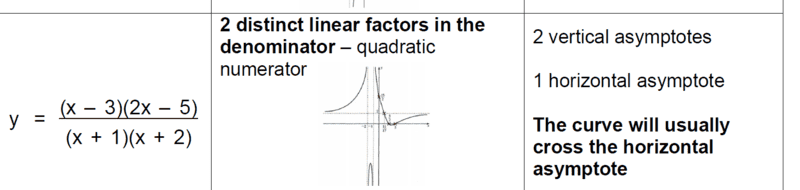
Consider,

1712649782012.png


I am self-studying;

My interest is on the horizontal asymptote, now considering the degree of polynomial and leading coefficients, i have
##y=\dfrac{2}{1} =2## Therefore ##y=2## is the horizontal asymptote.

The part that i do not seem to get is (i already checked this on desmos) why an asymptote can be regarded as such if it is crossing the curve. In my small understanding, i thought asymptote ought not to intersect any curve or line...
For vertical asymptote, that is straightforward, solving the denominator, shall give me ##x=-1## and ##x=-2##.
Thanks
 
Physics news on Phys.org
This is related to the original post;

1712650542641.png


What about the horizontal asymptote? ##y=1##? Now considering the fact that asymptotes can cross curves.
 
An asymptote is about how a curve behaves at infinity, not how the behaviour looks in some intermediate range. It does not matter at all if it crosses the curve or not. All that is relevant is whether or not the curve approaches the asymptote at infinity.

chwala said:
This is related to the original post;

View attachment 343040

What about the horizontal asymptote? ##y=1##? Now considering the fact that asymptotes can cross curves.
What about it?
 
Reply
  • Like
Likes   Reactions: DeBangis21 and chwala
Orodruin said:
An asymptote is about how a curve behaves at infinity, not how the behaviour looks in some intermediate range. It does not matter at all if it crosses the curve or not. All that is relevant is whether or not the curve approaches the asymptote at infinity.


What about it?
Noted, that is clear. I am now looking at how to determine the stationary points; either for local maximum or local minimum. To close this well, let me determine that and share ... considering the function in post ##1##. I have

##y= \dfrac{(x-3)(2x-5)}{(x+1)(x+2)}##

Let the graph meet the horizontal line ##y=k##

##k= \dfrac{(x-3)(2x-5)}{(x+1)(x+2)}##

##kx^2+3kx+2k=2x^2-11x+15##

##(k-2)x^2+(3k+11)x+2k-15≥0##

##(9k^2+66k+121)-4(2k^2-19k+30) ≥0##

##9k^2+66k+121-8k^2+76k-120 ≥0##

##k^2+142k+1 ≥0##


##k=-141.99 ⇒x= -1.441## will give us local maximum

and ## k=-0.007 ⇒ x= 2.755## will give us local minimum.

Cheers @Orodruin ... most math concepts I teach myself. Of course with great support from Physics Forums! Bingo!
 
Last edited:
chwala said:
Noted, that is clear. I am now looking at how to determine the stationary points; either for local maximum or local minimum. To close this well, let me determine that and share ... considering the function in post 1. I have
##y= \dfrac{(x-3)(2x-5)}{(x+1)(x+2)}##

Let the graph meet the horizontal line ##y=k##
<snip>
Or you could find the derivative ##\frac{dy}{dx}## and see where it is zero. Maxima or minima can be found at places were a) the derivative is zero, or b)places where the derivative is undefined (as for example y = |x|), or c) endpoints of a possibly restricted domain of the original function.
 
Reply
  • Like
Likes   Reactions: chwala and DeBangis21
Mark44 said:
Or you could find the derivative ##\frac{dy}{dx}## and see where it is zero. Maxima or minima can be found at places were a) the derivative is zero, or b)places where the derivative is undefined (as for example y = |x|), or c) endpoints of a possibly restricted domain of the original function.
That is correct, using derivative i have

##\dfrac{dy}{dx} = \dfrac{17x^2-22x-67}{(x+1)^2 (x+2)^2} =0##

##⇒17x^2-22x-67=0##

##x_1=-1.44## and ##x_2=2.74## as shown in post ##5##.