Developing the Feynman diagram expansion

Click For Summary
SUMMARY

The discussion focuses on the calculation of Feynman diagram expansions as presented in "Introduction to Many Body Physics" by Piers Coleman, specifically in section 7.2. The user initially understands the calculation for the n=1, m=1 term but seeks assistance with the n=1, m=2 term. The solution involves applying the chain rule in the context of functional derivatives, which the user acknowledges needing to revisit for better comprehension of the equations involved in expansions.

PREREQUISITES
  • Understanding of Feynman diagrams and their applications in quantum physics.
  • Familiarity with functional derivatives and their notation.
  • Knowledge of the chain rule in calculus.
  • Basic concepts of many-body physics as outlined in Piers Coleman's textbook.
NEXT STEPS
  • Review the chain rule in calculus to strengthen understanding of functional derivatives.
  • Study Feynman diagram expansions in greater detail, focusing on generating functionals.
  • Explore advanced topics in many-body physics as presented in "Introduction to Many Body Physics" by Piers Coleman.
  • Practice calculating higher-order terms in Feynman diagrams to gain proficiency.
USEFUL FOR

Students and researchers in theoretical physics, particularly those studying quantum mechanics and many-body systems, will benefit from this discussion. It is also valuable for anyone looking to deepen their understanding of Feynman diagrams and their mathematical foundations.

ShayanJ
Science Advisor
Insights Author
Messages
2,802
Reaction score
605
TL;DR
Trying to figure out Feynman rules from expansion of the generating functional.
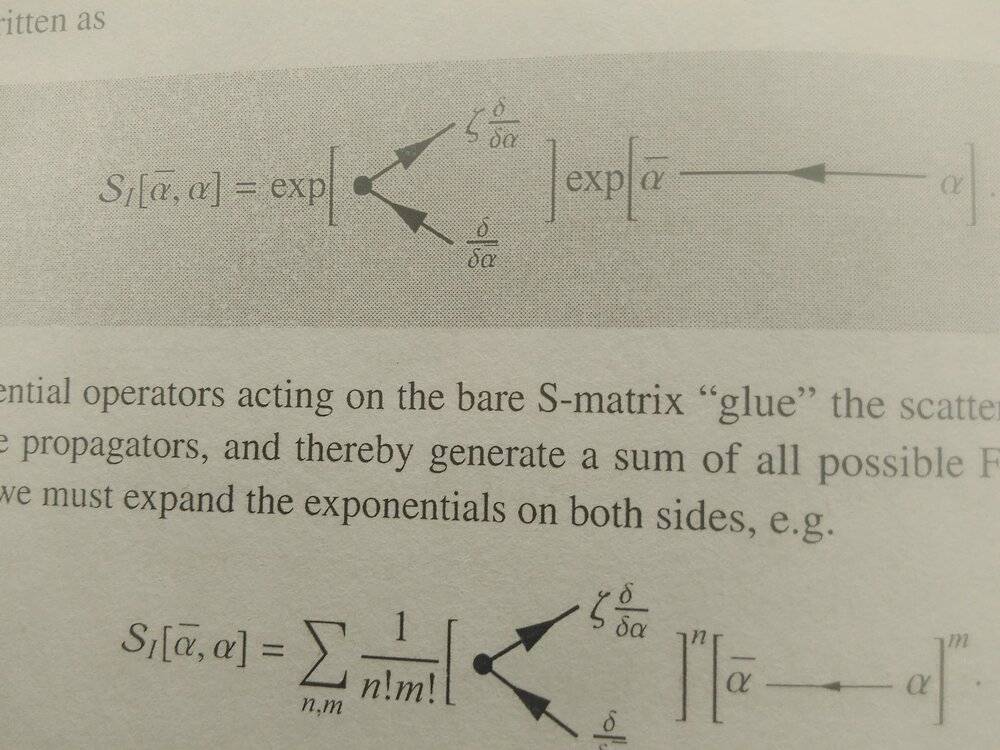
I'm reading "introduction to many body physics" by Piers Coleman. In section 7.2 he's trying to introduce Feynman diagrams by expanding the generating functional. But first he transforms it into this pictorial form:
16005897616301785018040.jpg

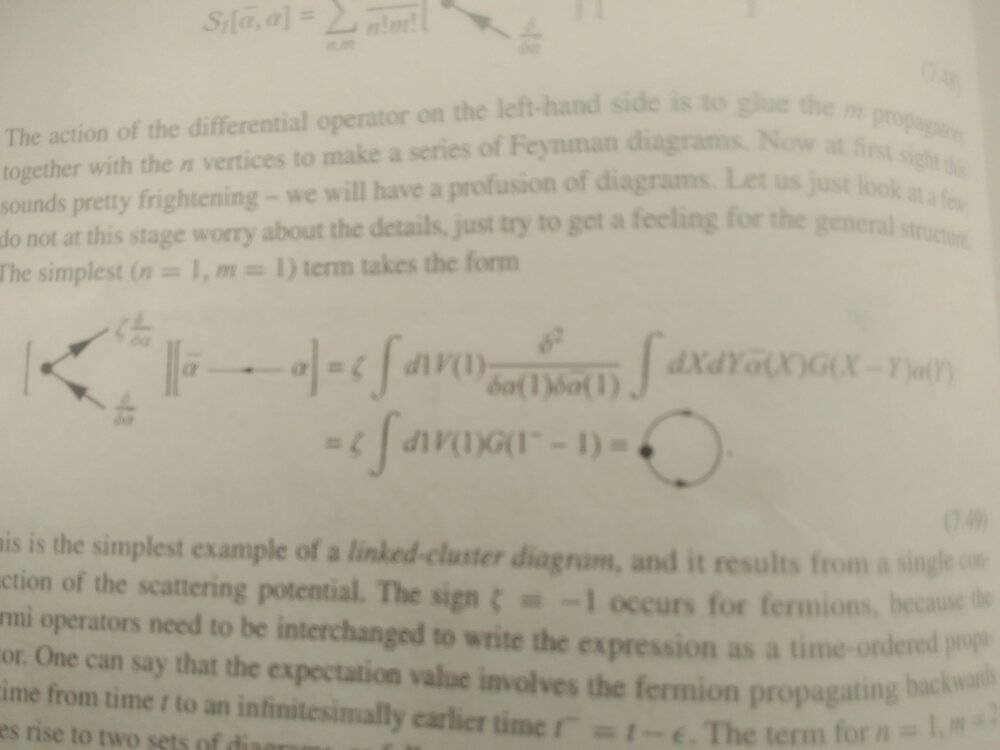
Then he calculates the n=1, m=1 term like below:
1600589855368-1948804519.jpg

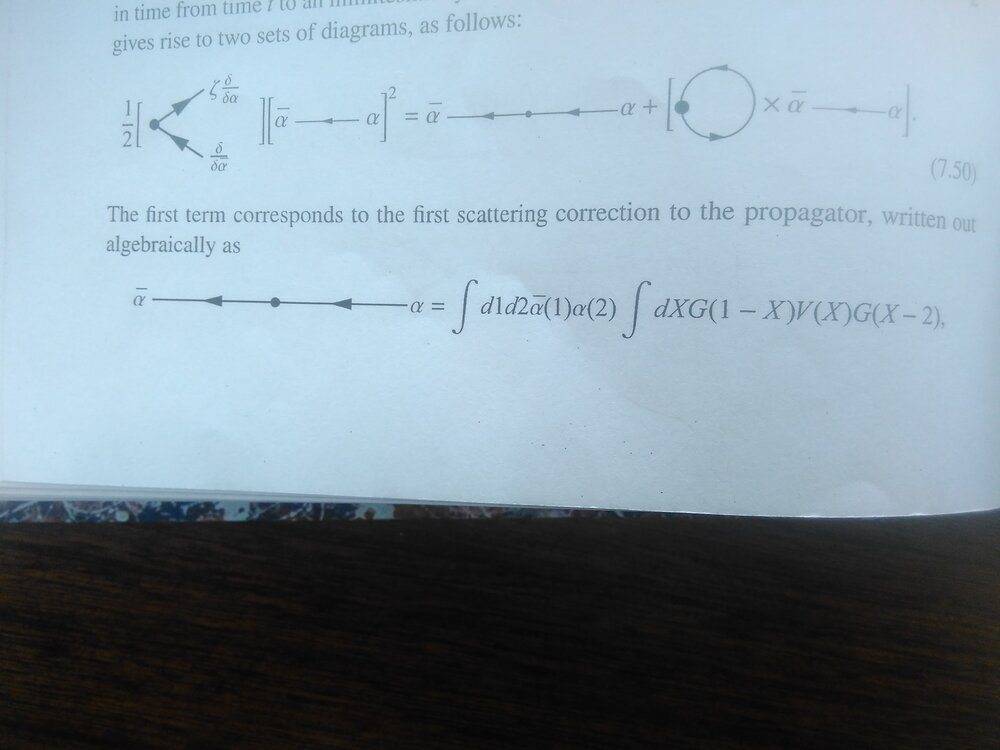
Which I understand. But I have no idea how he calculates the n=1, m=2 term:
1600590043927788924167.jpg


Can anybody help?
Thanks

PS
d1 and 1 mean ##dt_1 dx_1## and ##(t_1,x_1)##
 
Physics news on Phys.org
I figured it out. It was a simple application of the chain rule. I'm really rusty!
$$ \int d1 U(1) \frac{\delta^2}{\delta\alpha \delta\bar \alpha}\left( \int dX dY \bar\alpha(X) G(X-Y) \alpha(Y)\right)^2 = \\ 2 \int d1 U(1) \frac{\delta}{\delta\alpha} \left[\left( \int dX dY \bar\alpha(X) G(X-Y) \alpha(Y)\right) \left( \int dY G(1-Y) \alpha(Y)\right)\right] $$
And so on and so fourth!
 
  • Like
Likes   Reactions: Quarkman1 and vanhees71
As Kipling wrote "You're a better man than I, Gunga Din!" :smile: I like that you wrote it out and explained what you found. I am extremely rusty. The chain rule is something I need to read up on more, I think it would help me sort of get the grasp of many of the equations, especially with expansions, etc.
 

Similar threads

  • · Replies 1 ·
Replies
1
Views
2K
  • · Replies 6 ·
Replies
6
Views
4K
  • · Replies 6 ·
Replies
6
Views
2K
  • · Replies 13 ·
Replies
13
Views
4K
  • · Replies 3 ·
Replies
3
Views
2K
  • · Replies 3 ·
Replies
3
Views
3K
  • · Replies 33 ·
2
Replies
33
Views
6K
  • · Replies 1 ·
Replies
1
Views
1K
  • · Replies 6 ·
Replies
6
Views
2K
  • · Replies 4 ·
Replies
4
Views
3K